
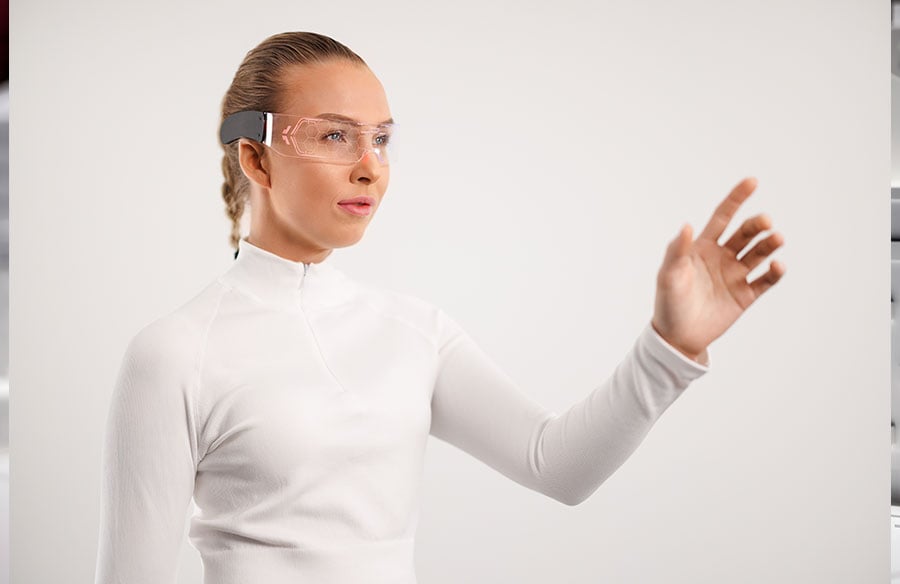
For more than two decades, the main portal for humanity to access digital intelligence has stubbornly remained flat. The ubiquitous handheld smartphone – a small, dark rectangle of glass- has shaped how we record environments, navigate urban density, and interface with computational tools. But this interaction model is fundamentally flawed spatially from an architectural and industrial design perspective. It enforces a head-down posture, prohibits direct eye contact, and erects a physical barrier between the person and the immediate environment.
The meeting of spatial computing and artificial intelligence is causing a significant paradigm shift in the hardware landscape. Instead of reactive software limited to pocket-sized display devices, we are heading toward ambient, multimodal hardware integrated into everyday accessories. The chief driver of this transformation is smart eyewear—face-mounted spatial hardware that shifts computational support from an app on a screen to an ambient assistant at eye level.
From Handheld Interfaces to First-Person Spatial Intelligence
Architects, industrial designers, and urban planners have long been aware that human perception is inextricably linked to spatial orientation. It’s our natural line of sight that experiences the scale of a building, the quality of natural light flooding through a clerestory, or the rhythm of pedestrian movement down a city street.
Digital devices that tell us to look down at a portable screen momentarily break our cognitive map of the world around us. Conversely, face-worn multimodal hardware delivers camera sensors, directional open-ear audio, and real-time machine intelligence directly to the face of the user.
Hardware engineers have embedded low-power optical sensors into everyday frames to allow for first-person visual capturing and real-time environment querying. Ambient hardware lets users record and study physical spaces entirely without touching anything—whether it’s an architect on a site walkthrough, an engineer reviewing structural schematics on a live construction floor, or a designer assessing material patinas out in the field.
We bring together fashionable sunglasses with camera technology to enable professionals and creators to record real first-person visual perspectives, inquire multimodal models about physical objects, and take spur-of-the-moment spatial details without lifting a smartphone. The turn towards spatial intelligence is in step with broader conversations about the architecture of the future, in which ambient automation and responsive systems become part of our built environment.
Key Capabilities for Ambient Hardware Design
To shift from reactive screens to ambient wearables, a triad of hardware and software innovations will be needed for spatial environments:
- First-Person Visual Question Answering (VQA): Multimodal AI models are created to view the physical world from the exact perspective of the user, with optical sensors positioned right along the natural eye-line. Designers can point to a building material, structural detail, or typographic sign and immediately ask for identification, translation, or structural analysis without interrupting their physical flow.
- Open-Ear Directional Audio: Miniaturized micro-speaker arrays built within the frame temples project crisp audio feedback towards the wearer’s temples. Unlike traditional in-ear headphones that block the user from the environment around him, open-ear audio leaves the canal completely open. This allows total user awareness of the environment, so architects and urban explorers can hear traffic, acoustic reverberations, and conversations alongside digital cues.
- Low-Latency Edge Processing: Contemporary spatial hardware employs on-device processing with local voice-activity detection and compressed machine learning algorithms for command interpretation. This removes the lag in data transmission that makes voice interaction feel like having a conversation with a knowledgeable colleague, rather than a delayed query to a database.
These capabilities add to ongoing developments in immersive technologies in architecture, where virtual, augmented, and physical realities merge to change the way spatial structures are conceived and built.
Industrial Ergonomics: Merging Performance with Timeless Design
Early smart glasses failed to gain widespread acceptance by consumers or professionals, mainly because of shortcomings in industrial design. The prior generations were big, ran hot and uncomfortable, had terrible battery life, and projected a futuristic, industrial aesthetic that felt alien in everyday social settings.
These design challenges required a complete rethinking of hardware architecture and weight distribution. Today’s industrial design is all about embedding micro-components—batteries, logic boards, microphone arrays, optical sensors—in lightweight, classic frame silhouettes.
Engineers have achieved an ergonomic balance by evenly distributing the mass of the internal micro-batteries along the length of the temple arms. It eliminates awkward pressure points on the bridge of your nose, so you don’t get the physical fatigue that made older headsets impossible to wear for long stretches of time.
Additionally, the American Optometric Association’s referenced research on visual ergonomics indicates that controlling ambient glare and eye fatigue in prolonged visual tasks is critical. The modern smart frame is primarily a high-performance optical accessory, with its computational capabilities secondary. These frames are paired with high-end polarized lenses that reduce glare when outdoors and shield the wearer from high-altitude solar radiation.
| Spatial Interaction Dimension | Traditional Handheld Interface | Ambient Multimodal Wearable |
| User Posture | Head-down screen posture | Eyes-up physical activity |
| Physical Operation | Fits one or both hands | 100% hands-free operation |
| Social Presence | Blocks natural eye contact | Preserves personal connection |
| Environmental Awareness | Interrupts spatial awareness | Continual environmental & situational awareness |
| Interaction Friction | High physical interaction friction | Zero-friction voice and gesture triggers |
Privacy Architecture, Edge Security, and Public Spaces
The use of optical cameras and directional microphones in common public spaces raises significant issues around user privacy, urban etiquette, and spatial ethics. To gain lasting public trust for face-worn AI, hardware developers need to embed transparency into the physical architecture of the device.
Hardware-level protocols are used by major smart eyewear makers to tackle these privacy concerns:
- Mandatory, Hardwired Privacy LEDs: High-visibility indicator lights are hard-wired directly into the camera power circuit at the hardware level. When the optical sensor turns on or records video (to the exact millisecond), the LED lights up bright. It’s physically connected to the camera’s power line, so it can’t be bypassed or disabled through software changes, providing immediate visual notification to anyone in the vicinity.
- On-Device Cryptographic Encryption: Visual media and voice inputs are encrypted in the secure element of the frame hardware before syncing to cloud storage, preventing unauthorized interception over public networks.
- Physical Hardware Isolation: Physical switches or gesture inputs enable users to disable sensor modules entirely, ensuring ambient recordings are not made without explicit user intent.
Digital civil liberty organizations, such as the Electronic Frontier Foundation, frequently emphasize that transparent hardware cues, local encryption, and physical kill switches are essential, non-negotiable standards to preserve social trust as connected technology continues to expand into public architecture and urban spaces.
Reclaiming the Physical World
With artificial intelligence moving beyond isolated web browsers and mobile applications into spatial, physical environments, face-worn wearables are poised to become the primary hardware interface for how we capture, analyze, and organize spatial information.
Ambient hardware removes the physical barrier of the glass display, allowing architects, designers, and urban citizens to capture spontaneous moments, navigate complex built environments, and query computer models with their eyes up and their hands totally free. The future of human-technology interaction won’t be staring down into a glowing rectangle in our palms, but stepping out into the physical world with clarity, focus, and purpose uncompromised.