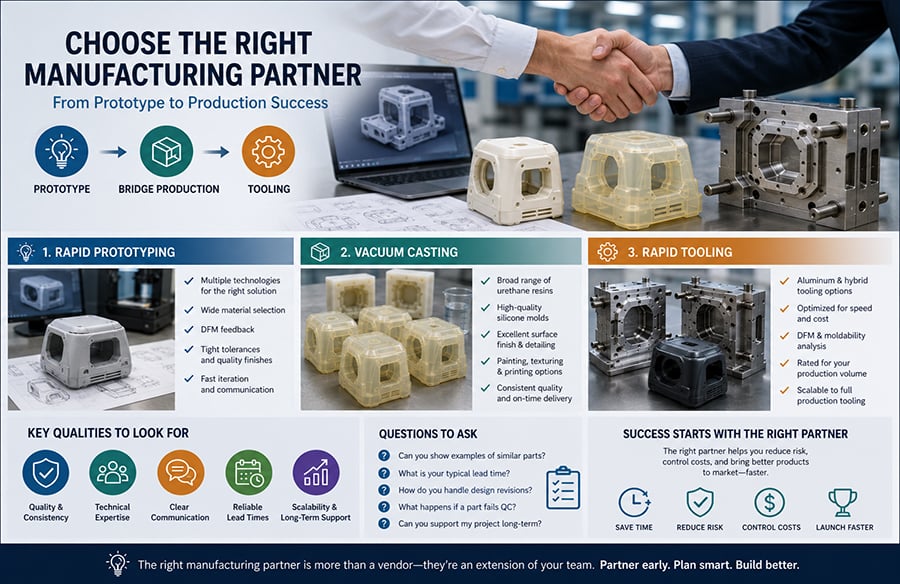
Choosing a manufacturing partner is one of the most consequential decisions in a product’s development journey. The right partner can shave weeks off your timeline, catch design flaws before they become expensive, and give you the flexibility to adapt as your product evolves. The wrong partner can mean missed deadlines, inconsistent quality, and costly rework. Because so many companies now rely on a mix of prototyping, bridge production, and tooling services to bring products to market, knowing what to look for in a manufacturing partner at each stage is essential.
Why the Right Partner Matters More Than the Right Process
It’s tempting to think of manufacturing decisions purely in terms of process selection — should we prototype, cast, or tool this part? But the process is only half the equation. Two companies offering “the same” service can produce very different results depending on their equipment, quality control, materials expertise, and communication practices.
This is especially true for companies managing multiple stages of development at once. A design flaw that goes unnoticed during prototyping can carry through to bridge production and, eventually, get baked into an expensive production mold. A capable manufacturing partner catches these issues early and flags them before they become costly.
What to Look For in a Rapid Prototyping Partner
When evaluating providers of rapid prototyping services, consider more than just turnaround time. Key factors include:
- Technology range — Does the provider offer multiple processes (SLA, SLS, FDM, CNC machining) so they can recommend the best method for your specific part, rather than forcing every project into the same process?
- Material library — A wide range of resins, filaments, and metals allows for more accurate functional testing.
- Design-for-manufacturability feedback — The best partners flag potential production issues during the prototyping stage, saving costly surprises later.
- Tolerance and finish quality — Confirm the provider can meet the tolerances your application requires, especially for parts with tight mechanical fits.
- Communication and iteration speed — Since prototyping is inherently iterative, a partner who turns around revisions quickly adds real value to your timeline.
A red flag to watch for: providers who only offer one printing technology and try to fit every project into it, regardless of whether it’s the best fit for your part’s geometry, material requirements, or intended use.
What to Look For in a Vacuum Casting Partner
Once you’re ready to move into small-batch production, evaluating a vacuum casting service requires a slightly different set of criteria:
- Resin selection — Look for a provider with a broad range of polyurethane resins that can simulate the mechanical properties of your target production material, whether that’s ABS, polypropylene, rubber, or glass-filled nylon.
- Mold-making capability — Ask how master patterns are produced (typically via 3D printing or CNC machining) and how many parts a single silicone mold can reliably produce before quality degrades.
- Finishing options — Confirm whether the provider offers painting, texturing, pad printing, or overmolding, since these finishing touches often matter for market-ready samples.
- Quality consistency — Because silicone molds degrade slightly with each use, ask how the provider manages consistency across a full production run.
- Lead time transparency — A trustworthy provider will give realistic estimates for both mold creation and part production, rather than overpromising on timelines.
Vacuum casting is often used for time-sensitive projects like trade shows or funding rounds, so reliability and honest communication about lead times are just as important as part quality.
What to Look For in a Rapid Tooling Partner
As your product moves toward higher-volume production, choosing the right rapid tooling service becomes critical to avoiding costly missteps. Key evaluation criteria include:
- Tooling material options — Aluminum tooling, steel-aluminum hybrids, and 3D-printed inserts each offer different trade-offs between cost, speed, and expected mold lifespan. A good partner will help you choose based on your projected volume.
- Expected mold lifespan — Ask directly how many shots (production cycles) a given tool is rated for, and whether that aligns with your actual production needs.
- Design for moldability review — An experienced tooling partner will review your part design for draft angles, wall thickness, and gate placement before cutting a mold, preventing costly mid-production issues.
- Scalability path — Ask whether the provider can support a transition to full production tooling later, and whether design data and lessons learned carry over smoothly.
- In-house injection molding — Providers who offer both tooling and molding under one roof often reduce miscommunication and delays compared to outsourcing these steps separately.
Common Mistakes When Selecting a Manufacturing Partner
Even experienced product teams make avoidable mistakes when choosing manufacturing partners. Watch out for:
- Choosing based on price alone — The cheapest quote often reflects lower material quality, less rigorous quality control, or hidden costs for revisions.
- Ignoring communication responsiveness during the quoting process — If a provider is slow or vague before you’ve even signed a contract, that pattern often continues into production.
- Failing to ask about failure rates — Whether it’s prototype accuracy, vacuum-cast part consistency, or tooling defect rates, providers should be able to share realistic performance data.
- Overlooking scalability — A provider who can’t support you beyond a single stage may leave you scrambling to find (and vet) a new partner mid-project.
- Not requesting sample parts or case studies — Physical samples or documented case studies from similar industries can reveal a lot about a provider’s actual capabilities versus their marketing claims.
Questions Worth Asking Before You Commit
Before signing on with a manufacturing partner, it’s worth asking directly:
- Can you show me examples of similar parts you’ve produced?
- What is your typical lead time, and how do you handle rush requests?
- How do you handle design revisions mid-project?
- What happens if a part fails quality inspection?
- Can you support my project through multiple stages, from prototype to scaled production?
Providers who answer these questions clearly and confidently — with data and examples, not vague reassurances — are generally the ones worth trusting with your product development timeline.
Final Thoughts
Selecting the right manufacturing partner is just as important as selecting the right manufacturing process. A provider with deep expertise across prototyping, bridge production, and tooling can guide your product through each stage of development with fewer surprises, tighter timelines, and better overall quality. Taking the time to properly vet potential partners — asking the right questions and requesting real evidence of capability — pays dividends throughout your product’s entire development journey, from the prototype to full-scale production.