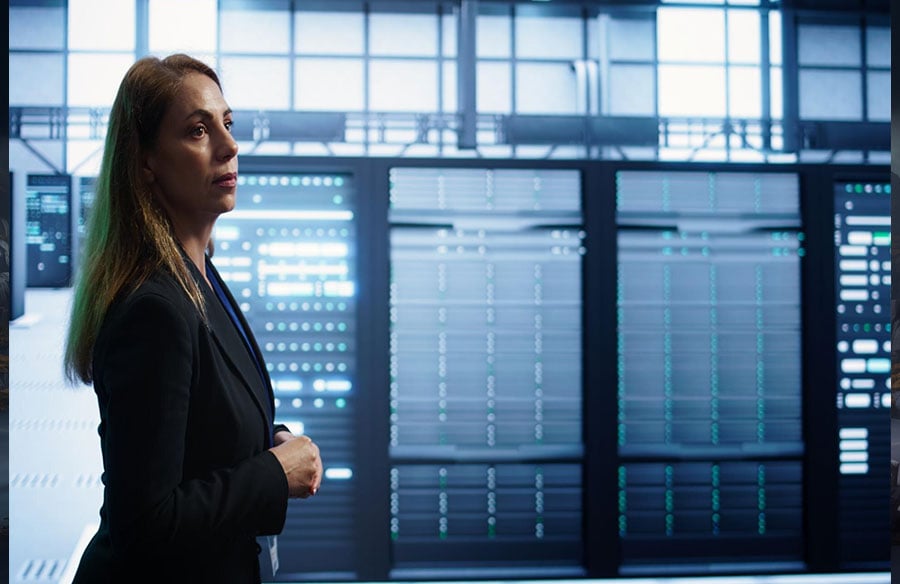
A cabinet of blinking servers in a storage room next to the brooms may once have been enough. Today, however, an on-premise server room is more of a risk than a source of pride. All it takes is one prolonged power outage, one overheated afternoon, or the departure of a single administrator for the entire company to come to a standstill. An external data center provides a level of availability that a typical server room can never match, while also helping to reduce electricity costs. Below, we explain why this move has become the standard and what you can expect from data center colocation.
Moving servers out of the office and into a data center used to seem like a luxury reserved for major players. Today, it is more a matter of common sense. Requirements for availability, security, and efficient operations have grown to the point where a small set of company servers can no longer support them on its own. Let us first look at why an on-premise server room reaches its limits sooner than many businesses expect.
Why an On-Premise Server Room Is No Longer Enough
Server rooms in office buildings were often created at a time when a company only needed a few machines for accounting and file sharing. The room itself usually reflects that reality: it was never designed or built to support IT operations.
Hardware ages, warranties expire, and every new application means another rack, more cooling capacity, and another person who understands how everything works.
The problem is not only technical. An on-premise server room typically depends on a single power supply, a single cooling system, and often one administrator who keeps everything in their head. A holiday, sick leave, or power outage can quickly turn a routine operation into a crisis scenario. The more a company relies on its IT, the more expensive and risky it becomes to maintain this kind of improvised setup. That is also why it makes increasing sense to look for an environment built specifically for continuous operation.
Security and Availability That an On-Premise Server Room Cannot Match
Today, two things keep a business running: secure data and services that are available virtually all the time. An on-premise server room cannot deliver either as effectively.
Security involves far more than a lock on the door. A professional data center relies on multiple layers of physical protection, continuous monitoring, controlled access, and certifications such as ISO 27001. Achieving this level of protection independently is difficult and expensive for most individual companies.
Availability makes the contrast even clearer. Reputable data centers guarantee uptime of around 99.98% through redundant power supplies, cooling, and connectivity in an N+1 configuration, allowing maintenance without downtime. A server room with a single power feed cannot come close to that level of resilience, and every hour of downtime means lost orders and damaged customer trust.
Tip: Find out what server colocation with guaranteed uptime and transparent pricing based on actual consumption looks like here.
Why an On-Premise Server Room Loses Money on Electricity
Electricity is a hidden drain on IT budgets, and an on-premise server room loses money on it twice: first by powering the servers themselves and then by cooling them in a room that was never designed for that purpose. Air conditioning runs at full capacity, heat escapes, and the bill rises without delivering any additional performance.
Professional data centers take the opposite approach. They measure efficiency using the Power Usage Effectiveness (PUE) metric, where values around 1.3 approach the technical optimum. A typical server room does not come close. Efficient cooling, bulk energy purchasing, and transparent billing based on actual consumption can reduce costs to a fraction of what it takes to run an in-house facility – freeing up money for areas that can genuinely grow the business.
Did you know? The shift away from on-premise server rooms is a measurable trend. According to an analysis by Synergy Research Group, corporate server rooms and internal data centers now account for only 34% of total capacity, compared with nearly 56% six years ago. The remainder have moved to hyperscale and colocation facilities.
Scalability, Business Continuity, and the Rise of Data Center Colocation
In an on-premise server room, company growth becomes apparent immediately: there is not enough space, not enough power capacity, and every expansion requires purchasing hardware weeks in advance. Data center colocation changes that. You can add capacity as needed and pay only for what you use, allowing IT to keep pace with the business rather than holding it back.
The same applies to business continuity. A data center relies on redundant systems, backups, and outage-response scenarios that are difficult for an individual company to build and even more difficult to maintain. That is why data center colocation has shifted from being a privilege of large corporations to a common choice for small and medium-sized businesses as well. It offers a level of security, availability, and efficiency that an on-premise server room cannot match, with predictable costs and without the burden of managing your own hardware.