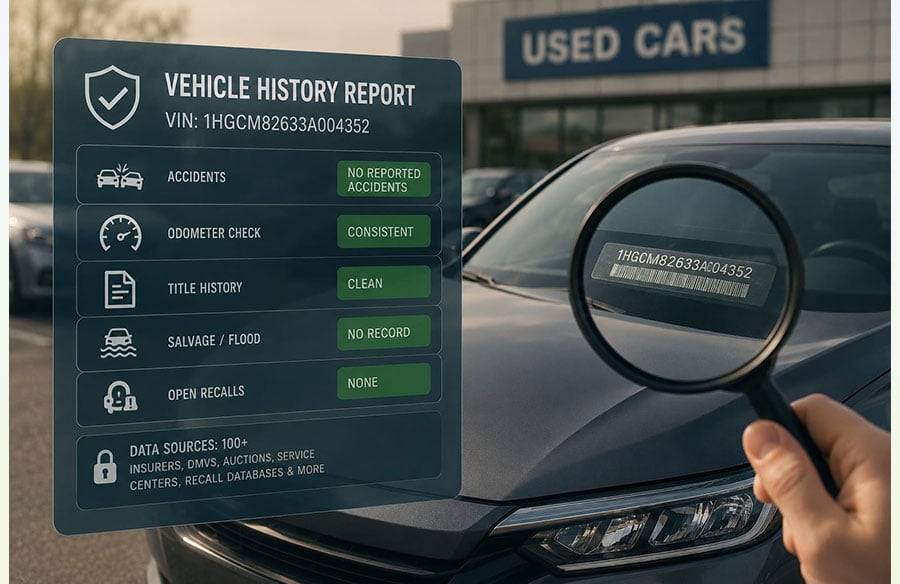
A car is one of the most designed objects most people will ever own — yet its history is often the least visible thing about it. That gap, and how we close it, is a design problem worth thinking through.
By Theresa Lindqvist
We tend to think of design as the visible: the silhouette of a building, the lines of a chair, the sweep of a car’s body. But the most consequential design decisions are often invisible — the systems that determine what information reaches us and when. A used car makes the point vividly. It is among the most meticulously designed objects a person will ever buy, and yet the single most important thing about any individual example, its history, is usually hidden from the person deciding whether to buy it.
This is a familiar failure in the built environment too. A facade can be beautiful and a structure unsound; a neighborhood can photograph well and function poorly. Appearance and reality drift apart whenever the information that would connect them is locked away from the people who need it. The used-car market has spent decades as a case study in exactly this kind of opacity — and, more recently, in how thoughtfully designed information systems can dissolve it.
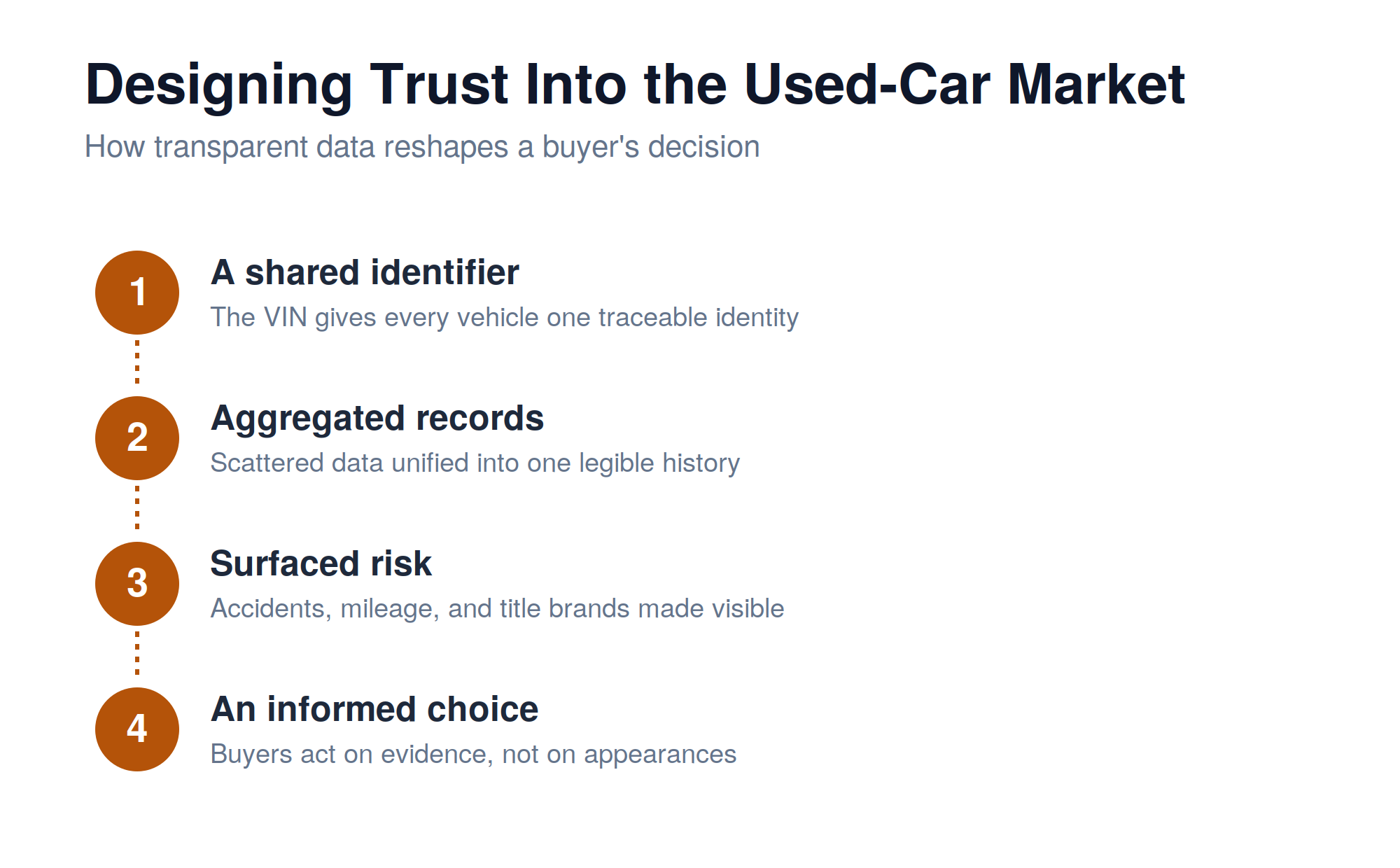 The framework above describes that shift in almost architectural terms. It begins with a shared identifier: the seventeen-character Vehicle Identification Number that gives every vehicle a single, traceable identity — the equivalent of a building’s address within a wider system of records. From that anchor, scattered data from insurers, motor-vehicle agencies, auction houses, and safety regulators can be aggregated into one legible history. Risk becomes visible, and the buyer’s choice shifts from appearances to evidence.
That movement — from a unique identifier to an aggregated, legible record — is the same logic that underpins good information design anywhere. Enter the VIN into a service such as a vehicle history report and the car’s past resolves into something readable: reported accidents and their severity, the odometer timeline, title brands such as salvage or flood, and any open safety recalls. What was fragmented and concealed becomes structured and visible. It is wayfinding for a decision, not a place.
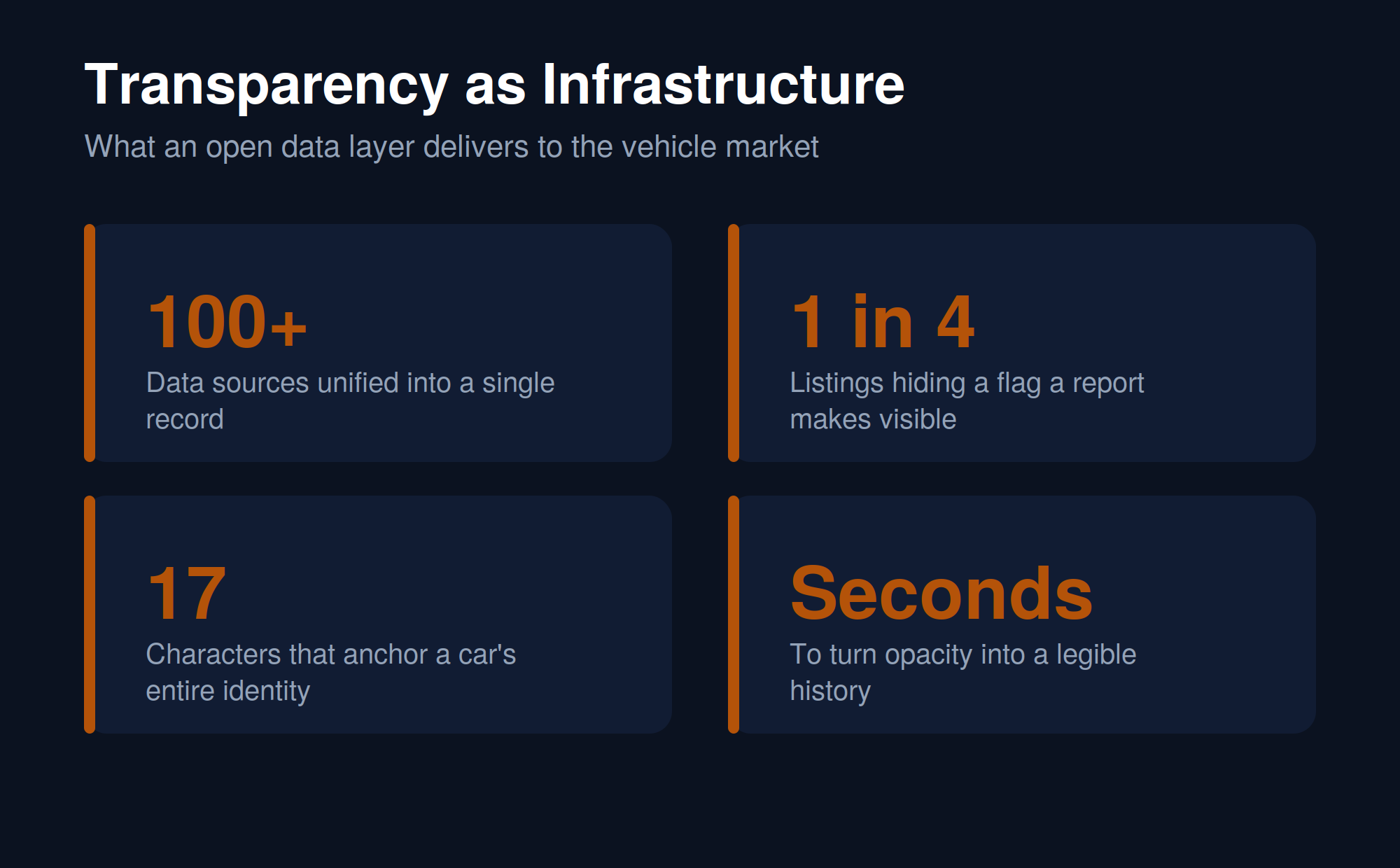 Seen this way, transparency functions as a kind of infrastructure. The figures above frame it plainly: a hundred or more data sources unified into one record, a meaningful share of listings concealing a flag the report makes visible, an entire vehicle identity anchored to seventeen characters, and the whole transformation accomplished in seconds. Like good infrastructure, it is most powerful when it recedes into the background and simply works — turning what was opaque into something anyone can read.
There is a lesson here that reaches well beyond cars, and it speaks directly to anyone who designs the systems people live inside. The value of information is not just whether it exists, but whether it is legible to the person making a decision at the moment they make it. A vehicle’s accident record has always existed somewhere; what changed is that it became accessible, structured, and timely. That is a design achievement as much as a technical one — the difference between data that is merely stored and data that is genuinely usable.
The parallel to the built environment is more than metaphor. Cities are increasingly governed by data layers — mobility patterns, energy use, structural histories of buildings — and the question of who can see that information, in what form, shapes how well people can act within those systems. A used-car history report is a small, mature example of a much larger ambition: making the invisible histories of the things around us legible enough to inform real decisions. The principles that make one work are the principles that will make the others work.
For the individual buyer, the practical application is immediate. On a significant purchase it is wise to corroborate the record against a second, independent source. Running the same VIN through a separate provider such as an independent history report allows a direct comparison: agreement between two records is strong reassurance, while any discrepancy points precisely to what deserves a closer look. Redundancy, as any systems designer knows, is not waste — it is how trust is engineered into a process.
Intellectual honesty about the limits of any system is part of designing it well, and the reputable services state those limits openly. A history report reflects what was reported to the sources it can reach; it is powerful reassurance rather than an absolute guarantee, and coverage varies by region. The thoughtful approach treats the report as one essential layer and pairs it with a physical inspection by a qualified mechanic. The record describes the documented past; the inspection assesses the object as it exists now. Two complementary lenses, each covering what the other cannot.
It is worth sitting with how recently this was impossible. A generation ago, the history of a used car was effectively unknowable to an ordinary buyer — locked in disconnected paper files across agencies that did not speak to one another. The change was not that the data appeared, but that someone designed the connective tissue to unify and surface it. That act of design quietly rebalanced a market that had favored whoever held the information, handing ordinary people the legibility they had always lacked.
That is the future worth re-thinking: not only the objects we make, but the information systems that let us understand them. A car, a building, a city — each carries a history that shapes whether it is safe, sound, and worth our trust. The used-car report is a modest, working proof that opacity is a design choice, and so is transparency. When we choose to make the histories of the things we buy legible, we do not just prevent bad purchases. We design a world in which people can act on what is true rather than on what merely appears to be.