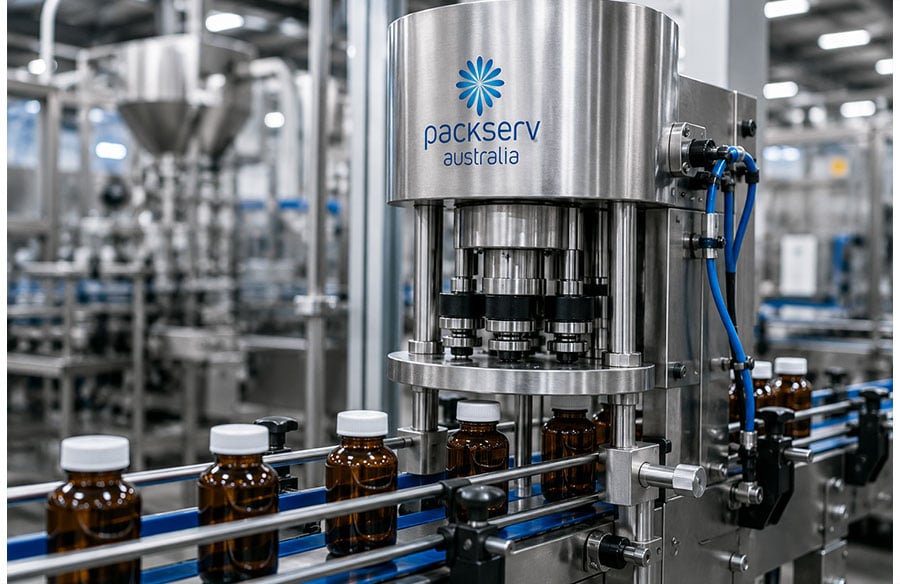
When people picture a packaging line, they tend to imagine the flashy parts — high-speed fillers, slick labelling stations, robotic arms moving products down the conveyor. The capping stage rarely gets a second thought. It’s seen as a simple, almost mechanical afterthought: a lid goes on, the bottle moves along, done.
But ask any production manager who’s dealt with a leaking bottle recall, a customer complaint about a loose lid, or a line that keeps jamming at the capping station, and you’ll get a very different answer. The capping machine isn’t just another piece of equipment on the line — it’s often the single point that determines whether your product reaches the customer in perfect condition or comes back damaged, leaking, or contaminated.
This article looks at why capping deserves far more attention than it usually gets, the different types of capping machines available, what happens when this stage goes wrong, and how to know when it’s time to upgrade.
Why Capping Gets Overlooked
Part of the reason capping flies under the radar is that, when it works well, nobody notices it. A correctly sealed bottle just looks like a finished product. There’s no visible “wow factor” the way there might be with an eye-catching label or a beautifully filled container.
But that invisibility is exactly the problem. Capping is a quality control checkpoint, a safety measure, and a brand protection mechanism all rolled into one — and most of that value is only visible when something goes wrong. A cap that’s too loose can lead to leaks during transport, contamination, or tampering concerns. A cap that’s too tight can crack containers, damage threads, or make the product frustrating for customers to open. Either way, the result is the same: wasted product, returned stock, and a dent in customer trust.
For manufacturers operating on tight margins, these aren’t small issues. A single batch of poorly capped bottles can mean reprocessing costs, wasted raw materials, shipping losses, and — in industries like cosmetics, food, and pharmaceuticals — potential compliance issues.
The Many Faces of a Capping Machine
One reason capping doesn’t get the credit it deserves is that people assume it’s a “one size fits all” piece of equipment. In reality, there’s a surprising amount of engineering and variety behind getting a cap onto a container correctly, consistently, and at speed.
- Chuck cappers — use a rotating chuck head to grip and twist screw caps onto containers, applying controlled torque so every cap is tightened to the same standard — critical for industries where over- or under-tightening can cause real problems.
- Spindle cappers — use multiple spinning discs or belts to apply continuous rotational force as bottles pass through, making them ideal for high-speed lines handling large volumes of uniform containers.
- Snap-on (press) cappers — apply downward pressure to snap caps, lids, or pumps into place — common for products like lotions, creams, and certain beverage containers where a twisting motion isn’t needed.
- ROPP (Roll-On Pilfer-Proof) cappers — roll aluminium caps onto bottles and form tamper-evident bands, frequently seen in spirits, wine, and premium beverage packaging.
- Pick-and-place cappers — are designed for irregular or delicate caps, gently placing them onto containers before a separate tightening or sealing step.
Each of these serves a different purpose, and choosing the wrong type for your product can be just as costly as not automating at all. A business filling thick creams, for example, has very different capping needs than one bottling spirits or sealing pharmaceutical containers.
What Happens When Capping Goes Wrong
It’s easy to underestimate how much rides on this one stage until something breaks down. Consider a few common scenarios:
A cosmetics brand ships out a batch of moisturisers with inconsistent cap tightness. Some leak in transit, others arrive with broken seals. The result isn’t just a handful of damaged units — it’s refunds, negative reviews, and a hit to brand reputation that’s far harder to repair than the product itself.
A craft brewery relying on manual capping struggles to keep up with demand during a busy season. Staff fatigue leads to inconsistent seals, and a portion of bottles end up under-carbonated or, worse, contaminated after losing their seal integrity.
A pharmaceutical manufacturer using outdated capping equipment finds that tamper-evident bands aren’t forming correctly, creating a compliance issue that could affect an entire production run.
In each case, the root cause isn’t a “big” failure — it’s a small, often invisible gap in the capping process that snowballs into a much larger problem. This is precisely why capping deserves the same level of scrutiny that businesses apply to filling accuracy or labelling precision.
Signs Your Capping Process Needs a Second Look
Several signals suggest it might be time to rethink your approach to capping:
- If your team is manually capping more than a few hundred units a day, fatigue-related inconsistency is almost inevitable — and inconsistency is where leaks, recalls, and complaints begin.
- If you’re experiencing recurring complaints about loose caps, leaks, or seal failures, this is rarely a “bad batch” issue; it usually points to a process or equipment limitation that will keep repeating until it’s addressed.
- Bottlenecks at the capping stage, where every other part of the line is ready to move faster but capping can’t keep pace, are another clear sign.
- If you’re expanding into new markets or product lines — particularly in regulated industries — your current capping setup may not meet the tamper-evidence or sealing standards required.
None of these issues are necessarily dramatic on their own. But together, they point to a capping process that’s quietly limiting your business rather than supporting its growth.
Choosing the Right Capping Solution
The good news is that capping machinery has come a long way, and there’s a solution suited to almost every stage of business — from small operations just starting to automate, to high-volume manufacturers running multiple shifts.
The right choice depends on a few key factors: the type of cap you’re using (screw caps, snap-on lids, pumps, ROPP bands, and so on), your container shapes and sizes, your required production speed, and the level of precision and compliance your industry demands.
Modular, scalable equipment is particularly valuable here. Rather than committing to a single fixed setup, many businesses benefit from machinery that can be adjusted, reconfigured, or expanded as their needs change — whether that means switching cap types, increasing speed, or integrating the capper into a larger automated line alongside fillers, labellers, and conveyors.
It’s also worth considering long-term support. Capping machines, like any mechanical equipment, need maintenance, spare parts, and occasional servicing. A machine that’s well-supported with local technical expertise and readily available parts will save far more time and money over its lifespan than a slightly cheaper option that leaves you stuck when something needs fixing.
The Bottom Line
Capping machines may not be the most glamorous part of a production line, but they’re arguably one of the most important. They’re the final checkpoint between your product and your customer — the difference between a package that arrives intact and one that doesn’t.
For businesses looking to reduce waste, protect their brand reputation, and build a production line that can scale with demand, paying closer attention to the capping stage isn’t optional — it’s essential.
If you’re ready to explore your options, Packserv offers a wide range of reliable, high-performance capping solutions designed to suit businesses of every size and industry — with flexible buy, rent, and finance options to help you find the right fit for your production line.