Nothing in Wuyi Dream of Splendor exists for a single camera angle.
Production Designer Anakin Li created the project as a walkable cultural environment where visitors move through the story instead of observing it from a distance. The immersive tourism project in China challenged him to adapt film production design methods into a public space that had to work from every direction, across a longer visitor journey, and through direct audience participation.
For Li, the project reshaped the role of production design itself.
From Film Sets to Walkable Environments
Li learned and worked within both Chinese and American film systems, experiences that shaped his approach to visual research, atmosphere, composition, and material detail. His work included independent films, branded projects, immersive spatial design, and professional art department experience in the United States.
Storytelling has remained the center of his work across each format.
Wuyi Dream of Splendor pushed those ideas into a different kind of space. Film production design usually operates within controlled framing. Designers know where the audience will look as they direct the camera and attention through composition, lighting, blocking, and editing. Sets only need to function inside selected views.
Wuyi required a completely different approach.
Visitors entered from multiple directions, followed performers into side streets, paused beside storefronts, and examined architecture at close range. No frame hid unfinished surfaces or redirected attention away from secondary spaces. Every pathway, sign, lighting transition, and prop remained visible as visitors moved freely through the environment.
Li approached the project as a continuous spatial experience rather than a sequence of cinematic images.
Designing a 360-Degree Story World
Architecture, costume, signage, lighting, props, live performance, and visitor circulation all worked together within a single narrative system. Each design choice needed to support the historical atmosphere while remaining convincing at the human scale.
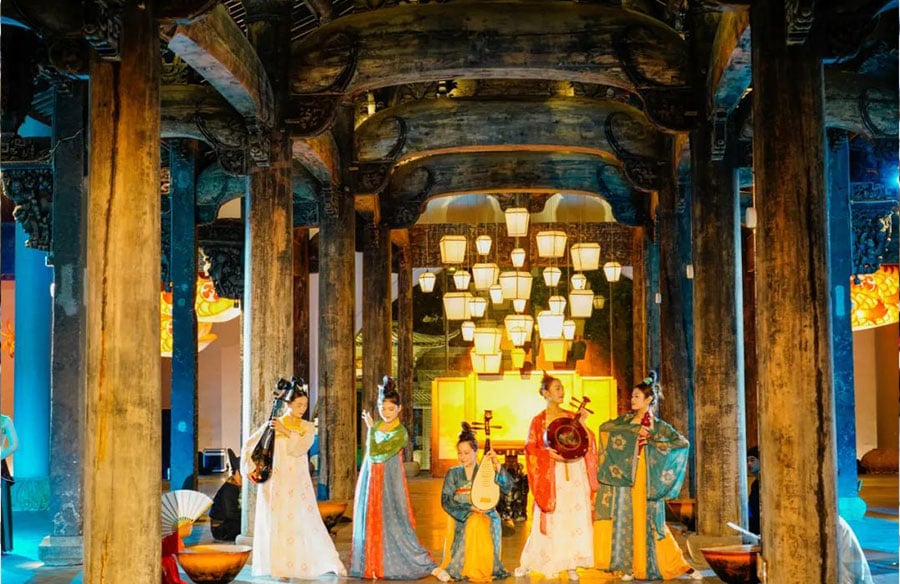
Street layouts shaped rhythm without making visitors feel controlled. Narrow alleyways compressed movement before opening into gathering spaces filled with performers and market activity. Lantern light shifted gradually between districts, creating mood changes that unfolded naturally as movement through the environment progressed. Weathered wood surfaces, layered storefront signage, and textured stone pathways gave the streets the feeling of a lived place instead of a polished attraction built only for photographs.
Movement also became part of Li’s storytelling structure.
Performers use gestures, conversations, and small encounters to redirect attention, spreading it throughout the environment. As some visitors gather around to watch live scenes, some wander deeper into the quieter streets lined with fabric banners and merchant stalls. Li treated crowd flow as part of the visual composition of the world itself.
That approach distinguished Wuyi Dream of Splendor from more conventional themed entertainment models. Visitors did not stand outside the performance. They became part of the atmosphere surrounding it
Costume Transformation and Audience Participation
Costume transformation played a central role in the experience.
Guests changed into period-inspired clothing before entering deeper areas of the project. Long sleeves alter posture and gestures. Visitors slowed their pace, posed differently for photographs, and blended into the visual rhythm of the streets around them.
Li expanded that participation through in-world tokens and role-based interactions. Visitors exchanged modern currency for tokens used within the environment’s internal social system. NPC-style performers guided guests through scripted encounters, small discoveries, and unfolding narrative scenes across different locations.
Several interactions drew from live-action role-playing, board-game storytelling structures, and Chinese “script murder” entertainment culture. Visitors followed clues, joined conversations, and chose how deeply they wanted to participate in the larger story framework.
The project combined historical visual language, cinematic worldbuilding, live performance, visitor circulation, costume transformation, game-like interaction, and cultural tourism within a single coordinated physical environment. Li used production design not only to create atmosphere, but also to shape how people moved, interacted, and participated in the world around them.
Expanding the Role of Production Design
The experience changed Li’s understanding of production design.
Film audiences remain outside the frame. Visitors inside Wuyi Dream of Splendor stood within the designed environment itself. They decided where to look, how long to stay, and which performers or storylines to follow. That shift expanded Li’s responsibilities beyond visual composition. He had to consider crowd rhythm, performer movement, visitor behavior, and long-duration engagement across real architectural space.
The project also connected his film background with broader forms of immersive entertainment and cultural tourism. Li worked across concept design, historical reference research, environmental storytelling, and communication with construction-related teams throughout development.
Outside Wuyi, Li has continued building experience across Chinese and American production environments. His work includes commercial projects, professional art department experience on the union-level feature Nightwatching, and a presentation for the Art Directors Guild Education Department focused on 3D printing workflows in production design.
Despite those different formats, his focus has remained consistent. His approach is still guided by space, atmosphere, material detail, and storytelling, whether audiences watch at a distance from the stage or move directly through a designed environment.
A New Direction for Immersive Cultural Tourism
For Li, Wuyi Dream of Splendor represents more than a single project. The work reflects a broader direction in contemporary Chinese-themed entertainment and immersive cultural tourism.
The project demonstrates how cinematic production design can expand into physical environments without losing its foundation in storytelling. Architecture becomes part of the narrative structure. Lighting shapes emotional rhythm across public space. Costumes change social interaction. Visitors influence the atmosphere simply through movement and participation.
By the time guests leave the streets of Wuyi Dream of Splendor, they no longer function as passive observers. Their decisions shape the pace of the environment around them. Their presence changes the composition of each street and gathering space.
The world holds together because Li designed it for direct human interaction rather than controlled cinematic viewing.
Bettina Song
Bettina Song is a New York-based writer interested in architecture, film, design, and contemporary spaces. She explores how storytelling, visual culture, and spatial design influence how people experience environments, media, and public life.