Most artists spend a career learning to say one thing well. Erekle Tsuladze seems constitutionally unable to stop at one thing.
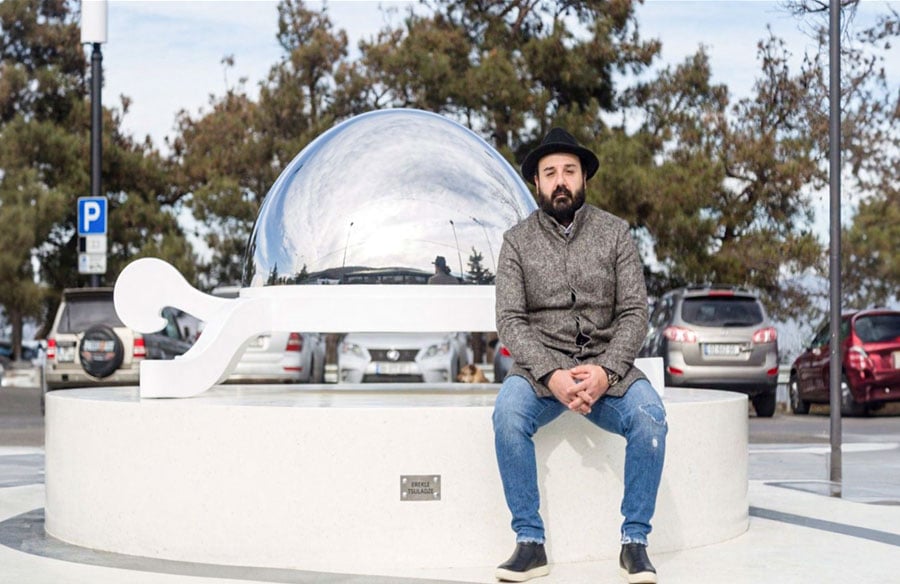
People across Georgia know his public monuments. There is the stainless steel turtle at Turtle Lake, the hippopotamus Begi in Mziuri Park, and the bronze couple on Batumi Boulevard. These monuments sit alongside a parallel creative life devoted to invented characters, animated worlds, and philosophical exhibitions.
How Ekeman Came to Life
Standing at the center of this expanding territory is a figure called Ekeman.
He started as a sculptural form. He has become considerably more than that. Tsuladze describes Ekeman as an allegory, a kind of symbolic everyman navigating the contradictions of existing reality without resolving them neatly. Over time, the figure grew a visual language, a mythology, a cast of recurring characters, and an internal logic that Tsuladze keeps developing.
The most recent development: a ten-episode animated series. Tsuladze wrote every episode himself.
The public encounters his work in parks and city squares and hotel lobbies. People don’t see the writing, the character development, the storytelling infrastructure he has been building around Ekeman for years. Cinema has shaped him since he was young, as someone absorbing lessons about visual rhythm, emotional weight, and how a character can carry meaning that no single image could hold alone.
Ekeman is not a side project. It is, Tsuladze has said, his best alternative self, a version of him that can go places reality does not permit.
Where Life and Work Overlap
One recurring figure in the Ekeman universe is Maxi Dog, named after Tsuladze’s own dog, Max.
This speaks to the permeable boundary between daily life and the invented worlds he builds. Many of the ideas that find their way into Ekeman begin as observations or feelings from ordinary moments. His fictional universe is a distillation of life.
Away from the studio, Tsuladze’s mornings often begin with a walk with Max alongside him.
He is also a serious cook, with a particular attachment to traditional Georgian game dishes. He approaches cooking the way he approaches everything else: as a process of taking raw elements and shaping them into something with its own internal logic.
Public Art Rooted in Human Experience
None of this has drawn him away from public sculpture. If anything, his most recent civic works carry more emotional weight than anything he made earlier in his career.
We All Together (2023) is a five-meter monument in stainless steel and artificial stone, placed in one of Tbilisi’s oldest districts. It was commissioned through his company, AS Georgia, and dedicated to the survivors of the Shovi natural disaster of August 3, 2023. It is a monument to those who lived through it, oriented toward endurance rather than grief. In the context of Georgian sculpture, it represents something genuinely new: a fully contemporary visual language applied to a raw national wound, and applied without sentimentality.
Tsuladze was asked to develop the full artistic concept for the Georgian Fencing Federation headquarters in 2025, when Georgia hosted the Fencing World Championships, and a Georgian claimed the world title.
He designed the entire facade and created a three-meter sculpture of a fencer for it. It is among the most comprehensive commissions of his career, and fuses architecture, sculpture, and a genuine moment of national sporting history into a single statement.
Gazing Toward the Cosmos
His next major exhibition points somewhere else entirely.
The 6th Element begins from a question most artists never attempt: how did life on Earth begin? The exhibition will feature seven large sculptural figures; forms shaped by meteorite material, cosmic textures, and structures from beyond the atmosphere. The Zim figures, as he calls them, carry something ancient and something futuristic in the same surface.
This is a departure from civic commemoration, from urban commissions, from everything that has defined his public reputation. It is not about politics or memory or national identity. It is cosmological. It is Tsuladze asking where everything ultimately comes from and trying to make the answer visible in steel and stone.
Shaping the Future Through Imagination
There is a phrase he uses for what he believes sculpture is moving toward: the theatre of sculptures. Figures that move through public spaces on their own. Works that respond to the people standing near them; shifting color, producing sound, answering questions in multiple languages through an integrated application. A synthetic firstborn of art and science, he calls it. An echo of the future.
Whether through public monuments, animated series, cosmic exhibitions, or dynamic interactive forms that do not yet exist, Tsuladze keeps returning to the same underlying question: what else can this do?
He started his career by placing a bronze couple on a bench in a seaside boulevard. That work is still there, still drawing people in to take photographs. And somewhere alongside it, in animation software, in a studio, in the logic of a fictional universe still being written, the next version of the work is already taking shape.
Nadia Forestier
Nadia Forestier is an arts and culture writer who focuses on contemporary sculpture, public art, and the intersection of craft and technology.