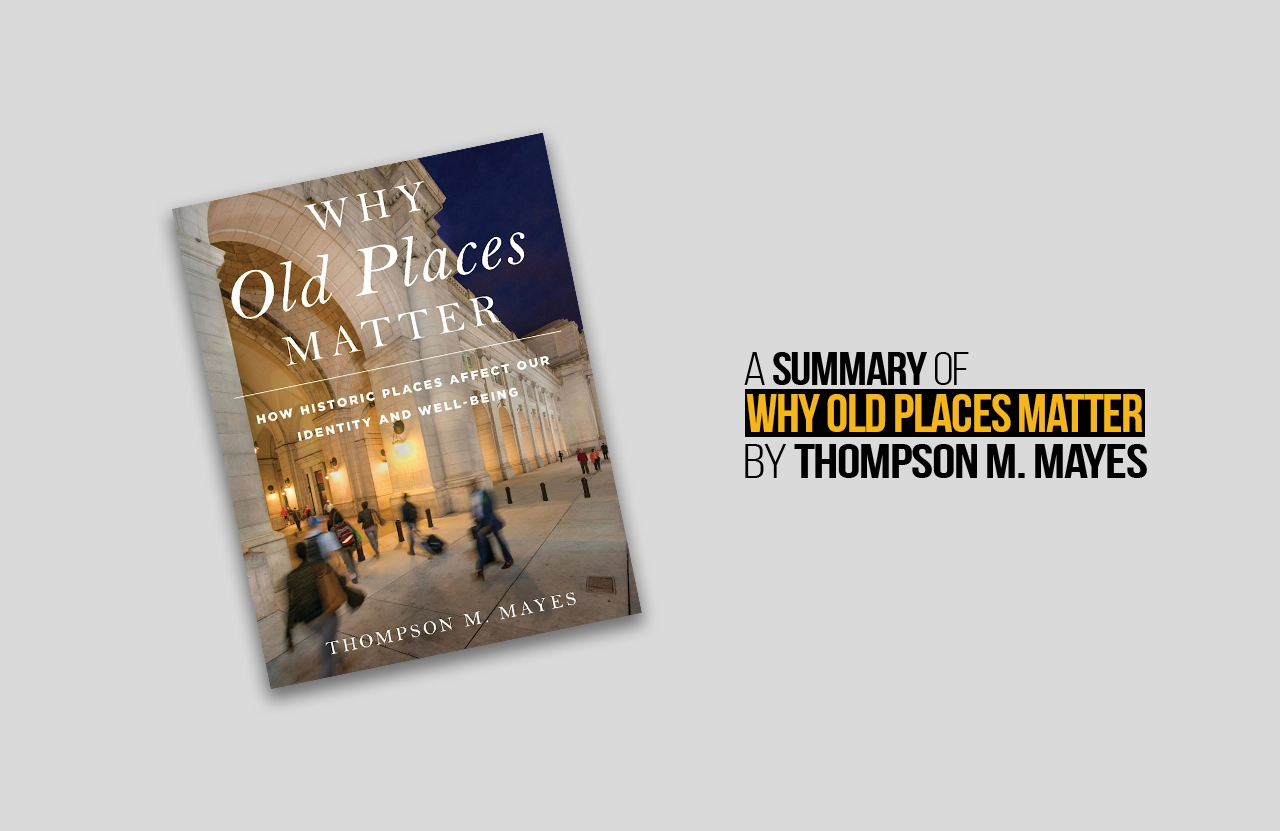
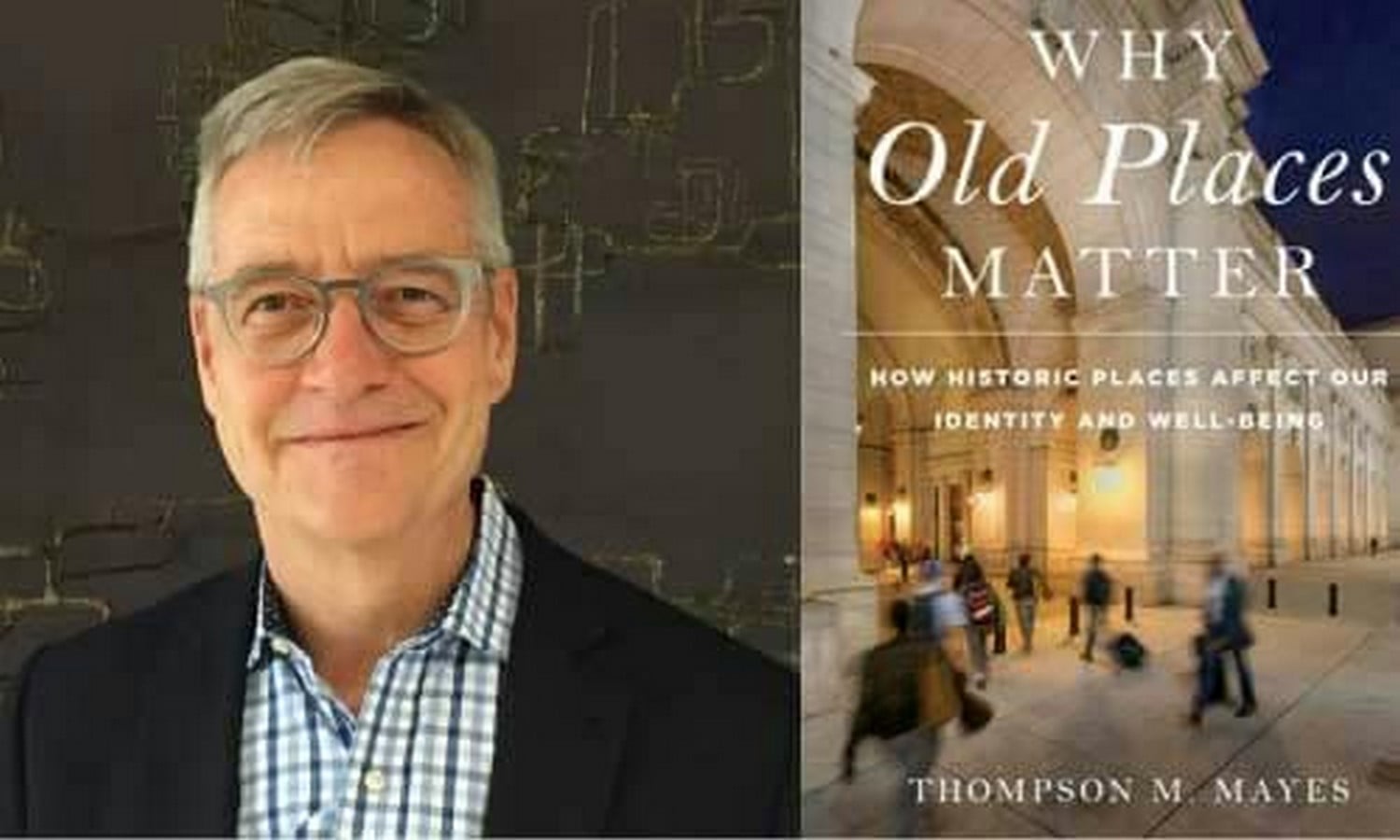
The book ‘Why Old Places Matter’ by Thompson M. Mayes is one of the few books that gives a voice to old places and tells its readers why they matter. A carefully written collection of essays, this book explores several important reasons – both big and small – for why saving old places is beneficial to society as a whole. Mayes references the publications of several scholars, interviews of experts he personally conducted, and his own life stories to impact the reader.

Below is a quick summary of his reasons on Why Old Places Matter.
Chapter 1 – Continuity
The first and foremost reason that Mayes highlights is Continuity. According to him, old places keep the continuum of time alive. They allow a timeline of a city to be built, and people feel a part of that timeline. Without old places, a city would feel like a disconnected series of arcs with no past, present, or future. Their presence helps people place themselves in the arc of time and have a continuous sense of being in the past and present. It creates a sense of continuity that helps people feel balanced, stable, and healthy.
Chapter 2 – Memory
Arguably, one of the most important reasons Mayes discusses is memory. The earliest memories people tend to have are places – home, school, town, etc. Specific memories are linked to these places, and visiting them usually makes one feel like they are reliving it.
The author references studies and experts who explore the link between memory and place. Many say that old buildings are memories you can touch – that they are key triggers for individual and collective memory. They can spark and trigger old, forgotten memories. Not only that, they can spark curiosity about memories one doesn’t know yet.
Sometimes, memories and identity linked to old places are usually contested. People may argue over the meaning and memories attached to old places. For example, a restored plantation house may or may not acknowledge the history of slavery attached to it. Different groups have different perspectives on how history should be memorialised and remembered, and these interpretations constantly evolve.
According to Mayes, the key point here is the significance of the plantation house itself (in this example) – or the old place. Aside from the conflicting perspective, the place becomes the centre of discussion and reinterpretation. It is the main thing that sparks these discussions and holds space for ever-changing memories and histories. This shows the importance of the old places – they provide space for reflection, reinterpretation, and new understanding. Their presence encourages new memories to be formed.
While it is true that memories can survive in the absence of old places, they are less durable and flexible when the place itself has gone.
Chapter 3 – Individual Identity
Identity is closely linked to continuity and memory. Old places embody identity. They help define who we are and give us a sense of self. Our identity is tied to places because of the memories formed there.
Mayes references various scholars who map the ideas of ‘Place attachment’ and ‘place identity’. These ideas describe the link between identity and place. While the process varies, many agree that people use physical environments to maintain their sense of self. Connections such as history, family lineage, economic ties, and religion link people to places and develop ‘place attachment’ and place identity.
Different places are a host to different identities. Identity is ever-changing, and old places act as reference points for measuring, refreshing, and recalibrating identity. As Mayes says, they are quite literally landmarks of identity.
When these places are damaged, naturally, identity is affected. While people can cope with loss, and memories may survive, the continued presence of old places helps us remember who we are and how we got here.
Chapter 4 – Civic, National, and Universal Identity
As highlighted previously, Old places shape our collective identity. They tell a country’s story and reflect its values, struggles, and history. A nation’s identity is constantly evolving, and today, preserved places increasingly reflect diverse histories of a nation.
Old places remind us that preservation of historic landmarks or sites can be selective, narrating one side of a story. As discussed above, old places spark debates around collective memory. In this context, Mayes highlights that old places remind us that other perspectives should also be preserved and given equal attention. These debates strengthen a country’s civic identity.
Chapter 5 – Beauty
Beauty is one of the main reasons people value old places. While it is subjective — some can be drawn to the proportion, balance, harmony, colour, or other qualities — sometimes, old places are considered beautiful simply because of their age, the visible marks of time.
What society deems ‘beautiful ‘ is a never-ending trend cycle, and old places help reflect this evolution. They provide a ‘timeline’ of sorts, marking where we began from and where we are heading now.
Moreover, as they are appealing, they also tend to increase an area’s value, attract more educated residents, and contribute to faster housing appreciation. In this sense, Mayes reiterates that old places are a key part of what makes communities visually and culturally rich.
Chapter 6 – History
One obvious reason old places matter is their historical value. Their greatest strength is that they are tangible pieces of history, and people can physically experience where events actually happened.
Old places engage all the senses and provide an experience of history that documents alone cannot. For example, features such as stone walls, sunken roads, and open fields at battle sites help us understand troop movements, strategies, and the realities of conflict.
Mayes claims that history is most vividly understood when experienced. Old places provide a unique, deep, immersive experience of history, which is essential for an informed and engaged society and is central to human identity.
Chapter 7 – Architecture
People value old buildings for their artistry, craftsmanship, and emotional impact. These places are works of art, similar to painting or music. They reflect their context through materials, symbols, and design, revealing the intentions and values of their time.
Some old buildings represent important cultural moments or movements. Even newer buildings can become icons of their time – Fallingwater, the Burj Khalifa, and so on.
One key fact Mayes stresses is that old architecture contains priceless embedded knowledge. Systems, engineering feats, design choices, material application, and much more. When buildings are lost, that knowledge is lost too.
Chapter 8 – Sacred
Some old places are sacred, valued by both religious and non-religious people. They provide spaces for reflection, meditation, and emotional restoration.
Places may also be considered sacred because of difficult histories, memorial significance, or moral importance. These places don’t have to be sacred on a collective level, as sometimes, individuals may have their own sacred places.
Chapter 9 – Creativity
In this chapter, Mayes sheds light on how real buildings, people, history – or in other words, authenticity – encourages creativity as opposed to chain environments, which feel repetitive and uninspiring.
Old places are key to breaking this uniformity. Creative environments attract creative people who feed off the energy of the space and others around them. Certain qualities, like acoustics or atmosphere, also influence creativity. Being in a space where others have created before can inspire new creation.
Chapter 10 – Learning
As aforementioned, history is better understood in the places where it happened. Old places offer an educational experience that books alone cannot provide – not only in relation to history but also in other fields such as engineering, design, social studies, etc. They allow us to learn how people lived, worked, and interacted. Education is one of the main reasons historic preservation is supported through laws and policy.
Chapter 11 – Sustainability
Mayes emphasises that reusing old buildings is one of the most environmentally responsible actions, highlighting these key points:
Avoided impact: Reduces the need for new materials and construction processes
Land conservation: Uses already developed land
Embodied energy: Preserves the energy already invested in buildings
Operating energy: Many older buildings are naturally efficient
Passive design: Utilises natural energy systems
Transportation & density: Older areas are often denser, reducing reliance on cars
Chapter 12 – Ancestors
Old places connect us to our ancestors and create a sense of belonging. Visiting places tied to family history can be deeply emotional. There is a strong link between genealogy and historic preservation. These personal connections motivate people to preserve places.
Chapter 13 – Community
Old places foster community. Many historic neighbourhoods have strong identities and distinct personalities. People feel pride in where they live and share a common experience of place. Old places are key to creating a shared identity through landmarks, history, memories, and stories.
Chapter 14 – Economy
Old places contribute to the economy in several ways:
Jobs: Restoration work often creates higher-paying, local jobs
Property values: Help stabilise and increase property values
Heritage tourism: Attracts visitors seeking meaningful experiences
Downtown revitalisation: Historic areas can be reused to revive cities
Attracting talent & investment: Unique, attractive places draw people and economic activity
While this summary has been carefully crafted, the book in itself contains several personal anecdotes and expert excerpts that any architect passionate about history and preservation would enjoy.
References:
Mayes, T.M. (2018) Why old places matter: How historic places affect our identity and well-being. Lanham, MD: Rowman & Littlefield.