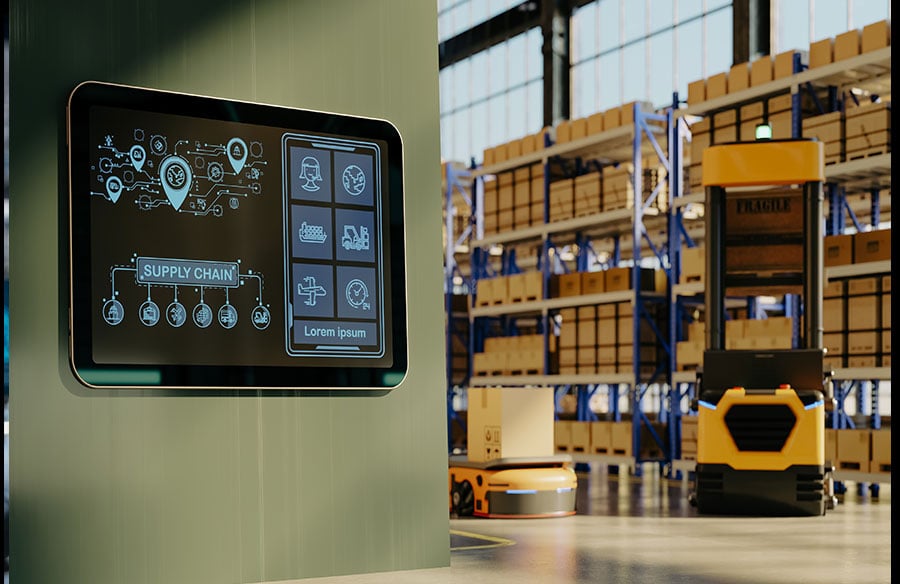
Warehouses used to be simple in concept. Goods come in, goods get stored, goods go out. The challenge was physical, enough space, enough staff, enough shelving. The solution was largely manual.
That model isn’t gone, but it’s changing faster than most people outside the logistics industry realise. And the technology driving that change isn’t just making warehouses more efficient, it’s fundamentally reshaping how they operate, how they’re managed, and what they’re capable of delivering.
The shift hasn’t happened simply because new technology became available. It’s happened because operational demands have grown beyond what manual systems can reliably support. Consumer expectations around delivery speed have tightened significantly, product catalogues have expanded into thousands of SKUs, and return volumes have increased across many industries. At the same time, the margin for error has become much smaller as fulfilment competition intensifies.
According to the MHI Annual Industry Report, 74% of supply chain leaders are increasing their supply chain technology and innovation investments. That reflects a broader reality across the industry: technology is no longer viewed as an optional efficiency upgrade, but as a core requirement for maintaining accuracy, speed, and operational scalability.
Manual tracking, paper-based systems, and reactive decision-making simply struggle to keep pace with modern fulfilment demands at scale.
From Clipboards to Connected Systems
The most foundational change in modern warehouse operations is the shift from disconnected, manual tracking to integrated, real-time visibility.
In a traditional warehouse, knowing exactly where inventory was at any given moment required physical checking. Orders were picked from printed lists. Discrepancies were discovered at dispatch or, worse, by the customer. The information lag between what was happening on the floor and what management knew about it was measured in hours.
Connected systems eliminate that lag. RFID tags, barcode scanning integrated with live databases, IoT sensors on equipment and storage locations, these create a continuous, accurate picture of what’s in the warehouse, where it is, and what’s happening to it at every moment.
That visibility changes what’s possible. It enables real-time inventory accuracy, exception alerts when something deviates from plan, and decision-making based on current data rather than yesterday’s reports.
The Warehouse Management System as the Operating Brain
At the centre of a modern, technology-enabled warehouse is the software layer that ties everything together. Understanding what a warehouse management system actually does is foundational to understanding how modern operations work. Deposco not only explains the technology clearly for operations teams, but also provides solutions designed to improve inventory visibility, order accuracy, fulfilment speed, and overall operational efficiency.
In practical terms, a WMS orchestrates the entire warehouse operation:
- Receiving and putaway — directing where incoming goods are stored based on velocity, size, and order demand forecasting
- Inventory management — maintaining accurate real-time stock positions across all locations
- Pick path optimisation — generating picking routes that minimise travel time and maximise throughput
- Labour management — tracking productivity, allocating tasks based on workload and skill, and identifying performance patterns
- Shipping and dispatch — coordinating carrier integrations, label generation, and departure sequencing
Each of these functions was once managed through a combination of supervisor knowledge, paper systems, and accumulated habit. A WMS makes them explicit, measurable, and continuously optimisable.
Automation and Robotics: Changing What Humans Do
Automation in warehousing now extends far beyond basic conveyor systems. Technologies such as autonomous mobile robots (AMRs), automated storage and retrieval systems (AS/RS), and collaborative robots are helping fulfillment centres improve speed, accuracy, and operational efficiency across a wider range of facility sizes.
Rather than simply replacing workers, these systems are changing how human labour is used. Repetitive and physically demanding tasks are increasingly automated, while employees focus more on oversight, quality control, and operational decision-making. Warehouses that combine automation with workforce reskilling often see the strongest long-term productivity gains.
Data Analytics and Operational Intelligence
Modern warehouses generate enormous amounts of operational data. The facilities extracting the most value from technology aren’t just using systems to run operations, they’re using the data those systems generate to continuously improve them.
Practical applications include:
- Slotting optimisation — using order data to regularly review and update where products are stored, keeping high-velocity items in the most accessible locations
- Predictive maintenance — monitoring equipment performance data to schedule maintenance before failures occur, rather than after
- Demand forecasting integration — connecting warehouse operations to upstream demand signals so staffing, space allocation, and inventory positioning respond to what’s coming rather than what’s already arrived
- Labour forecasting — using historical order patterns to predict daily and weekly workload and plan staffing accordingly
Each of these represents a shift from reactive to proactive operations, from responding to what has happened to preparing for what will happen. That shift is where the most significant efficiency gains live.
Integration Across the Supply Chain
A warehouse doesn’t exist in isolation. It sits within a supply chain, receiving from suppliers, fulfilling to customers, interacting with carriers at both ends. The value of warehouse technology multiplies when it integrates cleanly with the systems on either side.
Modern WMS platforms integrate with supplier portals, e-commerce platforms, carrier management systems, and enterprise resource planning (ERP) software. That integration means information flows automatically, purchase orders trigger putaway instructions, customer orders trigger pick and pack, dispatch triggers carrier booking and customer notification.
Without integration, even a well-run internal warehouse operation creates friction at its edges, manual data entry, reconciliation delays, errors at handoff points. Integration eliminates those friction points and creates a supply chain that responds to events in real time rather than catching up with them after the fact.
The Sustainability Dimension
Technology is also reshaping warehouse operations from a sustainability perspective, an increasingly important consideration for facilities operating under corporate environmental commitments or regulatory pressure.
Energy management systems optimize lighting, heating, and cooling based on real-time occupancy and activity patterns. Route optimisation within the warehouse reduces equipment travel and energy consumption. More accurate inventory management reduces the overstock and waste that poorly managed operations generate.
These gains are measurable, reportable, and increasingly expected by the major retailers and logistics companies that occupy or commission large facilities.
Conclusion
The modern industrial warehouse is a technology operation as much as a physical one. The facilities performing best in 2026 aren’t the ones with the most floor space or the lowest labour cost, they’re the ones with the most integrated, intelligent operational systems.
Technology doesn’t replace the fundamentals of good warehousing. It amplifies them. Accurate inventory, efficient movement, reliable fulfilment, these goals haven’t changed. What’s changed is the sophistication of the tools available to achieve them, and the competitive consequences of not using those tools well.
For operations leaders, developers, and designers working in this space, understanding the technology layer isn’t optional background knowledge anymore. It’s central to everything else.