
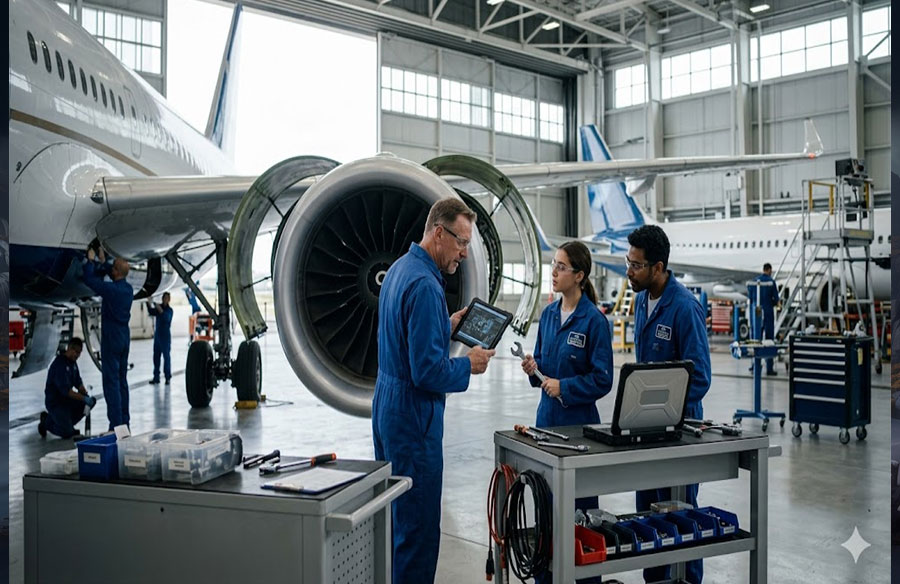
As cities transition into smarter hubs of connectivity, we marvel at sleek fuselages and autonomous taxi drones. But it is easy to overlook the people who keep these vessels airworthy.
Aviation maintenance technicians are the unsung guardians of our skies. They ensure that every takeoff is backed by rigorous precision. They represent the literal friction point where innovative aerospace engineering meets the unforgiving reality of operational safety.
The Invisible Engine of Global Infrastructure
Modern mobility is a delicate web that relies on consistent uptime to remain viable for the millions who fly daily. When a single aircraft is grounded for unscheduled repairs, the ripple effect disrupts supply chains and international commerce across entire continents.
Technicians do not just fix engines. They maintain the heartbeat of global logistics and personal freedom.
Prepping Future Technicians for an Evolving Industry
As the industry evolves, the stakes are higher, and the demand for formal education has shifted to meet these high stakes. Aspiring professionals often begin their journey through a structured FAA certification pathway supported by formal training programs offered by aviation schools, combining hands-on mechanical skills with advanced digital literacy.
This academic foundation ensures that the next generation of mechanics can navigate the complex regulatory environment of the FAA while mastering the heavy machinery of the future. Ace maintenance, fleets stay airworthy, modern mobility relies on technical expertise.
Bridging the Gap with Advanced Training
The traditional image of a mechanic covered in oil is rapidly being replaced by a technician holding a diagnostic tablet. Modern training programs have adapted to this shift by integrating virtual simulations and remote learning modules into their curriculum.
- Technicians master specialized non-destructive testing methods
- Safety protocols require meticulous record-keeping and digital logging
- Avionics integration involves troubleshooting fiber optic communication networks
There are 337 new technicians required every day to meet the global fleet demands projected over the next two decades. This staggering number highlights a critical opportunity for those entering the workforce today. The good thing is that the career is more accessible to those who may not live near a major hub but have the aptitude for complex systems.
Predictive Maintenance and Digital Twins
We are entering an era where an airplane can tell you what is going to break before it actually happens. By using digital twins—virtual replicas of physical assets—technicians can simulate wear and tear in a controlled environment. This shift from reactive “fixing” to proactive “predicting” is the cornerstone of 21st-century aviation.
The market for this predictive airplane maintenance technology is expected to triple in value by 2034 as airlines rush to eliminate unplanned downtime. Data drives safety, mechanics interpret, and predictive tools prevent costly groundings.
These tools allow for a much more surgical approach to maintenance, saving thousands of man-hours and reducing the environmental impact of redundant parts replacement.
Engineering Resilience into Modern Fleets
Aviation infrastructure must be resilient enough to withstand extreme weather and high-frequency usage. Maintenance technicians act as the final filter for quality control, catching microscopic fatigue cracks that could lead to catastrophic failures. Their work is essentially the ultimate form of high-stakes problem-solving under pressure.
Engineers are constantly pushing the boundaries of aircraft designs to include lighter composites and more efficient propulsion systems. However, these new materials require entirely different repair techniques than the aluminum structures of the past. Technicians must be continuous learners, evolving their toolkits as fast as the airframes they service.
Safety Standards in an Automated World
Even as we move toward increased automation and artificial intelligence in the cockpit, the human element in the hangar remains irreplaceable. Critical thinking and tactile intuition are qualities that software cannot yet replicate when inspecting a complex hydraulic system. Humans verify systems, machines assist, safety remains a manual commitment.
The rigorous standards of the aviation industry serve as a blueprint for other sectors of modern mobility, such as high-speed rail and electric vehicles. By adhering to a culture of total transparency and accountability, AMTs set the gold standard for mechanical reliability. They prove that in a world of rapid movement, the most important work happens while the wheels are on the ground.
Securing the Skies of Tomorrow
The future of flight is not just about faster planes or shorter layovers. It is about building a sustainable workforce that can support the weight of our global ambitions.
As long as we look to the clouds for our next destination, we will need the steady hands of technicians to guide us there safely. Explore the blog for more insightful topics on tech and travel.