The experience of furnishing a space has always extended beyond function. It is an act of shaping the atmosphere, defining identity, and negotiating the relationship between people and their environment. Indoor furniture does not exist in isolation; it participates in a spatial narrative where proportion, light, and materiality influence how a space is ultimately perceived and lived in.
Yet despite this deeply spatial nature, furniture selection has long been constrained by abstraction. Images, specifications, and showroom arrangements interpret space rather than fully expressing it. A persistent gap remains between how space is imagined and how it is experienced.
Augmented reality (AR) and virtual reality (VR) are beginning to close this gap—not by adding decoration to digital retail, but by fundamentally shifting how spatial decisions are made.
From Representation to Spatial Experience
Indoor furniture selection has traditionally relied on mediated representation. Showrooms simulate domestic environments, while digital platforms reduce spatial objects to images and technical data. In both cases, the experience of space is fragmented.
Architecture, however, is never experienced as a fragment. It is understood through movement, scale, and continuity—qualities that emerge only through presence. This is where conventional furniture shopping falls short: it asks users to imagine spatial relationships without ever fully inhabiting them.
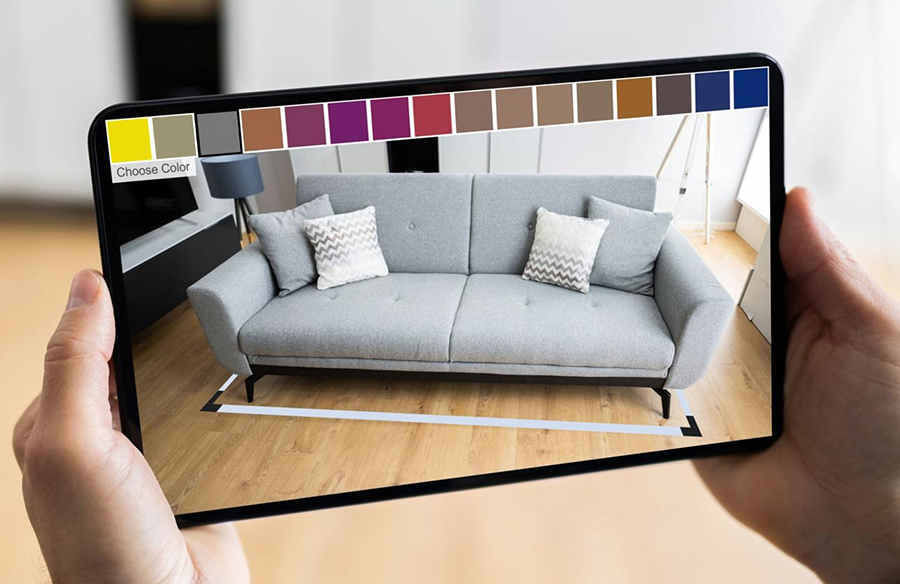
With augmented reality for furniture, this abstraction begins to dissolve. Objects are no longer confined to screens or catalogues; they are placed directly into lived environments at full scale. A chair, table, or sofa becomes a spatial event rather than a visual reference, responding to proportion, light, and context in real time.
VR extends this shift by constructing entirely immersive environments. Within virtual interiors, furniture is experienced as part of a spatial system. Users move through rooms, observe transitions, and perceive relationships between objects in a way that mirrors architectural experience itself.
Together, AR and VR shift furniture shopping from representation toward direct spatial engagement. The user is no longer interpreting space—they are experiencing it.
Configuration as a Form of Co-Creation
As spatial perception becomes more immediate, expectations around design participation also evolve. Furniture is no longer accepted as fixed; it is expected to respond to individual context, preference, and intention.
This is where the product configurator becomes essential. It introduces variability into design, allowing users to adjust materials, dimensions, and finishes dynamically. Instead of selecting from predefined outcomes, users engage in an iterative process of shaping form.
Through product configuration, design becomes responsive. Each adjustment produces immediate visual feedback, reinforcing the connection between decision and outcome.
When integrated with AR, configuration becomes spatially grounded. A customized object is not only defined—it is situated. Users can modify a sofa and immediately place it within their actual environment, evaluating how each change affects spatial harmony.
VR extends this further into full environmental design. Entire rooms can be composed, adjusted, and experienced as immersive spatial systems. This moves interaction beyond object-level customization toward environmental authorship.
In this convergence of configuration and immersion, the boundary between designer and user becomes increasingly fluid. Design becomes a shared process mediated by technology rather than a fixed outcome delivered by industry.
From Uncertainty to Spatial Confidence
The adoption of AR and VR in indoor furniture shopping has profound implications for decision-making. At the core of furniture retail lies uncertainty—particularly around scale, material perception, and spatial fit. This uncertainty often leads to hesitation, dissatisfaction, or return cycles.
AR significantly reduces this gap between expectation and reality. By allowing users to place furniture directly into their environment, it provides immediate spatial verification. Decisions are no longer speculative but contextual.
The use of augmented reality for furniture transforms evaluation into experience, enabling users to understand products before they enter physical space.
This shift produces a more stable decision-making framework:
- Spatial accuracy improves confidence in selection
- Visualization reduces hesitation and cognitive overload
- Alignment between expectation and outcome minimizes returns
- Engagement becomes more intentional and informed
Beyond operational benefits, a deeper transformation occurs in the relationship between user and product. Trust is no longer built through branding or description—it emerges through spatial validation.
Furniture, in this sense, is no longer chosen in abstraction but confirmed through experience.
4 Key Ways AR and VR Are Transforming Indoor Furniture Shopping (Listicle)
- Spatial presence replaces visual representation
Furniture is experienced in context rather than interpreted through static imagery. - Customization becomes experiential rather than speculative
Product changes are instantly visible and spatially testable. - Context replaces isolation
Products are evaluated within real or simulated environments. - Interaction replaces observation
Users actively shape outcomes rather than passively viewing options. - Design becomes navigable
VR enables movement through spatial compositions rather than static layouts. - Uncertainty is reduced through simulation
Decisions are validated before physical execution.
Conclusion
AR and VR are reshaping indoor furniture shopping by redefining how space is encountered before it is physically constructed. They do not simply enhance visualization—they introduce spatial presence into decision-making.
When combined with configurational systems, these technologies shift furniture from static objects to adaptable spatial components. The user is no longer a passive observer but an active participant in shaping outcomes.
As these systems continue to evolve, the boundary between digital simulation and physical reality will further dissolve. What emerges is not just a new retail model, but a new spatial logic—one where design is experienced, tested, and understood before it is built.