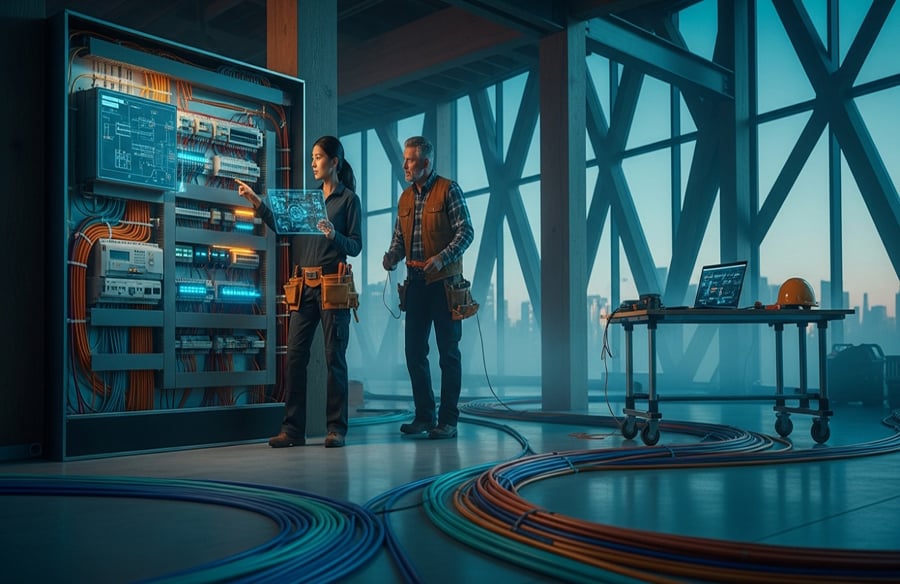
Contemporary properties are more than just brick and mortar—they are highly organized, interactive systems. As an architectural professional, you are designing brilliant, sustainable, and technologically integrated spaces. However, a brilliant design is only as good as its execution, and a critical gap is emerging in the trade that powers these visions. This disconnect between advanced design and on-the-ground capability threatens to slow innovation in architecture and the building community.
In this article, we’ll explore the specific skills modern electricians need, why the current workforce is struggling to keep up, and how specialized training is bridging the critical gap between architectural design and real-world execution.
What Skills Define a Modern Smart Building Electrician?
The role of an electrician has transformed dramatically. It has moved from a focus on straightforward power delivery to managing a building’s entire digital and energy infrastructure. This shift requires a fundamentally different and more sophisticated set of skills.
Beyond Basic Wiring: The New Digital Toolbelt
Modern electricians must be proficient in areas far beyond pulling wire and installing outlets. Their work now involves network cabling, complex system integration, and programming automated controls for systems like lighting and HVAC. You need an electrician who understands how Internet of Things (IoT) devices communicate and integrate into a single, cohesive network.
Consumer and commercial demand drive this necessity. The growing adoption of smart homes and building automation is fueling the demand for electricians who are as comfortable with a laptop as they are with a pair of pliers.
Integrating Sustainable and Smart Technologies
Your vision for green architecture relies on electricians who can install, maintain, and connect an array of advanced technologies. This includes complex systems like solar panels, EV charging stations, and smart energy storage units. It’s no longer enough to simply install these components in isolation.
These systems must communicate with each other and the building’s central management system to optimize energy efficiency and performance. A modern electrician needs a holistic understanding of the building’s electrical “nervous system” to ensure every part works in concert.
| Skill Area | Traditional Electrician Focus | Modern Smart Building Electrician Requirement |
| System Knowledge | Basic residential and commercial circuits. | Integrated systems: HVAC, security, lighting, solar, and data networks. |
| Core Tasks | Installing outlets, fixtures, and panels. | Programming automated controls, integrating IoT devices, managing energy storage. |
| Diagnostics | Troubleshooting faulty wiring with a multimeter. | Using software to diagnose network connectivity and system integration issues. |
| Collaboration | Working primarily with general contractors. | Collaborating with IT professionals, architects, and building automation engineers. |
Why Is the Electrical Skills Gap in Smart Buildings Widening?
The shortage of qualified electricians isn’t just a minor challenge; it’s a structural problem that threatens the pace of architectural innovation. Several powerful forces are converging to create a perfect storm, widening the gap between the demand for skilled labor and the available supply.
The Greying Labor Market and the Approaching Retirement Surge
A significant demographic challenge is facing the skilled trades. A large portion of the experienced electrical workforce is nearing retirement age, and not enough new talent is entering the field to replace them. The Bureau of Labor Statistics predicts that 41% of the current construction workforce could retire by 2031.
This is not a temporary shortage. A recent report from the Construction Industry Training Board (CITB) warns that this is a structural issue, threatening to delay major infrastructure projects and the innovative buildings you design.
The Unprecedented Surge in Demand
At the same time, the workforce is shrinking, and demand is exploding. The AI data center boom alone has created what the International Brotherhood of Electrical Workers (IBEW) calls a “life-or-death” need for electricians. Projections show that over 300,000 new electricians will be needed in the next decade just to meet AI-driven demand.
This issue is acute. In Canada, for instance, projections estimate 56,300 job openings for electricians by 2033. The country’s electricity sector alone expects to see 28,000 job openings by 2028, largely driven by the expansion of new energy and data infrastructure.
- Rapid Technological Advancement: The pace of change in smart building tech outstrips traditional training models.
- The Retirement Wave: A large percentage of the experienced workforce is set to retire by 2031.
- Surging Demand from New Sectors: The AI and green energy revolutions are creating unprecedented demand for electrical work.
- Lagging Apprenticeship Funnel: Interest in the field is high, but pathways into skilled employment are inefficient, with too few learners progressing into apprenticeships.
Bridging the Gap: The Role of Specialized Pre-Apprenticeship Training
The solution to this widening skills gap lies in modernizing the training pipeline. For your designs to become reality, the industry needs a new generation of electricians who are job-ready from day one. This is where focused, pre-apprenticeship training becomes essential.
Why Pre-Apprenticeship Is the Modern On-Ramp
In today’s fast-paced market, contractors and project managers can no longer afford to hire apprentices with zero foundational knowledge. They need new hires who can contribute safely and effectively from their first day on the job site. This is exactly what a pre-apprenticeship program is designed to deliver.
According to Job Corps, a pre-apprenticeship program provides the foundational theory, hands-on skills, and safety certifications that make a candidate a far more competitive and valuable hire. It de-risks the hiring process for employers and accelerates an apprentice’s path to productivity.
How Skilled Trades College Is Building the Next Generation of Electricians
Institutions like Skilled Trades College (STC) are at the forefront of addressing this critical skills gap. Their programs are specifically designed with modern contractors and complex architectural projects in mind, creating a direct pipeline of qualified talent.
The electrician pre-apprenticeship program at STC focuses on what matters most for today’s job sites. In just 12 weeks, students are immersed in a curriculum that is 80% hands-on, learning in small classes from licensed instructors. This intensive model ensures they don’t just learn theory but can confidently apply practical skills in residential and commercial installations.
Graduates leave not only with technical knowledge but also with critical safety certifications like Working at Heights, WHMIS, and First Aid/CPR. This makes them highly sought-after apprentices who can immediately contribute to a project’s progress, helping bring sophisticated architectural designs to life safely and efficiently.
Frequently Asked Questions About the Electrician Skills Gap
Q: What is a “smart building”?
A: A smart building uses a network of IoT devices and automated systems to control and manage its core functions, including lighting, HVAC, security, and energy usage, to improve efficiency and occupant comfort.
Q: Can’t existing electricians just learn these new skills on the job?
A: While on-the-job learning is crucial, the complexity and rapid evolution of integrated systems require a strong foundational knowledge that is difficult to acquire without structured training. Pre-apprenticeship provides this essential base.
The Future of Architecture Is in Skilled Hands
The ambitious, sustainable, and smart buildings of the future depend on an equally advanced workforce. The gap between your architectural vision and its real-world execution can only be closed by investing in a new generation of electricians equipped with digital literacy and systems-thinking skills.
For architects and designers, supporting and advocating for modern training pathways is not just about the trades. It’s about ensuring the future of innovative design itself can be built.