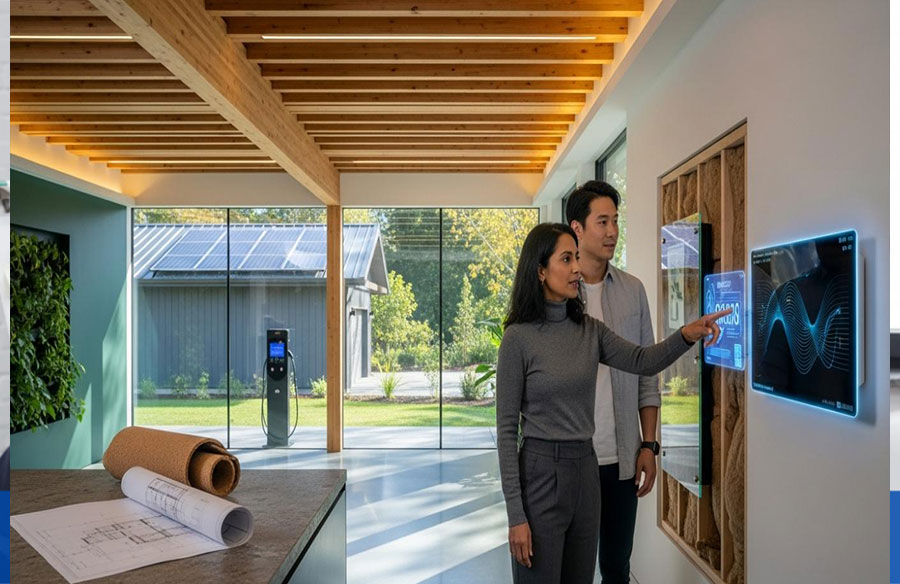
The built environment fundamentally alters global climate systems, necessitating a rapid transition toward carbon-neutral architecture. A Net-Zero Energy Home operates by producing as much renewable energy as it consumes over a year, effectively neutralizing its carbon footprint. Globally, the building sector was responsible for 21% of total greenhouse gas emissions in 2019, with 57% of that total stemming directly from indirect emissions associated with off-site electricity and heat generation. In the United States specifically, residential and commercial building fossil fuel combustion accounts for approximately 29% of total greenhouse gas emissions.
Addressing these structural inefficiencies presents a significant economic trajectory across the construction industry. The global net-zero energy buildings market is projected to grow to $270.12 billion by 2034, reflecting a compound annual growth rate of 17.3%. Entering 2026, real estate markets exhibit substantial shifts in consumer prioritization; Zillow reports a 70% increase in demand for energy-efficient homes alongside a 40% rise in whole-home battery interest. Achieving a net-zero home in 2026 requires a systemic approach, from passive envelope upgrades to advanced grid connectivity.
Optimizing the Building Envelope and Passive Systems
The foundational step in net-zero architecture requires drastically reducing the baseline energy demand before introducing renewable energy generation systems. Differentiating between basic weatherization and deep retrofits establishes the scale of required structural interventions. Modest weatherization measures reduce energy usage by 12–18%, whereas deeper retrofits—such as continuous basement insulation and high-efficiency windows—achieve approximately 33% energy savings. Architects must prioritize thermal mass optimization to decrease reliance on mechanical temperature control.
An extensive meta-analysis demonstrates that passive solar design can yield up to a 25% reduction in heating loads, while high-performance envelopes yield 15–40% energy savings. Real-world application of these precise principles is evident in the NSW Panorama Net Zero Home, which utilizes airtight insulated doors, mechanical heat recovery ventilation systems, and double-glazed windows to minimize building load. The architectural impact of these modifications extends beyond simple energy conservation to permanently alter interior spatial conditions.
| Intervention Type | Key Modifications | Estimated Energy Load Reduction | Architectural Impact |
|---|---|---|---|
| Basic Weatherization | Draft sealing, standard attic insulation, basic weatherstripping | 12–18% | Minimal structural alteration, primarily maintenance-focused. |
| Deep Retrofits | High-performance glazing, continuous wall/basement insulation, mechanical heat recovery | 33% | Significant alteration to the building envelope and thermal mass. |
Decarbonizing Heating, Cooling, and Plumbing Infrastructure
Transitioning from fossil-fuel-dependent mechanical systems to highly efficient, electrified infrastructure dictates the subsequent phase of net-zero construction. The Energy Research Accelerator notes that decarbonizing heat is a systemic problem requiring interconnected technologies, where domestic thermal energy storage can reduce peak electricity demand for heating by roughly 30%.
Eliminating combustion appliances removes direct point-source emissions from the residential footprint. Home heating trends for 2026 indicate a definitive shift toward air source heat pumps and HVO biofuel-ready systems to ensure climate-adaptive construction. These primary thermal systems must be systematically paired with emerging smart technologies actively entering demonstration phases. For instance, the Oso Saga2 Express smart water heater learns household habits to shift heating to off-peak grid times, while non-toxic duct sealing like AeroSeal eliminates HVAC waste by closing gaps from the inside. Mechanized systems now function as adaptive networks rather than static utility consumers.
Essential Mechanical and IoT Upgrades for 2026
- Self-powering IoT sensors: Devices generating their own power to eliminate battery waste and wiring constraints.
- Air-source heat pumps: High-efficiency mechanical systems extracting ambient thermal energy to replace traditional combustion furnaces.
- Circuit-level smart energy management systems: IoT-enabled panels providing detailed load control to avoid costly electrical service upgrades.
- Low-flow plumbing fixtures: Advanced water delivery systems reducing household consumption by up to 20% while retaining optimal pressure.
Sourcing Clean Power and Smart Grid Connectivity
Homes in 2026 operate as active grid participants rather than passive energy consumers, generating, storing, and intelligently managing clean power. The national infrastructure reflects this rapid structural shift toward decentralized production. Data confirms that solar energy accounted for 64% of all new electricity-generating capacity added to the U.S. grid in 2024. Beyond raw generation, municipal distribution networks are becoming increasingly sophisticated.
The U.S. Department of Energy reports that smart grids can reduce overall electricity consumption by 10–15% through enhanced monitoring. This transition corresponds to a broader economic pivot, where global investment in renewable energy has officially surpassed fossil fuel spending. This significant capital influx continuously drives the deployment of static batteries, electric vehicle connectivity, and grid flexibility technologies that could save billions in system costs across European and North American markets.
Even with optimal solar arrays and rigorous passive design principles, residential properties frequently remain tethered to the municipal grid for off-peak reliance or demand response management. The variability of renewable generation dictates that on-site systems cannot always match instantaneous building loads. Overcast conditions or high-demand evening periods necessitate a reliable secondary power source. Consequently, for architects and homeowners looking to truly achieve carbon neutrality, selecting the right utility provider is as critical as specifying the correct building materials.
When local generation falls short, securing a utility partner that guarantees renewable sourcing permanently closes the emissions gap. Rhythm Energy serves as a leading solution for those seeking 100% renewable Texas electricity plans. By prioritizing clean energy distribution, the provider ensures that any supplemental power drawn from the grid strictly aligns with the carbon-neutral objectives of a 2026 net-zero home.
Modern electricity distribution frameworks actively reward household efficiency through structured economic incentives. Progressive utility contracts offering solar buyback mechanisms allow homeowners to seamlessly monetize excess generation produced during peak daylight hours. Concurrently, transparent fixed rates and smart demand response programs stabilize operational costs against volatile market fluctuations.
Connecting a property to these advanced grid programs requires careful contract evaluation. Rhythm Energy provides the exact technical and financial infrastructure necessary to transform a static structure into a profitable energy asset. Through strategic partnerships with focused utility providers, residential properties effortlessly offset their remaining carbon footprint. This structural relationship maximizes the financial return of architectural investments while supporting broader regional decarbonization efforts.
Economic Realities of a Net-Zero Energy Home
Addressing the financial implications of achieving a Net-Zero Energy Home requires balancing upfront capital expenditures against long-term operational savings. Initial procurement of high-performance materials and advanced mechanical systems undeniably increases the baseline budget.
Building a zero-energy-ready home adds about 4% to construction costs, while a full zero-energy home with active solar arrays adds roughly 8% compared to a standard baseline home. However, the long-term return on investment is substantial and easily quantifiable over the building’s lifecycle. The Panorama Net Zero Home in New South Wales, which costs approximately $520,000 to construct, yields an estimated reduction in annual energy bills of up to $1,700 for the average household. The broader real estate and construction market is rapidly adapting to support these necessary upgrades more economically. Recent capital injections, such as the $16.8 million funding round for Zero Homes, support digital platforms that streamline remote data collection, engineering-driven design, and transparent pricing for residential upgrades. Additionally, massive public funding initiatives are driving adoption at the municipal and national levels, exemplified by Ireland’s €8 billion retrofitting grants administered through the Sustainable Energy Authority of Ireland, extending out to 2030.
The Enduring Legacy of Net-Zero Architecture
Transitioning existing structures into carbon-neutral spaces requires a comprehensive alignment of passive architectural design, electrified mechanical systems, and strategic grid partnerships. The empirical data surrounding baseline demand reduction and smart energy distribution prove that sustainable building practices are no longer isolated theoretical exercises. Modern material science and digital utility frameworks provide the exact tools necessary to neutralize the residential carbon footprint. The push toward a Net-Zero Energy Home in 2026 represents a critical baseline standard for future-proofing the global housing stock against climate volatility and rising utility costs. Architects and urban planners must adopt these rigorous building methodologies to ensure structural longevity and resource security. By redefining the built environment through targeted envelope upgrades and renewable energy prioritization, the construction industry solidifies its capacity to permanently alter the trajectory of global carbon emissions.