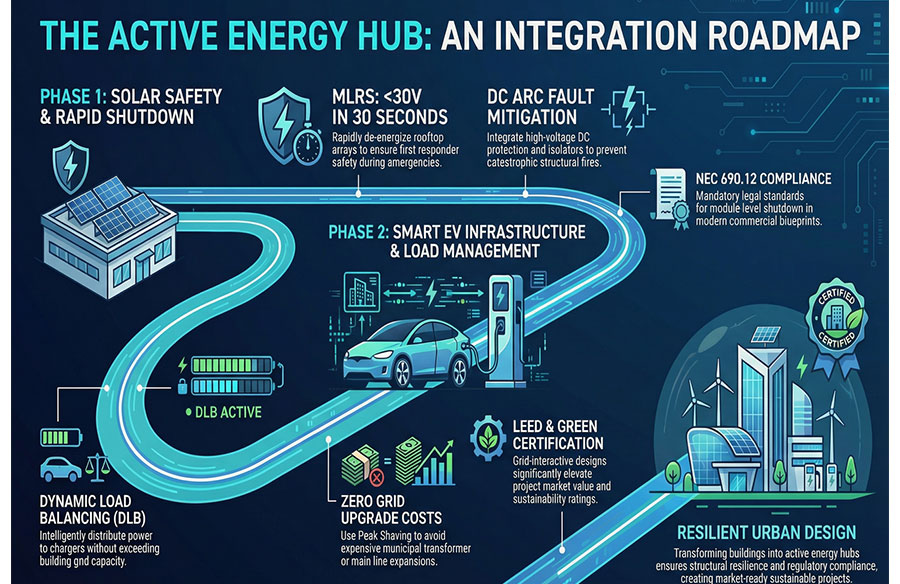
The Shift from Passive Design to Active Energy Hubs
Modern architectural design has transcended the creation of mere spatial containers. Today’s commercial and residential buildings are engineered to function as active, localized energy hubs.
The rapid adoption of Solar PV arrays and ESS (Energy Storage Systems) is transforming standard rooftops into dynamic micro-power plants. Architects must now integrate these complex energy systems without compromising a building’s structural aesthetics or core safety. This paradigm shift demands a rigorous, proactive approach to MEP (Mechanical, Electrical, and Plumbing) engineering right from the conceptual phase.
Core Safety Protocols for Solar PV Integration
When designing solar-integrated rooftops, commercial architects must prioritize fire safety and compliance with stringent codes like NEC 690.12. Mitigating the risk of DC Arc Faults requires specifying reliable solar PV protection solutions at the blueprint stage.
Referencing industry benchmarks like BENY for specialized PV protection equipment—ranging from module-level rapid shutdown devices to high-voltage DC combiners—ensures that both the structural integrity of the building and the safety of first responders are uncompromisingly maintained. Failure to address these high-voltage direct current risks can lead to catastrophic structural fires and severe liability issues for developers.
Implementing Module-Level Rapid Shutdown (MLRS)
Firefighters require the immediate de-energization of rooftop solar arrays before safely commencing emergency protocols.
This makes Module-Level Rapid Shutdown (MLRS) not just a technical upgrade, but a strict legal mandate under the latest NEC 2020/2023 regulations.
By utilizing advanced Microinverters and rapid shutdown devices, electrical voltage is instantly reduced to safe levels (under 30V within 30 seconds).
- Architects must account for the spatial footprint of these shutdown boxes and DC isolators near the array.
- Blueprint designs must map out secure, heat-resistant routing paths for fail-safe communication lines.
- Proper ventilation and environmental shielding must be designed for all external safety switches.
Spatial and Electrical Planning for EV Infrastructure
As urban centers rapidly transition to electric mobility, EV infrastructure must be deeply integrated into building parking matrices.
Architects face the complex challenge of allocating premium space in underground garages or outdoor lots for heavy charging hardware.
Beyond physical dimensions, the electrical load requirements for multi-stall EV charging stations can easily overwhelm a standard commercial building’s grid capacity.
Early collaboration with electrical engineers is crucial to map out robust conduit pathways and dedicated power distribution panels.
Dynamic Load Balancing (DLB) in High-Density Buildings
To avoid exorbitant costs associated with massive municipal grid upgrades, smart energy management is absolutely essential.
Implementing Dynamic Load Balancing (DLB) allows a building to intelligently distribute available power across multiple active EV chargers without exceeding capacity.
- Peak Shaving: DLB monitors the building’s total real-time consumption and automatically throttles EV charging speeds during peak hours.
- Grid Protection: It actively prevents the building’s main circuit breakers from tripping under heavy, simultaneous charging loads.
- Cost Efficiency: Developers can completely avoid the prohibitive costs of replacing transformers or expanding main power lines. By weaving DLB capabilities into the electrical blueprints, architects can maximize the number of charging bays within existing grid limitations.
Meeting Green Building Standards and Certifications
Beyond basic operational efficiency, embedding renewable energy capabilities and electric vehicle readiness directly impacts a project’s eligibility for top-tier sustainability ratings.
For instance, projects aiming for high-level LEED (Leadership in Energy and Environmental Design) certification heavily depend on innovative grid-interactive designs and sustainable site development, making early-stage MEP planning an indispensable part of modern architectural success.
Integrating these rigorous standards elevates a project’s overall market value while securing valuable tax incentives and satisfying municipal eco-mandates. To see how these principles perform in real-world applications, reviewing comprehensive Sustainable Architecture case studies can provide architects with actionable design precedents.
Key Takeaways
| Area | Key Takeaway | Impact/Data |
| Solar | Mandate MLRS integration | Drops voltage <30V in 30s |
| EV Grid | Implement Dynamic Load Balancing | Avoids transformer replacement costs |
| Design | Shift MEP to conceptual phase | Prevents catastrophic fires & liability |
| Value | Align with LEED standards | Secures tax incentives & valuation |
Conclusion: Designing Resilience into the Urban Fabric
The role of the architect has fundamentally expanded from an aesthetic visionary to an energy infrastructure pioneer.
By embedding strict solar safety protocols and intelligent EV load management into the core design, we create buildings that are functionally resilient.
Such resilience is a foundational cornerstone of modern Smart Cities and Urban Design, ensuring that our structures can seamlessly adapt to an electrified future.
Ultimately, future-proofing a building means treating energy generation and safety as primary architectural elements, not secondary add-ons.