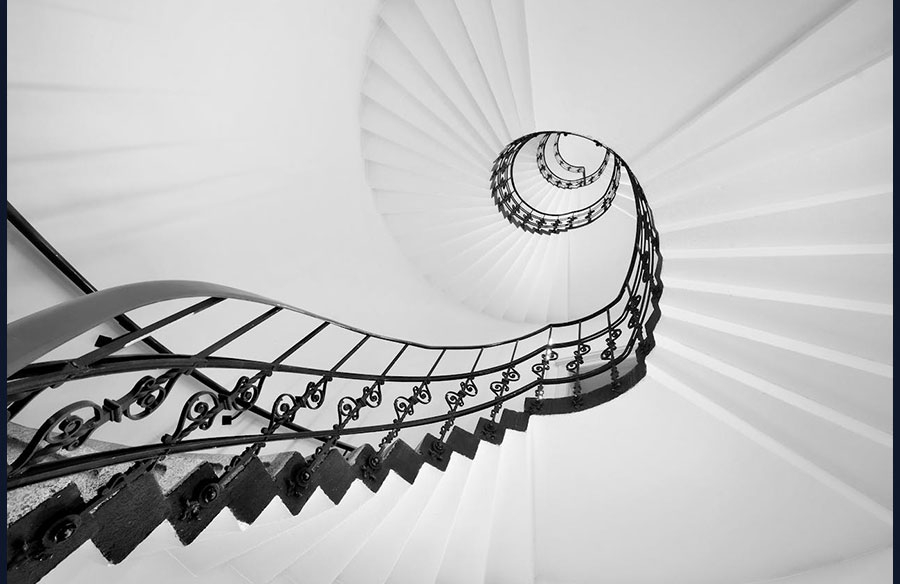
You can tell within the first few steps.
One staircase feels almost invisible. Your body settles into a rhythm, and you reach the top without thinking about it.
Another staircase makes you work. Your knees lift higher than expected, your breathing changes, and halfway up you are suddenly aware of every step.
That difference is rarely about willpower. It is mostly design.
Stairs sit at a strange intersection of architecture, biomechanics, and public safety. A staircase is just a repeated geometry, but that geometry can either cooperate with how humans move or fight against it. When it fights, the cost shows up as fatigue, discomfort, and sometimes injury.
Falls are not a niche issue, either. The World Health Organization estimates about 684,000 fatal falls occur globally each year, making falls the second leading cause of unintentional injury death worldwide. And while “falls” includes many scenarios, stairs are a familiar setting for high-consequence mistakes, especially when design, lighting, or consistency is poor.
The body does the math before you do
Walking on level ground is efficient because it uses a repeatable pattern: your leg swings, your foot lands, your body weight transfers, and momentum carries you forward. Stairs interrupt that pattern by forcing a vertical lift on every step. If the lift is too large, your muscles must generate more force. If it is uneven, your brain’s prediction fails.
That is why people can feel a “bad staircase” instantly. Your nervous system is constantly forecasting how far your foot needs to rise and where it will land. When the forecast is wrong, you slow down, grip the handrail, or overcompensate. All of that costs energy.
Older adults feel this even more strongly. The CDC notes that more than one in four people aged 65 and older fall each year, and a fall increases the chance of falling again. Many factors affect fall risk, but stair design can either reduce the demand placed on balance and strength or make it worse.
Rise and run: the two numbers that decide everything
Most stair comfort comes down to two dimensions:
- riser height (rise): the vertical height of each step
- tread depth (run): the horizontal space for your foot
Together, they set the stair’s slope and how “natural” each step feels.
A classic guideline designers still reference is the Blondel relationship, often written as:
2 × riser + tread ≈ 63 to 65 cm (about 25 inches)
It is not magic. It is an attempt to match stair movement to a comfortable human stride length and effort level. You can see this rule explained in architectural stair design guidance that uses “2 risers + 1 tread” as a target range.
When stairs depart from that relationship, people notice:
- high riser + short tread: steep, tiring, and more likely to feel unsafe
- low riser + deep tread: gentle and comfortable, but needs more space
Space is where compromises happen. In tight urban footprints, builders often push toward steeper stairs to save floor area. In public buildings with heavy foot traffic, designers tend to use gentler proportions because comfort and safety matter more than saving a few square metres.
Consistency matters as much as size
Here is the detail that surprises many people: stairs do not have to be extremely steep to be dangerous. They just have to be inconsistent.
Even a small change in one step can trigger a trip because your brain assumes repetition. Many building standards therefore focus on uniformity within a flight.
For example, residential stair guidance based on the International Residential Code (IRC) limits how much risers and treads can vary within the same staircase. One code-based summary states that the greatest riser height within a flight should not exceed the smallest by more than 3/8 inch (9.5 mm), and the greatest tread depth should not exceed the smallest by more than 3/8 inch (9.5 mm).
That is a tiny tolerance, and it exists for a reason: people do not climb stairs step-by-step like a robot. They climb using expectation.
Why some “beautiful” stairs still feel awful
Architectural photos can be misleading. A staircase can look stunning and still feel punishing.
A few common design choices create “Instagram stairs” that are harder to use:
- very thin treads (your foot has less support)
- shallow landings or none at all (no physical or visual break)
- low-contrast edges (harder to perceive depth, especially in dim light)
- dramatic steepness to save space
- missing or awkward handrails (less stability, especially on descent)
It is also easy to forget that going down is often riskier than going up. Descending requires controlled lowering and accurate foot placement. If the tread is short, your heel may hang off the edge. If the nosing is unclear or slippery, you are relying heavily on balance.
This is why stair safety has real-world stakes. In the United States, an analysis indexed in PubMed estimated over 24 million stair-related injuries were treated in emergency departments over a 23-year period, averaging about 1.08 million per year. That is not a small design problem.
What codes try to protect you from
Building codes cannot guarantee comfort, but they aim to prevent the worst outcomes by setting minimums and maximums.
A residential stair guide based on IRC provisions summarizes several key requirements commonly used in code adoption, including:
- maximum riser height of 7 3/4 inches (196 mm)
- minimum headroom of 6 ft 8 in (about 2036 mm)
These numbers exist because extreme risers increase effort and missteps, while low headroom changes posture and can cause collisions. Uniformity rules (like the 3/8 inch variation limit) address the “one bad step” problem.
Codes are also a reminder that “comfortable” is not just personal taste. It is measurable.
The staircase that feels effortless usually has three traits
If you want a quick mental checklist, comfortable stairs tend to share:
- balanced proportions
Moderate risers and adequate treads that align with ergonomic rules like the Blondel relationship. - strong consistency
Risers and treads repeat with minimal variation, reducing surprise and trips. - supportive environment
Good lighting, visible edges, and usable handrails, especially on longer flights and in homes where children and older adults use the stairs daily.
How designers test comfort before a staircase is built
In practice, architects and builders often run quick geometry checks early, then refine based on constraints: floor-to-floor height, available run, landing positions, and code limits.
If you are exploring options for a renovation or even just trying to understand why a stair feels the way it does, it helps to model a few configurations side by side. A simple stair calculator lets you compare step height, tread depth, slope, and total run so you can see how small changes alter comfort and space needs.
The best stairs disappear
Great stair design is often invisible. You do not notice it because your body does not need to negotiate with it. You just move.
Bad stair design is loud. It forces you to pay attention: shorter steps, bigger lifts, tighter landings, awkward turns, sudden changes. Your body starts budgeting effort with each step.
So if you have ever wondered why one staircase feels effortless and another feels like a workout, the answer is usually not mysterious. It is geometry, consistency, and how closely the design respects the way humans actually move.