FDM and resin printers are among the most popular choices in the field of 3D printing, which aid in product design, prototyping, and more.
Read on to understand the difference between FDM and resin 3D printers and the options that can be considered as the best high-resolution 3D printers in the market.
How Technology Determines 3D Printing Resolution?
3D printing technology is crucial when selecting a printer, as it is the core factor influencing the precision of the printed object. Only with the best system can you get the best quality and finest details.
When talking about 3D printing technologies, we have the following options:
- FDM: FDM 3D printers build parts by extruding melted filament through a nozzle, layer by layer. The print resolution is mainly determined by layer height, which typically ranges from 0.1 mm to 0.4 mm. A lower height produces smoother prints.
- SLA/DLP: Next are the Stereolithography (SLA) and Digital Light Processing (DLP) technologies, using either a laser or a projector to cure resin layers. SLA achieves high precision through a focused laser spot, while DLP relies on projected pixels to define XY resolution.
- MSLA/LCD: Another popular technology is the MSLA/LCD, which uses an LCD screen to mask UV light. The XY resolution is calculated from LCD pixel density and build area and delivers exceptional details.
For FDM printers, resolution depends on nozzle diameter and layer height, while for resin 3D printers, XY resolution determines fine details and layer height determines surface smoothness. Overall, each technology produces a high-resolution 3D print, but you should select one based on your needs and preferences.
An Overview of the Best High-Resolution 3D Printers
At this point, you would be fully aware of what technologies are needed, but you should also know of the possible options.
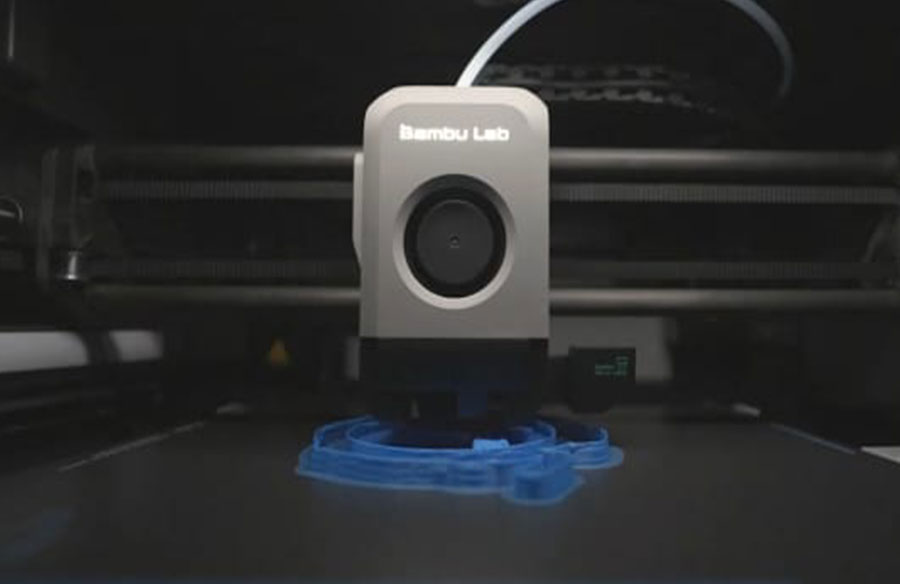
Bambu Lab P1S may be taken by FDM users as the best choice for printing in high resolution. Nevertheless, when you require a resin entry-level choice, then the Saturn 4 Ultra is the right choice for you. Similarly, models like Form u3+/Origin Two are best suited to professionals or business leaders.
The following table highlights the features for our top picks.
| Bambu Lab P1S | Elegoo Saturn 4 Ultra | Formlabs Form 3+ | Stratasys Origin® Two | |
| Price | $549.00 | $339.00 | $1,749 (Refurbished) | ~$100,000 |
| Technology | FDM | LCD (MSLA) | SLA | DLP |
| XY Resolution | – | 19 × 24 µm (12K LCD) | 25 µm | 38.5 µm |
| Layer Thickness (Z) | 60-560 μm | 10–200 μm | 25-300 μm | 25-200 µm |
High-Resolution 3D Printers for Daily Use
Bambu Lab P1S (FDM)
The all-new Bambu Lab P1S is the best FDM 3D printer available in the market, featuring a high-speed CoreXY system and a fully enclosed frame for stable, high-quality printing. It supports layer heights as low as 60 μm, delivering smoother surface finishes.
It is a high-end machine that has a high level of vibration compensation and suits engineering parts and designing prototypes.
In that way, in case you are interested in accuracy and quality, it is the first option. This high-resolution 3D printer is based on FDM, and it is impossible to find another machine that is more precise.
Elegoo Saturn 4 Ultra (LCD / MSLA)
Apart from Bambu Lab P1S, there is also Elegoo Saturn 4 Ultra. Offering exceptional detail, high resolution, and smooth product surfaces, this option is the most reasonable one. In case you were wondering how to step into high-resolution resin printing, this is your way in.
With a 12K monochrome LCD, a large build volume, and high-speed resin curing, this device is perfect for creating miniature models and for those who have made 3D printing into a hobby.
Formlabs Form 3+ (SLA)
Perfection comes in various sizes and shapes, and in 3D printing, it comes with Formlabs Form 3+. Even though it is costlier than other options, it is an easy-to-use, premium 3D printing system. The output is always of high quality, making it a profitable investment for anyone.
Apart from quality, the Form 3+ Low Force Stereolithography 3D printer includes all the essential tools required for printing. One can create end-to-end solutions for teams, scale production, and generate better prototypes, thanks to this advanced setup.
In other words, it has a professional material ecosystem that supports consistency, accuracy, and reliability. Thus, making it the best choice for dental labs, business setups, and engineering firms.
Stratasys Origin® Two (DLP)
Another high-resolution 3D printer is the Stratasys Origin® Two. Coming to its specifications, you get programmable photopolymerization (P3), ultra-precise DLP projection, and industrial-grade material support.
For individuals who wish to have an exceptional surface quality in their product or want to support mass production, this option is a godsend.
The highly controlled printing setup is near perfection and ideal for manufacturers or enterprise owners who need to create prototypes and machinery parts on a daily basis.
Crucial Factors Impacting 3D Printing Resolution
Technology is a crucial aspect of 3D printing, but other factors also need to be considered.
- Materials: When considering FDM printing, higher-quality filaments produce better layers and sharper objects. Conversely, inferior filaments lead to irregularities. Similarly, the resin’s composition affects the final product in resin printing.
- Nozzle Size: For FDM printers in particular, the nozzle size is equally important for resolution. Smaller nozzles aid in capturing minute details and producing intricate geometries. Even though it increases production time, the resolution is higher.
- Frame Stability: This impacts accuracy because an unstable frame results in poor designs. Only by using a rigid metal frame can one maintain accuracy.
- Slicing Settings: Although they are frequently overlooked, slice settings are crucial for preserving consistency and quality. If slicing parameters are not taken care of, even the best high-resolution 3D printers can create defective objects.
Pros and Cons of High-Resolution 3D Printing
As told earlier, the right kind of 3D printer can do wonders for you, but a poorly selected machine is equivalent to wasting your hard-earned savings.
Amongst the advantages of 3D professional printers, we have high-quality outputs and remarkable surface detail. These printers allow you to create intricate designs with precision. Further, these prove to be a strong support for your business needs.
Still, high-end models take a longer time to produce each item. That means you will need to dedicate more time and money. So, carefully analyze both sides.
Conclusion
The 3D printer is a complex option to select, and once you understand the intended use, the selection becomes easy. As an example, when discussing FDM technology, such solutions as Bambu Lab P1S can be regarded as the best. On the other hand, resin users should pick Saturn 4 Ultra. No matter what your choice might be, always carry out some research.