The first time Devashree Shah noticed how a street could quietly adapt, it wasn’t in a master plan or a policy paper. It was a narrow lane pressed between a train line and an old housing block, where a tea vendor had nudged his cart to make space for a wheelchair. No signage, no standards, just an unspoken act of spatial empathy.
That moment didn’t just stay with her. It became a lens.
“Mumbai constantly negotiates density and scarcity through improvisation, repair, and collective intelligence,” Shah says. “It taught me that design isn’t just about form-making, it’s about response.”
Today, as an architect, researcher, and inclusive design strategist, Shah brings that same sensibility into large-scale civic and cultural projects. But instead of adjusting spaces on the fly, she builds systems that make inclusion structural, not situational.
Architecture That Listens
At the Institute for Human Centered Design (IHCD), Shah leads inclusive design strategies across public transit networks, academic campuses, and high-profile cultural institutions. The names are often under NDA, but the ambition isn’t.
Her work doesn’t begin with ramps or signage. It starts with rethinking how design decisions get made in the first place.
“Each project becomes a negotiation between data and empathy, precision and perception,” she says.
That negotiation is reflected in frameworks that translate inclusive research into practical tools, guidelines, evaluative systems, and policy briefs. In other words, it’s not just about whether a space is technically accessible. It’s about whether the process that created it was equitable.
Shah’s role is part strategist, part translator. She helps clients move beyond compliance toward design that’s both measurable and meaningful, where accessibility is seen as a generative force, not a constraint.
Designing in States of Transition
Shah’s work doesn’t stop at the project scale. She is also a co-author and co-curator of Architectures of Transition, a book and exhibition series developed within The State of Architecture in South Asia, a larger research initiative exploring contemporary practice across the region. Through this project, she has helped shape one of the most vital platforms for architectural discourse, spanning cities from Delhi and Kochi to Karachi, Kozhikode, and soon Kabul.
Spanning cities like Delhi, Kochi, Karachi, Kozhikode, and soon Kabul, the project asks pointed questions:
What kinds of architectural practices are emerging in regions shaped by economic and ecological strain?
What new forms of architectural agency do those realities demand?
Rather than offering a singular narrative, the project gathers diverse voices from Afghanistan to Sri Lanka to explore how architecture can operate as a form of care, adaptability, and negotiation.
“It’s not about forecasting trends,” Shah explains. “It’s about listening to the conditions that shape design decisions and the people who live with their outcomes.”
This is not just theory. The traveling exhibition has evolved into an ongoing archive and conversation, blurring the line between academia and practice. You can explore more at SOA South Asia.
Systems Built for Real Life
Inclusive design is challenging to quantify and even more complex to institutionalize. It deals with experiences that don’t always show up in the data: the hesitation before entering a space, the way a gesture can replace signage, and the memory of being excluded.
Shah’s strength lies in navigating this gap.
She draws from adaptive reuse, cross-cultural pedagogy, and systems thinking. Her work seeks points of entry where inclusive principles can shape a project early, not as retrofits, but as foundational elements. She helps clients shift their questions from “Is this compliant?” to “Who might we be forgetting?”
This shift mirrors a broader evolution in the field. A 2022 study in The Journal of Inclusive Design found that projects incorporating accessibility from the start not only resulted in higher user satisfaction but also lower long-term costs and fewer redesigns. Design that listens early doesn’t just work better, it lasts longer.
Future-Building in the Global South
Shah’s next horizon is clear: contributing to the growing discourse on inclusive design across the Global South, where questions of accessibility, housing, and climate resilience often intersect, but rarely get addressed together.
She’s focused on creating frameworks that are locally rooted but globally informed tools that institutions, educators, and policymakers can use to embed inclusion across everyday design practices.
“Inclusion isn’t a specialty,” she says. “It’s a shared cultural responsibility.”
And that includes reshaping design education itself. Through teaching and cross-sector collaboration, Shah is helping equip the next generation of designers with more than just skill; they’ll need empathy, fluency across disciplines, and a willingness to work with complexity, not avoid it.
Designing for Participation, Not Perfection
One of the most compelling aspects of Shah’s practice is how she redefines the architect’s role not as the ultimate problem-solver, but as a facilitator of participation.
“Architecture isn’t about controlling outcomes,” she says. “It’s about creating conditions where different kinds of lives can unfold.”
In a profession that often celebrates singular vision or aesthetic control, Shah’s approach feels quietly radical. Her frameworks invite messiness, dialogue, and redefinition. Whether working on a transit hub or an academic institution, she builds systems that are less about universal solutions and more about shared authorship.
This philosophy isn’t just theoretical. It shapes how she engages with clients, communities, and collaborators. By shifting the conversation from “designing for” to “designing with,” Shah fosters environments where feedback isn’t a formality, it’s embedded in the process’s DNA.
The Takeaway
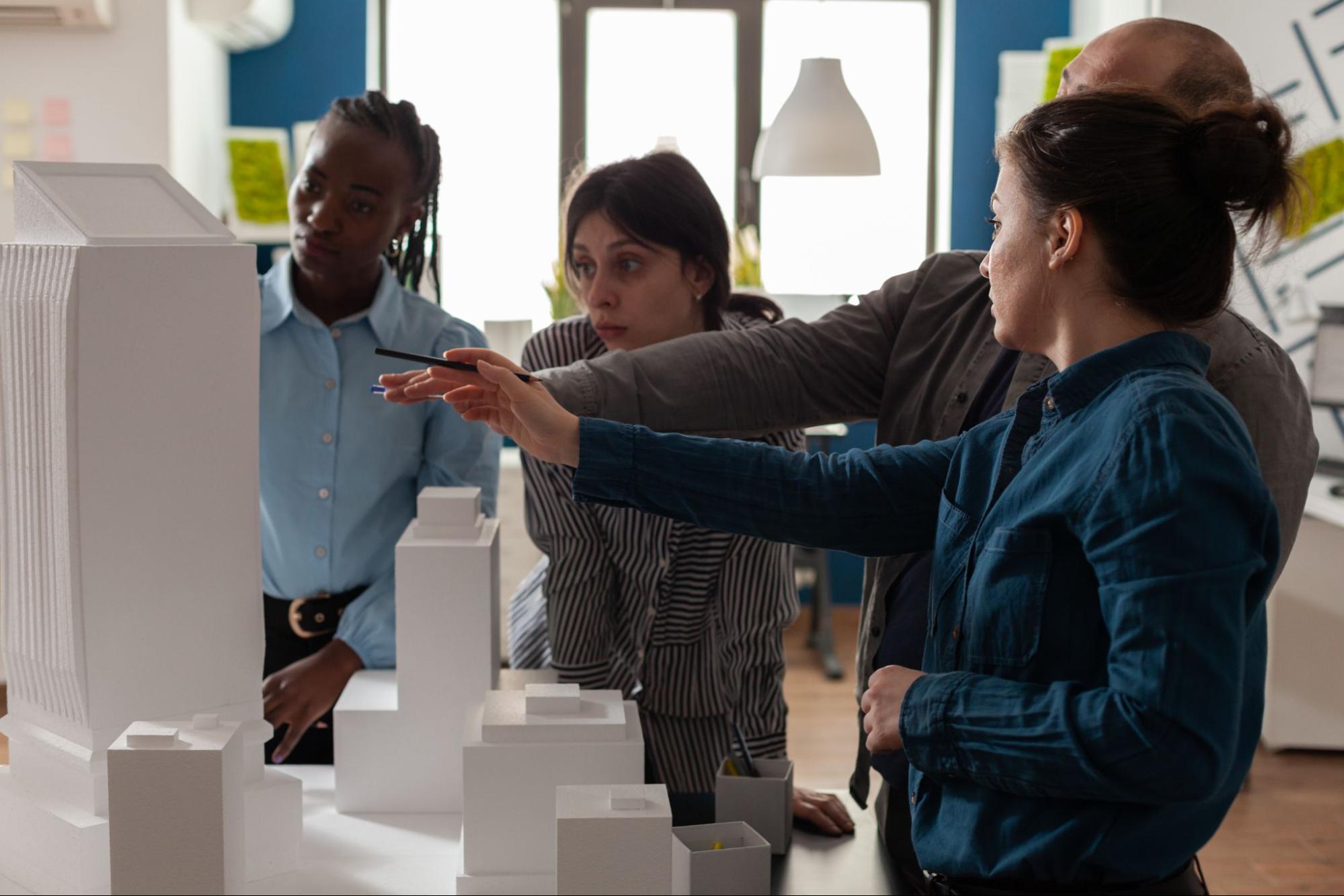 If you’re a young architect, a researcher, or a policymaker thinking about equity not as a checkbox but as a guiding principle, Shah’s work offers more than inspiration. It provides a roadmap.
It’s a shift in how we ask questions. From “How do we make space for others?” to “What happens when we build the space around them?”
And, somewhere in that reframing, we can begin to imagine a profession where care and complexity are no longer separate ideas but the exact blueprint. Want to embed inclusion in your design practice from day one? Learn from leaders like Devashree Shah, who are turning accessibility into a systems-level strategy. Explore more features on Re-thinking The Future.
Whether you’re rethinking a public space, drafting campus guidelines, or reshaping cultural policy, Shah’s work is a reminder that inclusion isn’t a destination; it’s a design process. One that demands attentiveness, collaboration, and a willingness to ask harder, better questions from the very beginning.
Aanya Mehta
Aanya Mehta is a design writer and strategist with a background in architecture and a passion for spatial justice. She explores the intersections of equity, urban form, and cultural identity through essays, profiles, and research-led storytelling. With experience in both design studios and editorial spaces, Aanya is interested in how architecture can move beyond aesthetics to become a tool for participation, empathy, and systems change.