The conversation around comprehensive tree removal services and strategic tree removal planning has evolved far beyond chainsaws and dump trucks. Picture this: sensors embedded in tree trunks communicating real-time health data to city planners, artificial intelligence predicting which street trees will survive the next heat wave, and drone networks mapping entire urban canopies in hours rather than months. This isn’t science fiction anymore. It’s happening right now in cities worldwide, transforming how architects, planners, and urban designers approach green infrastructure as integral elements of the built environment.
The Digital Forest Awakens
Urban trees have historically been managed with clipboards, eyeballs, and intuition. The process resembled wildlife photography more than modern infrastructure management. Someone would walk through a neighborhood, squint at a maple, scribble notes about its condition, and move on. Then, months later, when that tree decided to audition for a role in a disaster movie during a storm, everyone acted surprised. Strategic tree management requires a fundamentally different approach, one that architecture and planning professionals are now championing as essential to resilient urban design.
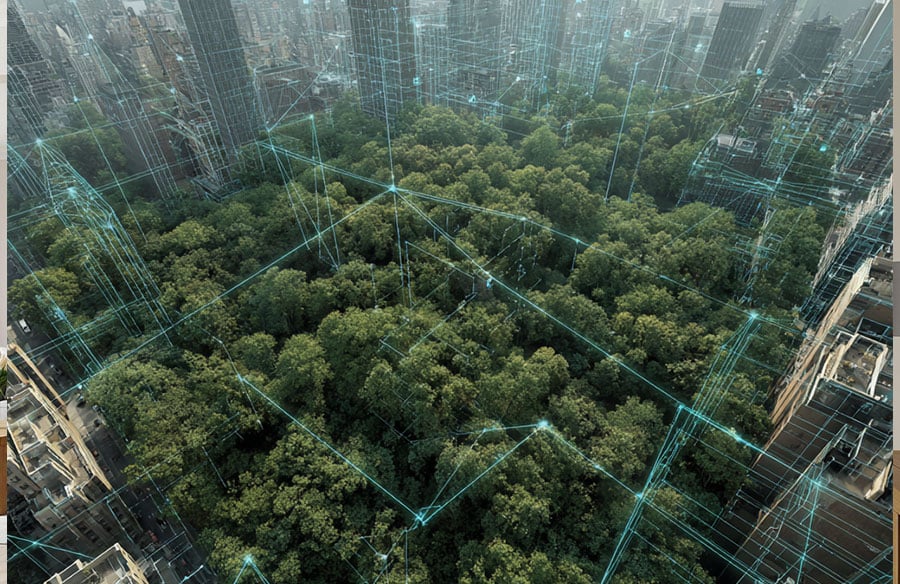
Enter the Internet of Trees. Seriously, that’s what some researchers call it. Wireless sensor networks now monitor everything from soil moisture to trunk stability, creating vast datasets that reveal patterns invisible to traditional observation. These systems represent a convergence of IoT technology with ecological stewardship, turning every tree into a data point in a living, breathing smart city ecosystem. For architects designing developments and urban planners mapping green corridors, this technology provides unprecedented insight into how vegetation performs within built environments.
The transformation mirrors broader shifts in how we conceptualize urban nature. Trees are no longer just decorative elements or afterthoughts in site plans. They’re critical infrastructure deserving the same analytical rigor we apply to electrical grids or transportation networks. When you’re designing a mixed-use development in a dense urban core, understanding which tree species will thrive given local microclimates, soil conditions, and projected climate shifts becomes as important as understanding load-bearing calculations.
Predictive Intelligence Reshapes Urban Forestry Decisions
Machine learning algorithms now predict tree mortality with startling accuracy. Feed them data about species, age, location, soil chemistry, and historical weather patterns, and they’ll tell you which trees need intervention before symptoms appear. It’s like having a crystal ball, except this one runs on Python instead of mysticism. Cities implementing these systems report 40 percent reductions in emergency responses and dramatic improvements in canopy retention.
Sustainable tree care benefits enormously from this predictive capacity. Rather than reactive maintenance that addresses problems after they’ve escalated, urban forest managers can allocate resources strategically. For architecture firms incorporating extensive landscaping into their projects, this means designing with confidence that planted trees will mature as intended, delivering promised cooling effects, stormwater management, and aesthetic benefits decades into the future.
The technology extends beyond individual tree health monitoring. Advanced remote sensing platforms now map entire urban forests at centimeter-level resolution. LiDAR-equipped drones and satellites using multispectral imaging can assess canopy structure, identify species composition, and detect stress indicators across thousands of hectares. This bird’s-eye intelligence transforms planning processes. Instead of abstract concepts about “green coverage,” designers work with precise inventories showing exactly where canopy gaps exist, which neighborhoods lack cooling tree cover, and where new plantings would deliver maximum impact.
Real-Time Monitoring Transforms Intervention Strategies
Traditional tree inspection meant someone climbing a ladder once every few years. Now, continuous monitoring systems track structural integrity 24/7. Strain gauges detect microscopic movements indicating root failure risk. Acoustic sensors identify internal decay by analyzing how sound waves travel through wood. Think of it as giving trees annual physicals but doing so every second of every day.
This constant vigilance particularly matters in high-density environments where tree failure poses significant risks. An unstable oak in a suburban park is one thing. That same tree overhanging a pedestrian plaza or adjacent to glass-walled office buildings requires different risk calculus. Real-time alerts enable intervention before catastrophic failure, protecting both public safety and substantial property investments.
The monitoring revolution extends to environmental performance metrics. Sensors quantify exactly how much carbon a specific tree sequesters, how many gallons of stormwater its canopy intercepts during rainstorms, and its precise cooling effect on surrounding microclimates. For architects pursuing LEED certification or similar sustainability benchmarks, this granular data transforms vague green infrastructure claims into verifiable performance metrics. You can literally prove that the trees you specified are delivering X tons of carbon reduction and Y degree temperature moderation.
Biotechnology Enters the Urban Canopy
Genetic research is producing tree cultivars specifically engineered for urban resilience. These aren’t your grandfather’s oaks. Scientists select for traits like pollution tolerance, drought resistance, compact root systems that won’t destroy sidewalks, and accelerated growth rates. Some varieties even exhibit enhanced carbon sequestration capabilities, essentially optimizing photosynthetic efficiency beyond what nature alone achieved.
For urban planners working decades into the future, this matters enormously. Climate projections suggest many current street tree species will struggle in conditions expected by 2050. Planting trees today that we know will fail creates orphaned infrastructure, negating upfront investment and leaving communities without critical green coverage exactly when they’ll need it most. Selecting climate-adapted species and cultivars based on rigorous scientific data rather than historical precedent becomes essential.
The technology here intersects fascinatingly with design aesthetics. Traditionally, landscape architects selected trees primarily for visual qualities, growth habits, and seasonal interest. Now, those aesthetic considerations merge with performance specifications resembling mechanical engineering. Does this cultivar’s canopy architecture provide optimal shade geometry for the building orientation? Will its root system integrate with proposed underground utilities? Can it withstand projected wind loads in this microclimate? These questions transform tree selection from art into science, or rather, into artful science.
Citizen Science Amplifies Professional Expertise
Crowdsourced data collection platforms enable residents to document tree health through smartphone apps. Snap a photo of suspicious leaf spots, and AI identifies the pathogen. Report a leaning tree, and the alert routes automatically to municipal arborists. This democratization of urban forest stewardship creates networks of engaged observers complementing formal monitoring systems.
The implications for community-engaged design processes are profound. When residents actively participate in monitoring urban forest health, they develop deeper connections to green infrastructure investments. This heightened awareness translates into political support for sustained funding and reduced vandalism or destructive behavior. Architects designing public spaces can leverage these platforms, creating built environments that facilitate rather than hinder citizen observation and engagement.
Some cities have gamified tree care, awarding points and badges for documented observations. It sounds gimmicky until you realize Portland’s tree monitoring app has logged over 50,000 observations in two years, detecting dozens of invasive pest infestations before professional surveys would have identified them. The collective intelligence emerging from these networks rivals or exceeds traditional surveillance systems at a fraction of the cost.
Augmented Reality Transforms Planning Visualization
Imagine standing on a vacant lot and seeing through AR glasses exactly how mature trees will look twenty years post-planting. Not artist renderings, but scientifically accurate projections based on species growth rates, local conditions, and climate trajectories. This technology already exists, transforming how clients and communities engage with proposed developments.
For architects presenting projects to planning boards or community stakeholders, AR visualization of future canopy overcomes abstract conceptualization challenges. People understand what they can see. Showing them the actual cooling effect, visual screening, and aesthetic transformation trees will deliver makes green infrastructure investments tangible rather than theoretical. Approval rates for projects with strong green components increase when stakeholders can literally experience proposed outcomes.
The visualization extends beyond static imagery. Time-lapse simulations show seasonal variations, growth progression, and performance under different climate scenarios. Designers can demonstrate how tree placement interacts with building shadows, how canopy evolution affects solar panel performance, or how root systems will navigate underground utility corridors. This multi-dimensional planning capability reduces costly design errors and optimizes spatial relationships between buildings and vegetation.
Integration Challenges Demand Interdisciplinary Solutions
Despite technological advances, implementation barriers persist. Municipal governments struggle with budget constraints, legacy infrastructure systems, and institutional inertia. Many cities lack IT infrastructure supporting IoT sensor networks. Others face data governance challenges around privacy, access, and interoperability between systems. The technology exists, but social and institutional frameworks lag behind.
Education gaps compound these challenges. Traditional forestry and arboriculture programs rarely emphasize data science, programming, or advanced spatial analysis. Conversely, tech professionals often lack ecological literacy. Creating truly smart urban forests requires professionals fluent in both domains, bridging between computer science and biological sciences in ways few training programs currently support.
For the architecture and planning professions, this represents both challenge and opportunity. Practitioners who develop competency in these emerging technologies position themselves as essential partners in smart city development. Understanding how to specify IoT-enabled landscaping, integrate sensor networks into site designs, and translate ecological data into spatial planning decisions becomes a competitive advantage.
The Path Forward: Synthesis, Not Substitution
Technology enhances rather than replaces human expertise. The arborist still needs to interpret data, assess context, and make nuanced decisions no algorithm can replicate. Sensors detect trunk movement, but experienced professionals determine whether that movement indicates failure risk or normal adaptation. AI identifies disease patterns, but certified specialists prescribe treatment protocols considering site-specific factors.
This human-technology partnership mirrors broader trends in built environment professions. BIM didn’t eliminate architects; it empowered them with better tools. Similarly, urban forestry technology amplifies rather than diminishes human capabilities. The professionals thriving in this new paradigm embrace technology while maintaining deep ecological knowledge and field experience.
Looking ahead, the convergence of artificial intelligence, IoT monitoring, genetic research, and citizen science promises urban forests more resilient, better integrated with built infrastructure, and quantifiably more valuable than current tree populations. For architects, planners, and designers committed to creating sustainable, livable cities, understanding and leveraging these technologies isn’t optional. It’s foundational to practicing in an era where green infrastructure equals gray infrastructure in importance and sophistication.
The future of urban tree management isn’t about choosing between nature and technology. It’s about synthesizing both, creating urban forests that are simultaneously more natural, more resilient, and more intelligently managed than anything previous generations imagined possible. The silicon doesn’t replace the chlorophyll. It ensures the chlorophyll thrives where we need it most.