The Story

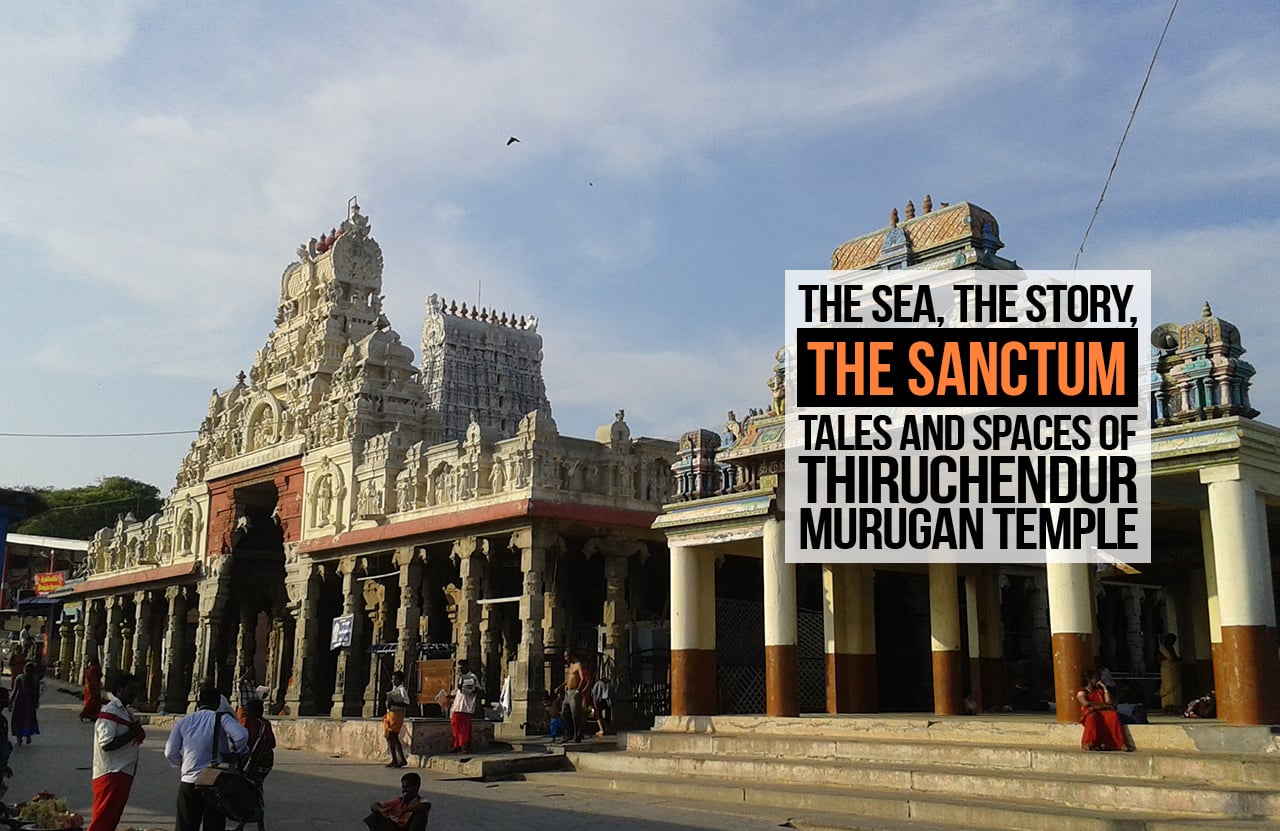
Dwelling from memory, place, people, and culture, the pivotal aspects of mythology still play a vital role. These contexts give birth to entities, and here, it emerges as a story — the story of Murugan slaying Surapadman.
Once upon a time, long, long ago, the demon Surapadman was a fearsome tyrant. Empowered by a boon of strength, he had seized control over the three worlds, inflicting great hardship upon the celestial beings, the Devas. To liberate the cosmos from Surapadman’s reign, the Devas appealed to Lord Shiva. In response, Lord Murugan was manifested with the sole, divine purpose of confronting the demon.
The two fought a massive battle at the seashore of Thiruchendur. Murugan defeated Surapadman with his divine spear, the Vel. Seeking mercy, the demon surrendered, and Murugan transformed the two halves of his being into objects of eternal service: a peacock, his permanent mount (vahana), and a rooster, which adorns his banner.
To sanctify this victory, Murugan commanded the celestial architect, Mayan, to construct a shrine at that exact coastal location, in gratitude to his father, Lord Shiva. Thus, Thiruchendur Murugan Temple was born out of an event, a story, and a place — when myth became site.
Site, Orientation and Axiality
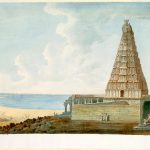
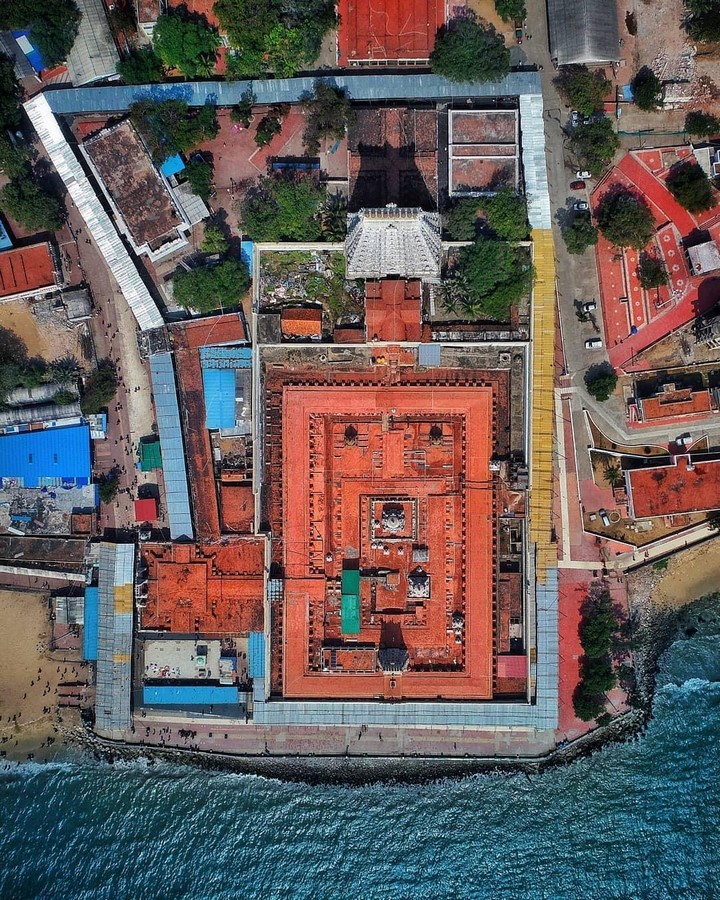
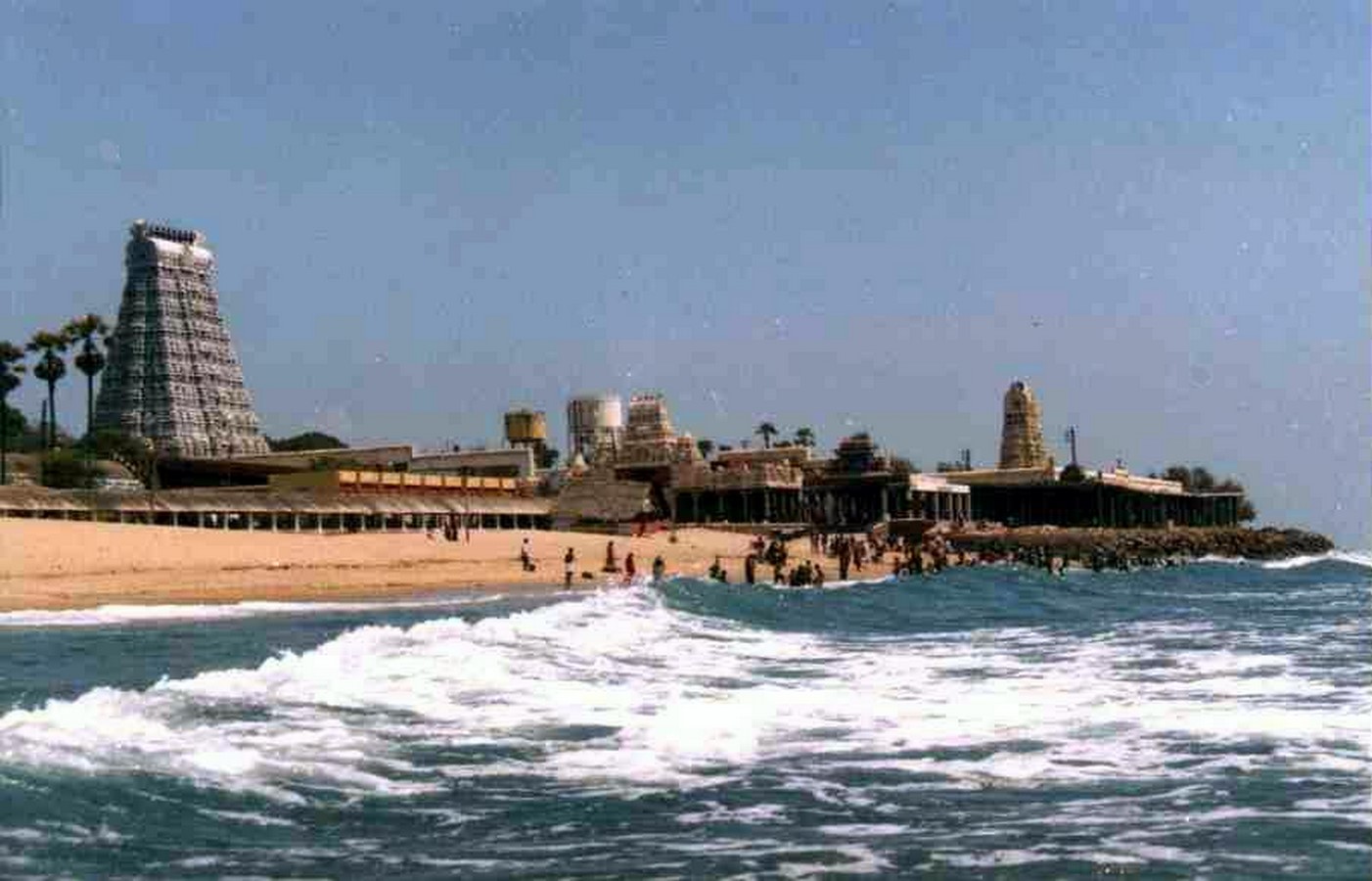
Tiruchendur’s principal architectural claim is its coastal siting. Unlike most of the Six Abodes (Āṟupadai Veedu), which occupy hilltops, Tiruchendur’s sanctum opens directly to the Gulf of Mannar. This immediate contact with the sea defines the temple’s spatial logic: the principal axis runs from the sea across the forecourt into successive prakarams (enclosures) and culminates in the garbhagriha (sanctum), where the deity is housed in a cave-like recess.
That axial procession — beginning from the sea (the notion that everything starts from the sea), then the forecourt, successive mandapas, and finally the sanctum — stages ritual movement. This choreography allows enactments such as Surasamharam (the slaying of Surapadman) and other seaside rites to unfold seamlessly. The temple is not only a beacon of devotion but also a cultural and architectural marvel, integrating myth, memory, and community life.
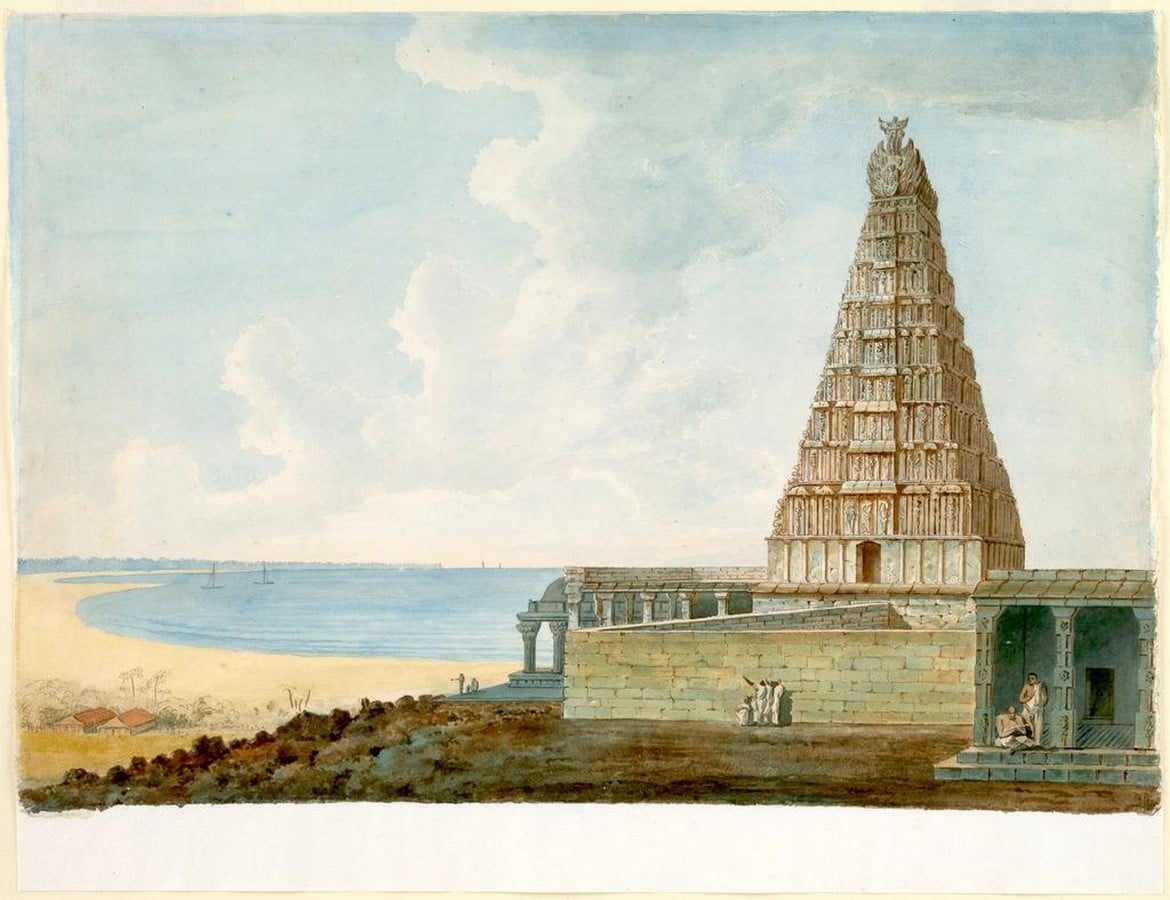
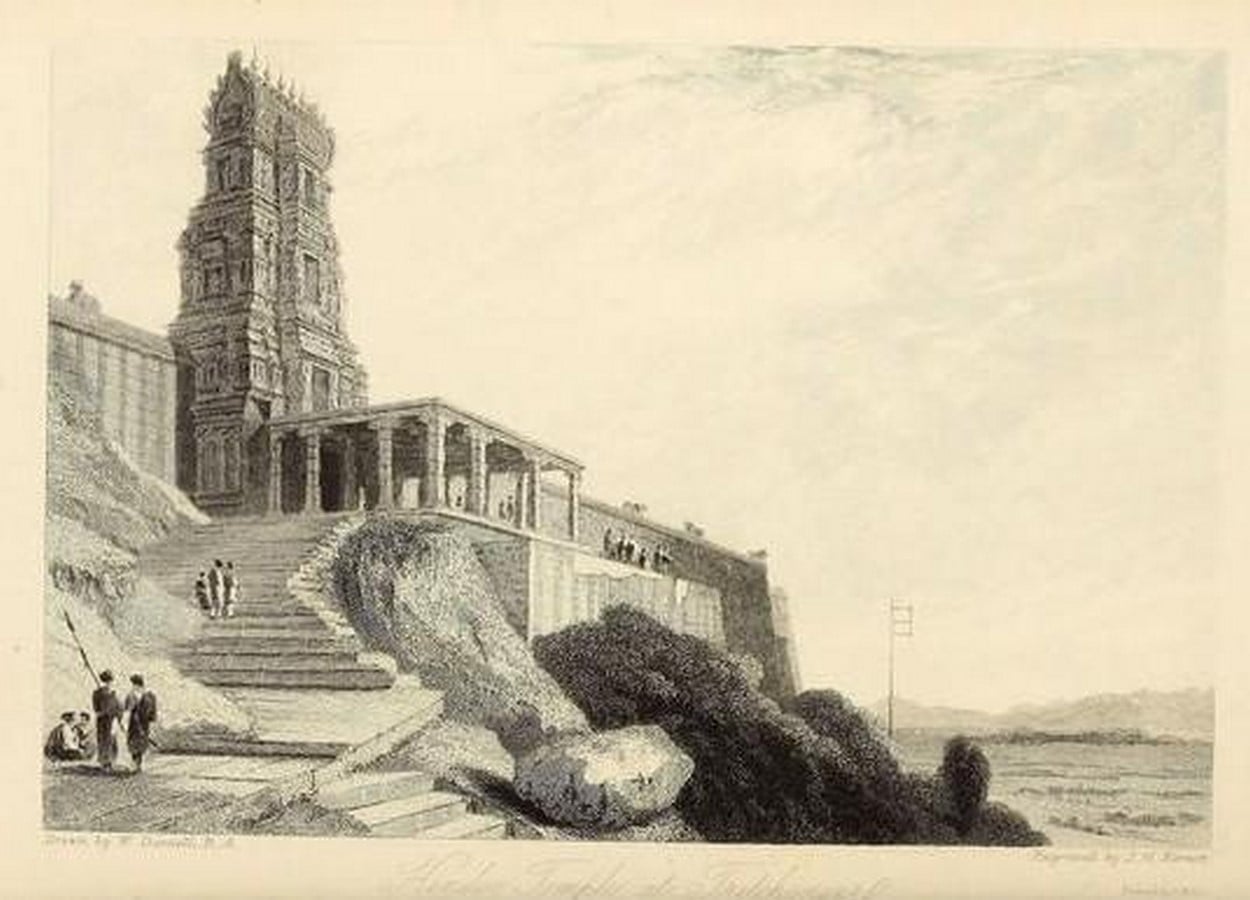
Artist: Elisha Trapaud
Credit: British Library Archive
Design and Planning
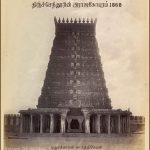
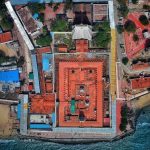
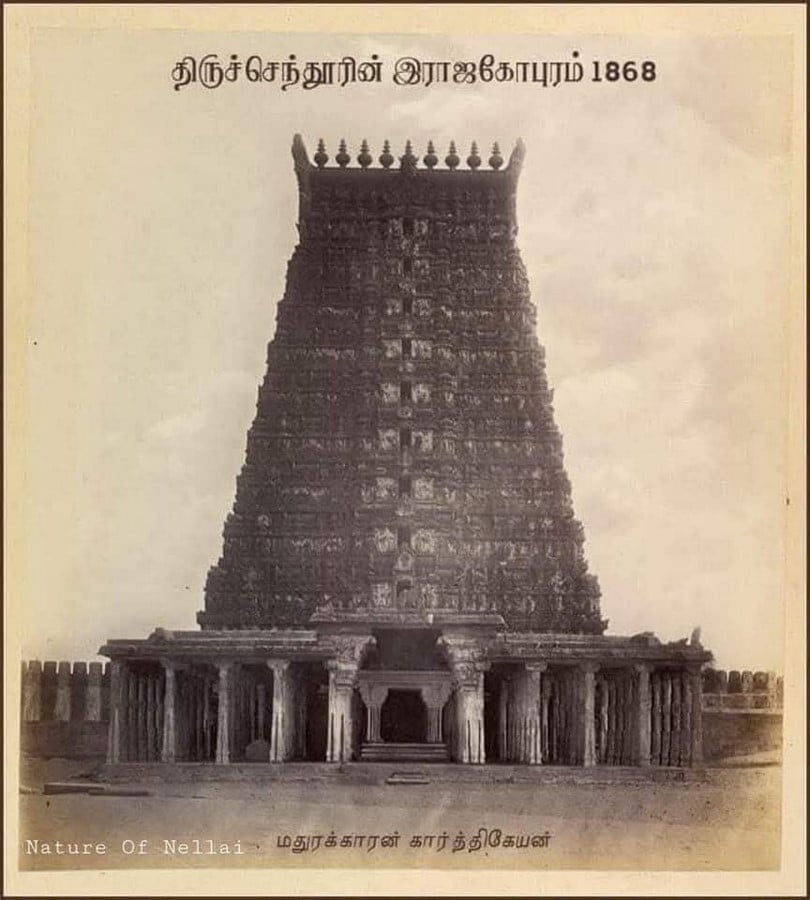
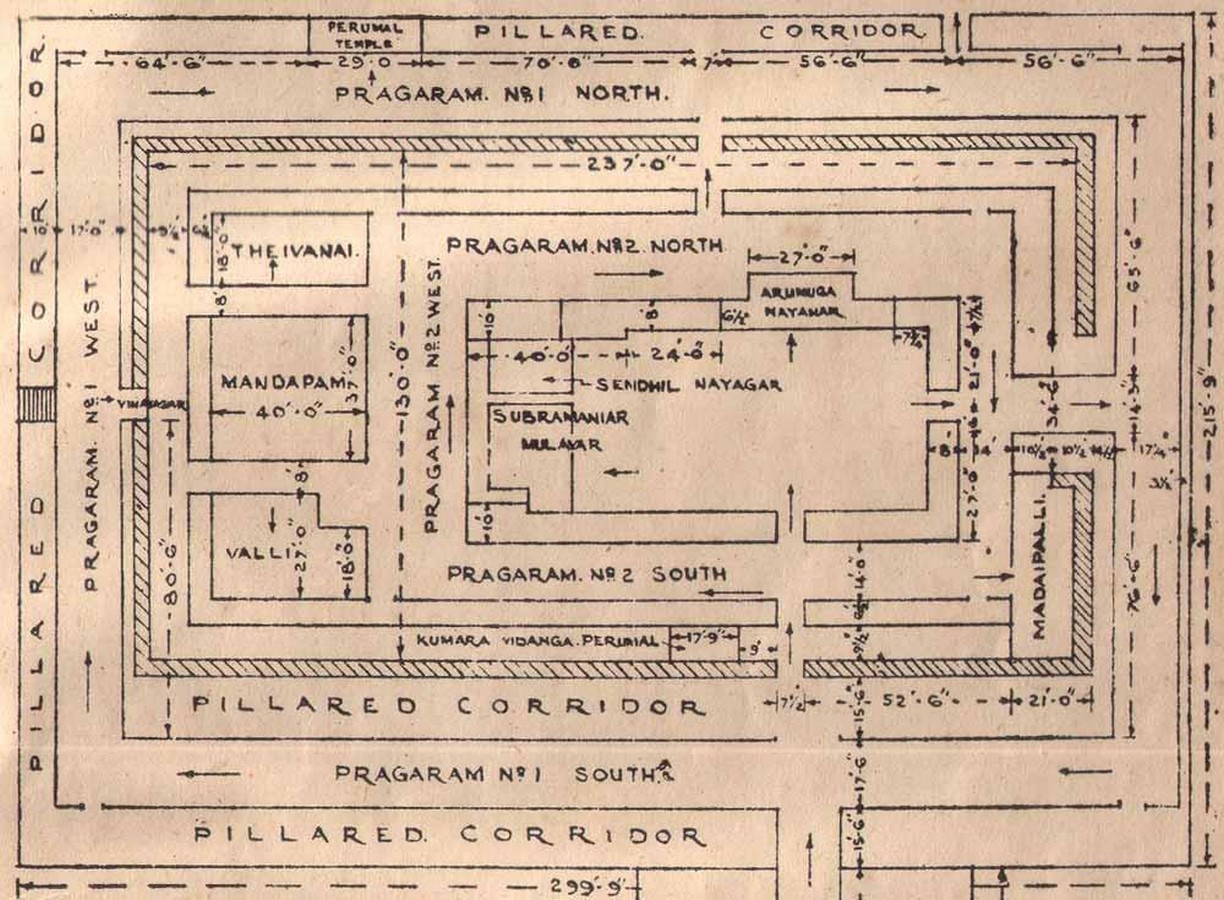
The temple’s history dates back over 2,000 years, as referenced in Tamil literature. The temple complex spans 299 feet north–south and 213 feet east–west, following the Dravidian style of temple planning. Its seven-tier gopuram (138 feet high) serves as a monumental gateway, richly adorned with carvings depicting episodes from Murugan’s mythology.
The spatial design supports ritual practices such as processional paths, re-enactments of Surasamharam, and annual festivals like Kanda Sasti, when over a million devotees gather, turning the temple into a performative urban stage.
Sequencing and Thresholds
The temple is organised as a series of thresholds. The monumental rajagopuram frames the pilgrim’s approach; inner mandapas and pillared halls reduce scale and redistribute light; and the final cave-like sanctum creates intimacy, accentuated by gradations of light and sonic enclosure.
The Avast (or Seeveli) mandapam — a broad, pillared hall with 124 carved columns — offers both glimpses of space and a stage for ritual gatherings. The repetition of column bays, the rhythm of vaults, and the shadows they cast orchestrate movement and waiting, so pilgrimage becomes a spatialised narrative. The broad seaward forecourt is designed for mass gatherings and processional spectacle, enabling simultaneous viewing, collective movement, and anticipation of the choreographed climax.
Materiality and Construction Logic
Structurally, the temple employs local hard stones — granite and sandstone — chosen for durability and sculptural capacity. Blocks are laid in coursed masonry with carefully dressed joints; sculptural carving is executed in situ or on pre-dressed blocks, creating an integrated surface of relief narrative and structure.
The heavy stone mass and low-slung plinth resist hydrodynamic forces, but the temple nevertheless contends with saline spray and monsoonal winds. Recent geo-technical studies confirm ongoing erosion pressures and recommend marine protection works to shield the temple’s foundations — an issue that continually shapes maintenance, repair, and conservation strategies.
Historically, inscriptions reveal contributions from the Pandya and Nayak dynasties, cementing its role as a site of continued royal patronage and community resilience.
Spatial Atmospheres: Light, Sound and Water
Tiruchendur’s coastal location produces a distinctive sensory regime. Light arrives from the seaward side, washing the forecourt in strong, directional brightness before softening through the colonnades into dimmer interiors. This gradation marks the transition from public to sacred, tangible to intangible.
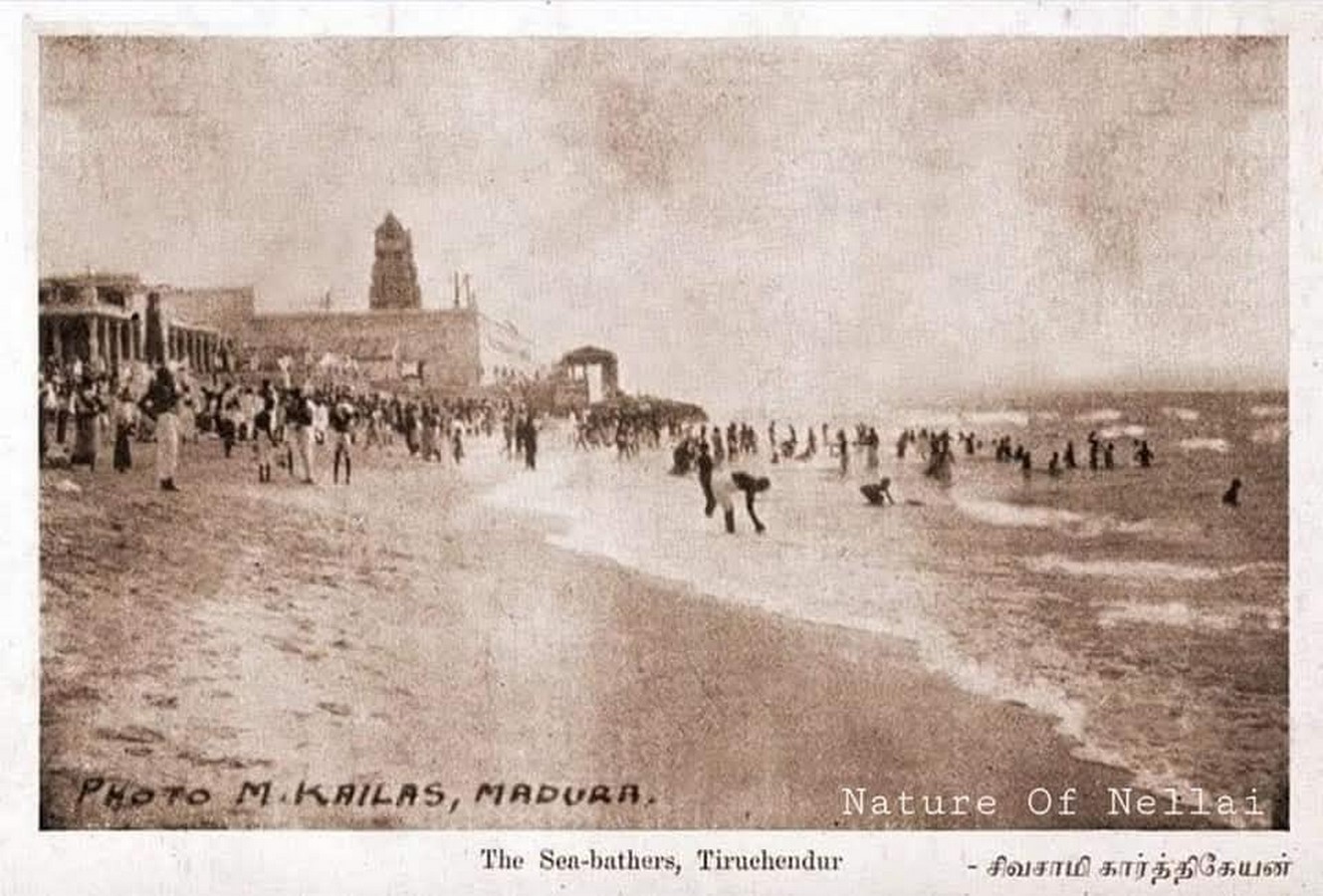
The sea’s ambient sound becomes part of the ritual acoustics (waves, wind, calls of vendors), layered with mantric chanting and drums. The pillared halls amplify certain frequencies while sheltering the inner sanctum. The Naali Kinaru (a freshwater spring/well) near the temple enriches the ritual topography: sea-bathing, well-cleansing, and shrine visitation form a sequence of water-based thresholds that embody devotion.
Urban Integration and Morphological Imprint
The temple’s spatial grammar — its processional axes, thresholds, and forecourts — has shaped the town’s morphology. Acting as a dense container of spatial memory, streets, market typologies, and lodging clusters align to processional routes. Seasonal spikes in population during festivals are absorbed by the scale and permeability of adjacent open spaces.
The temple acts as an urban generator: its spatial needs (storage for festival paraphernalia, chariot routes, vendor zones) have produced an urban choreography that repeats annually, reinforcing memory, economy, and identity.
A Memory of the Story
Born from the profane event of battle, the temple stands as a landmark of good triumphing over evil. Its spatial anchor formulates place-identity and layers of lived practice. Believed to be one of the most miraculous sites — where wishes are granted — it remains both a spiritual and architectural marvel, withstanding natural disasters and climate challenges.
Here, the city’s memory was generated around an urban artefact that holds both story and place. Today, conservation challenges — erosion, saline decay, increasing pilgrimage loads — make Tiruchendur a vital case for adaptive conservation: one that preserves not just fabric, but also ritual function. An architecture that must continue to be lived in order to remain meaningful.
References:
- Arulmigu Subramanya Swamy Temple, Tiruchendur. (n.d.). Retrieved from https://en.wikipedia.org/wiki/Subramaniya_Swamy_Temple%2C_Tiruchendur
- Thiruchendur Murugan Temple: A Historical Overview. (n.d.). Retrieved from https://www.cottage9.com/blog/thiruchendur-murugan-temple-a-historical-overview/
- Thiruchendur Murugan Temple: A Complete and Detailed Guide. (2025, April 27). Retrieved from https://blog.dharmikvibes.com/p/tiruchendur-murugan-temple-a-complete-gide
- Thiruchendur Temple – An Ancient Architectural and Geo-Technical Marvel. (n.d.). Retrieved from https://theverandahclub.com/article/thiruchendur-temple-an-ancient-architectural-and-geo-technical-marvel-747
- Sacred Splendor: Exploring Thiruchendur Temple Wonders. (2025, April). Retrieved from https://hinduculturehub.com/temples/thiruchendur-temple/