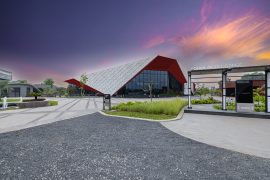

A key design challenge in the Pyeongtaek Administrative Complex was preserving the 12-meter pedestrian path that cuts through the site. Instead of treating it as a constraint, the design elevated it to a central organizing element.
Project Name: Pyeongtaek Administrative Town
Studio Name: Kalbod Studio

City Hall and the City Council buildings were placed on opposite sides of the path, and a sunken circular courtyard was created beneath it, turning the path into a viewing bridge—an elevated space for movement, pause, and contemplation. The project uses architecture as a lens for reinterpreting urban life. The path becomes more than circulation—it serves as a spatial threshold between civic programs and the broader city.
The complex invites the city inward. Narrow corridors and alley-like passages extend the urban pedestrian flow into interior spaces, softening the boundary between inside and outside. This spatial porosity improves microclimate conditions and enables a clear, adaptable organization of functions.

Building placement responds to the urban context: City Hall lies in the north, close to public transit; the City Council in the southeast with separate access; and a daycare beside the city park. Altogether, the complex fosters a civic landscape—open, permeable, and integrated with the rhythms and needs of the surrounding environment.
The landscape design of the Pyeongtaek Administrative Complex establishes a connection between ecological concerns and infrastructural strategies. This integration has produced a resilient and vibrant ground plane that improves the microclimate and enhances spatial quality. By incorporating pedestrian pathways, bicycle stations, and parking areas for electric vehicles and individuals with limited mobility, the design addresses both social and environmental dimensions of sustainability.

The project connects with its natural surroundings through urban stormwater management and the use of native woodland and wetland vegetation. Light and greenery penetrate the underground levels through the central courtyard, enhancing the atmosphere of spaces that are often neglected in conventional designs.

This project is not merely a collection of buildings—it is an effort to create an urban environment that breathes, flows, and belongs to the people.