Buildings fill cities, but people bring them to life. Spaces hold meaning when someone walks through a door, rests on a bench, or looks out a window. Brenda Laurel said it best: “A design isn’t finished until someone is using it”, while Jane Jacobs proposed the idea of “many eyes and activities on the street” as conditions to make cities safer and livelier.
But, what happens when cities seem to be more about glass towers and aesthetics than life itself?
Anabella Acevedo Peña, a forward-thinking architect with expertise in urban design and technology, continuously addresses this question in her work. She is committed to looking for solutions that contribute to shape a dynamic future, where cities not only adapt to emerging challenges, but also unlock their true potential to solve some of the world’s most pressing issues.
New York City has given her the space to push these ideas further. Anabella’s work blends innovative design and future-thinking solutions with social impact. Her expertise in architectural design and sustainability has been developed over the years of both studies and work experience, while her interdisciplinary research embraces urban planning, futurability and housing innovation as her main interests. Anabella deeply believes that architecture can evolve through exploring new technologies and innovative solutions, aiming to shape cities that work better for everyone.
Rethinking Housing in New York
As high-rises shape the skyline of the cities, housing challenges sprout throughout the concrete jungle and stretch far beyond glass towers. With more affordable units disappearing as the need for housing and rents grow, architects carry the responsibility of providing new housing models that are cost-efficient, functional and accessible to everyone.
At NAVA, Anabella is involved in a range of projects that address these challenges. Through new strategies such as adaptive reuse (updating the use of an existing building rather than demolishing them), to more traditional development approaches, her work in the firm provides opportunities to value-engineer design and integrate energy-efficient solutions that support environmentally conscious architecture for everyone.
In upstate New York, she’s working on the 6 Mulberry project, restoring an abandoned school and turning it into affordable rental units in the historic Village of Rhinebeck, preserving the site’s history while making it livable again. In New York City, she’s working on a residential project in Tribeca, at 14 White Street, pushing sustainability to the highest level, while combining design and functionality to enhance the city and serve its residents. Every decision taken in a project supports long-term and the highest environmental performance, while also value-engineering without cutting corners that compromise the architectural design.
Together with other projects, her focus at NAVA is always about taking a thoughtful approach to design and architecture, answering to current world demands, and meeting the standards for modern design—creating housing for everyone through innovative methods and cost-efficient solutions.
The Future Is In The Air
Moving to New York City helped Ms. Peña in expanding her impact and helped her achieve the next step in her career. At The City University of New York, she earned a Master’s in Urban Design and Planning, finishing top of her class with a 4.0 GPA. Her academic success came together with research and funding opportunities that pushed her career into the world of futurability and creative vision.
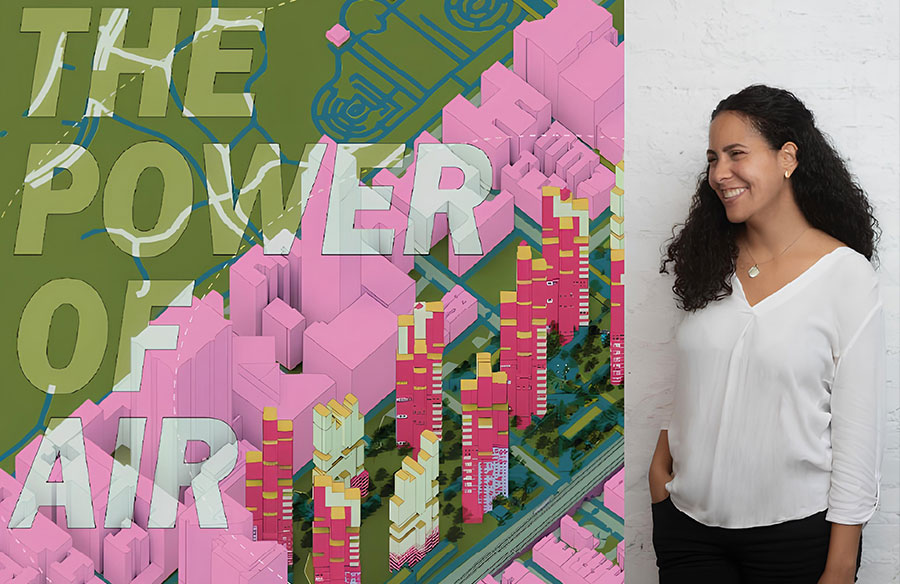
One of Anabella’s proposals, “The Power of Air” (https://www.the-collective-collective.com/work/powerofair), was awarded the CCNY Graduate Research Symposium Merit Scholarship, which drove her to continue this investigation in collaboration with The Collective | Collective, and with the support of the J. Max Bond Center. It explores Air Rights and its current and future role in the city, not only as latent development potential, but also as an innovative way to create means for housing access for everyone.
“The Power of Air” proposes a transformative Air Rights strategy and blockchain-based marketplace to address New York City’s dual challenges: shortage of affordable housing, and the financial and physical deterioration of New York City Housing Authority’s (NYCHA) aging portfolio. In this research, Anabella takes into consideration architecture, urban planning, policy and economics, mixing all of these with a creative approach to unlock untapped opportunities that can actually be developed into real solutions.
Her vision of architecture and cities embraces a holistic approach that unites diverse disciplines and perspectives. She understands that addressing complex challenges cannot be achieved in isolation; instead, it requires a collaborative effort that lays the groundwork for a more integrated society and, by extension, more connected and resilient urban spaces. While this multi-stakeholder approach introduces inherent complexity, it is fundamental for sustainable growth and long-term success. For Anabella, this is where futurability comes into play—empowering us to shape a dynamic future, where cities not only adapt to emerging challenges, but also unlock their true potential to solve some of the world’s most pressing issues.
Innovating With Research
As a forward-thinking professional with a holistic vision, Anabella investigates current topics and solutions based on current technologies, with a sensitive emphasis on the human presence as an integral part of the architectural design.
Her latest work, “Hybrid Districts”, focuses on binational contact zones, questioning how spaces between countries could function more effectively, and creating unique opportunities for urban reinvention. Recognized with the prestigious Spitzer History & Theory Travel Fellowship, her work will take her to San Diego, California, where close collaboration with organizations and locals will further enrich the research.
“Slumniverse”, featured by The New School’s Observatory of Latin America, challenges the perception of informal settlements, viewing the insight that these organic communities offer, serving as real-world case studies where alternative realities, adaptability, and future possibilities are explored. What happens when cities recognize the value of self-organized housing models? This project pushes that question forward. By analyzing these dynamic environments, she uncovers transformative solutions that not only address today’s challenges but also lay the foundation for tomorrow’s just cities.
Anabella firmly believes that speculating about the future is a powerful, yet often overlooked practice that every architect should embrace. As professionals responsible for shaping the built environment, architects must look beyond the present, envisioning future possibilities to develop solutions that not only address today’s challenges, but also lay the foundation for the cities of tomorrow. Anabella’s studies center on the challenges that shape cities today, from cost-effective housing and how to weave it into fast-growing urban areas, to urban informality and the lessons city planners can learn from self-built communities.
Building a Foundation in Design
Before stepping into New York’s architectural scene, Anabella studied architecture at Universidad Simón Bolívar, an institution known for its strong STEM focus and rigorous education. She stood out early, graduating Cum Laude with a 4.59 GPA out of 5. She also expanded her education at Pontificia Universidad Javeriana, bringing exposure to new city theories and design methodologies, as well as widening her architectural and urban perspective.
Shortly after her graduation, Anabella started putting what she learned in practice, working on public space projects. At Fundación Espacio, she worked in the CCScity450 project, focused on revitalizing both planned and informal urban areas with tactical urbanism interventions. Anabella co-led, managed, planned and executed tactical urbanism interventions in 5 slums, through community-focused urban design that provided spaces of interaction and brought urban life by performing small, but powerful transformations in the public space. Anabella’s approach emphasized public space as a vital community resource, bringing together local residents, authorities, and institutions for lasting impact.
At Minima Design Studio, she introduced Building Information Modeling (BIM), an industry-changing tool that streamlines construction workflows. Here, Anabella developed a residential project that involved multiple stakeholders, facilitating project coordination and enhancing efficiency. As a big enthusiast oftechnology, she believes every architect should stay ahead and be passionate about innovating and bringing to the table new tools that optimize workflows, freeing up time to focus on the human elements that truly define a great design.
Shaping new models and strategies
Ms. Peña has pioneered new ways of thinking about architecture through a unique combination of innovation, interdisciplinarity, collaboration, and participation. She continues to research transforming affordable housing from a traditional concept into a dynamic solution for the future, with forward-looking principles that are not just ideas—they’re the blueprint for creating more resilient, sustainable, and just designs.
Anabella highly regards details in architecture. As much as she pushes process and method evolution, she’s also very conscious that, in her field, the decisions architects take today influence how people will live for generations. The need to look ahead and to speculate about the future is vital for the efficient development of the urban environment and a productive society. Architects cannot rely on outdated models. Anabella continues to move forward these advancements, ensuring that architecture remains both high-performing and deeply human-centered.
As urban expansion continues at an unprecedented pace, the challenge for solutions that balance speed, efficiency, and livability without sacrificing quality grows. Anabella understands this very well, hence her approach to turn overlooked opportunities into new urban strategies, focusing on developing designs that benefit communities instead of displacing them.
The Future of Architecture and Housing
Anabella’s education and experience not only further ignited her passion for architecture, but also expanded her consciousness about its influence on urban environments. Being in New York helped her she understand the power and potential of looking at particular architectural expressions that often emerge in the Global South, to come up with creative solutions that could potentially influence the future of cities and its inhabitants worldwide.
Anabella sees architecture as an ever-moving and dynamic field, one where designers must anticipate what’s coming, and not only react to what’s already happened. Housing needs forward-thinking solutions that last and are cost-efficient, while public spaces need designs that respond to the people who use them.
She is committed to thinking about the future, and to look for technological and innovative ways of unraveling architecture, driving her to dedicate her expertise to creating better, more sustainable urban spaces that foster a higher quality of life for all. Her work reflects a deep conviction that architecture can evolve through exploring new strategies and solutions that help shape a better urban environment, making it more just and adaptive to the current world.