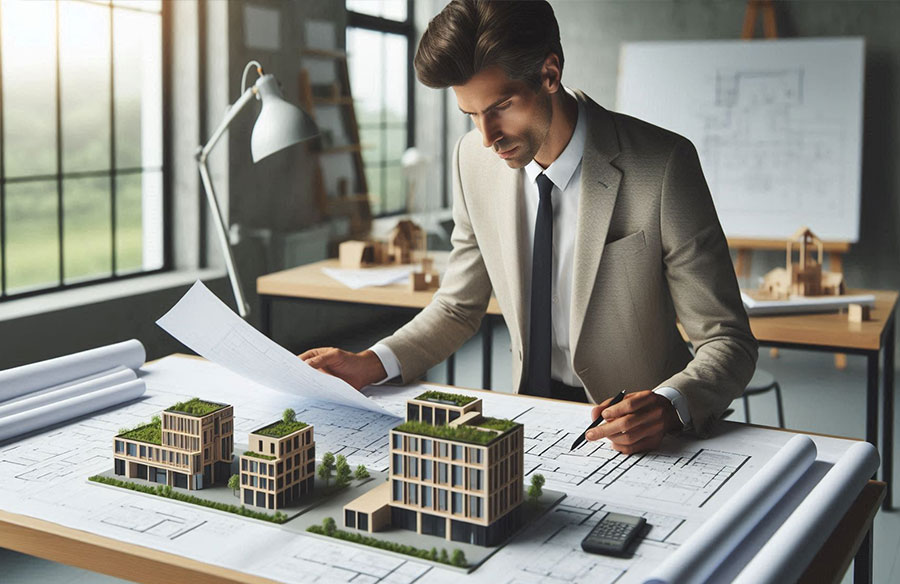
Ever noticed how modern buildings seem smarter, cleaner, and greener lately? You’re not alone!
Architects and designers continually adopt new ways to build sustainably. But what does sustainability actually mean in practical building design?
This guide will explore some of the latest sustainable practices shaping today’s construction industry. We’ll check out eco-friendly materials making big impacts, tools that boost energy efficiency, and technology solutions promoting precision.
Curious about these advancements?
Keep reading – let’s discover together how today’s designs minimize environmental impact while maximizing function.
Eco-Friendly Materials That Boost Building Sustainability
A big determinant of how green a building’s design becomes lies in what it’s made of.
In other words, material choice sets the tone for sustainability, and several innovative options reshape modern construction practices today.
Consider these impactful examples:
- Cross-Laminated Timber (CLT): Lightweight yet sturdy alternative to steel or concrete; reduces emissions significantly during manufacturing.
- Bio-Bricks: Created from natural bacteria and sand; they actively absorb CO2 rather than emitting pollutants.
- Ferrock: Made using recycled steel dust; hardens when exposed to carbon dioxide, sequestering it effectively into the structure itself.
- Mycelium Insulation Panels: Produced from mushroom roots; provide excellent thermal insulation while remaining completely biodegradable.
Each material listed helps architects meet high-performance goals without compromising ecological integrity or quality.
Selecting materials like these is critical not only for their immediate environmental benefits, but also because they lay foundations that promise healthier structures well into the future.
Advanced Measurement Software Enhancing Design Precision and Material Efficiency
Architectural design tech has seen massive leaps recently, especially regarding accuracy. Software advancements now simplify tasks once prone to human error.
Take RoofSnap gutter measurement app as a practical example.
It provides accurate gutter measurements remotely, cutting down site visits dramatically. This precision not only saves time but also reduces material waste significantly.
Other solutions include drone mapping technology that captures detailed topographic data in minutes.
Meanwhile, AI-powered platforms instantly evaluate structural integrity and identify potential risks.
Adopting these tech innovations is essential for precise designs, streamlined project timelines, and optimal sustainability results.
Reducing Waste Through Smarter Construction Practices
Construction sites are often viewed as major sources of debris, and for good reason. But with smart design and construction strategies, waste can be minimized drastically.
Prefabrication techniques, for instance, let teams assemble building components off-site. This cuts down material leftovers considerably while improving overall build quality.
Similarly, modular designs help optimize material use by standardizing component sizes to limit unnecessary cutting or reshaping.
Incorporating digital twin technology further ensures precise resource allocation – avoiding over ordering materials and substantially reducing on-site wastage.
Integrating Technology for Maximum Energy Efficiency
The intersection of tech innovation and architectural planning has sparked smarter energy solutions.
For example, sensor-driven systems automatically adjust lighting and heating based on occupancy.
Increasingly being seen in modern structures, intelligent glass adjusts transparency in real-time to maintain comfortable indoor temperatures without heavy reliance on HVAC systems.
Leveraging IoT-enabled dashboards provides continuous monitoring of a building’s performance metrics.
What’s more interesting is that data from these technologies empowers architects and engineers toward informed decisions about future sustainability improvements.
Efficient Water Management Solutions in Sustainable Buildings
Without a forethought design approach to conserving water, it’s hard to call a building truly eco-friendly.
Innovative strategies like rainwater harvesting and greywater recycling play key roles.
Harvested rain serves irrigation purposes, reducing the reliance on municipal water supplies significantly. Greywater systems redirect gently used household water into toilets or landscape hydration. Moreover, fixtures such as low-flow faucets and sensor-activated taps complement these strategies effectively.
Together, these elements define true water-efficient design while considerably minimizing overall resource consumption.
Practical Methods Architects Use to Lower Carbon Footprints
Building designs directly affect their environmental impact, influencing carbon emissions over their lifespan.
Several innovative techniques currently shape more sustainable building practices, including:
- Passive solar architecture: Utilizing strategic window placement and insulation to naturally regulate temperature.
- Green roofs: Incorporating vegetation layers that improve thermal insulation and air quality.
- Adaptive reuse strategies: Repurposing existing structures instead of new construction to conserve materials.
- Energy modeling software: Predicting a structure’s energy consumption early in the design phase.
Adopting methods like these actively supports lasting sustainability benefits.
Ultimately:
Sustainability in building design shapes a healthier future for communities and our planet. Thoughtful choices in materials, smart technology use, and waste-reducing practices all contribute significantly to positive environmental outcomes.
With each innovative decision architects make today, the potential grows for lasting sustainability benefits that generations ahead will appreciate deeply.