
Doctors spend twice as much time on documentation as they do with patients. AI tools like Bells AI, TheraPulse, and Freed AI are changing this by reducing documentation time by 30-73% and improving accuracy. These tools not only save time but also help reduce physician burnout and enhance patient care.
Key Benefits of Each Tool:
- Bells AI: Cuts documentation time by 60%, ideal for behavioral health with real-time transcription and compliance audits.
- TheraPulse: Tailored for mental health professionals, it offers real-time transcription, session tracking, and progress note automation.
- Freed AI: Reduces paperwork by 73%, specializing in templates for pediatrics and cardiology with ambient AI scribing.
Quick Comparison:
| Feature | Bells AI | TheraPulse | Freed AI |
| EHR Integration | Yes | Yes | Limited |
| HIPAA Compliance | Yes | Yes | Yes |
| Specialty | Behavioral Health | Mental Health | Specialty Clinics |
| Pricing | Enterprise Pricing | Starting $29/month | Not Disclosed |
AI-powered documentation tools are transforming healthcare by saving time, improving record accuracy, and reducing burnout. Whether you’re in behavioral health, mental health, or specialty care, these tools can streamline your workflow and let you focus more on patients.
1. Bells AI
Bells AI focuses on streamlining documentation in behavioral health and post-acute care, operating across 45 states. Impressively, it cuts training time from three weeks to just three days. This focus helps tackle the specific challenges of documenting mental health and rehabilitation care.
The system processes clinical data through various methods, including ambient listening, voice-to-text, and manual input. By using Bells AI, healthcare providers can reduce documentation time by up to 60%, offering a solution to the physician burnout problem discussed earlier.
Some standout features include real-time transcription for up to 10 participants, contextual clinical suggestions, and automated compliance checks. Its tagging system automatically maps content to ICD-10 and SNOMED codes, emphasizing the importance of precision in AI-supported systems.
The platform also supports offline documentation with automatic syncing and audits notes for duplicated language or overlapping service times. This makes it a tailored option for behavioral health workflows in healthcare organizations.
While Bells AI is highly effective in behavioral health, TheraPulse may be better suited for general practice documentation.
2. TheraPulse
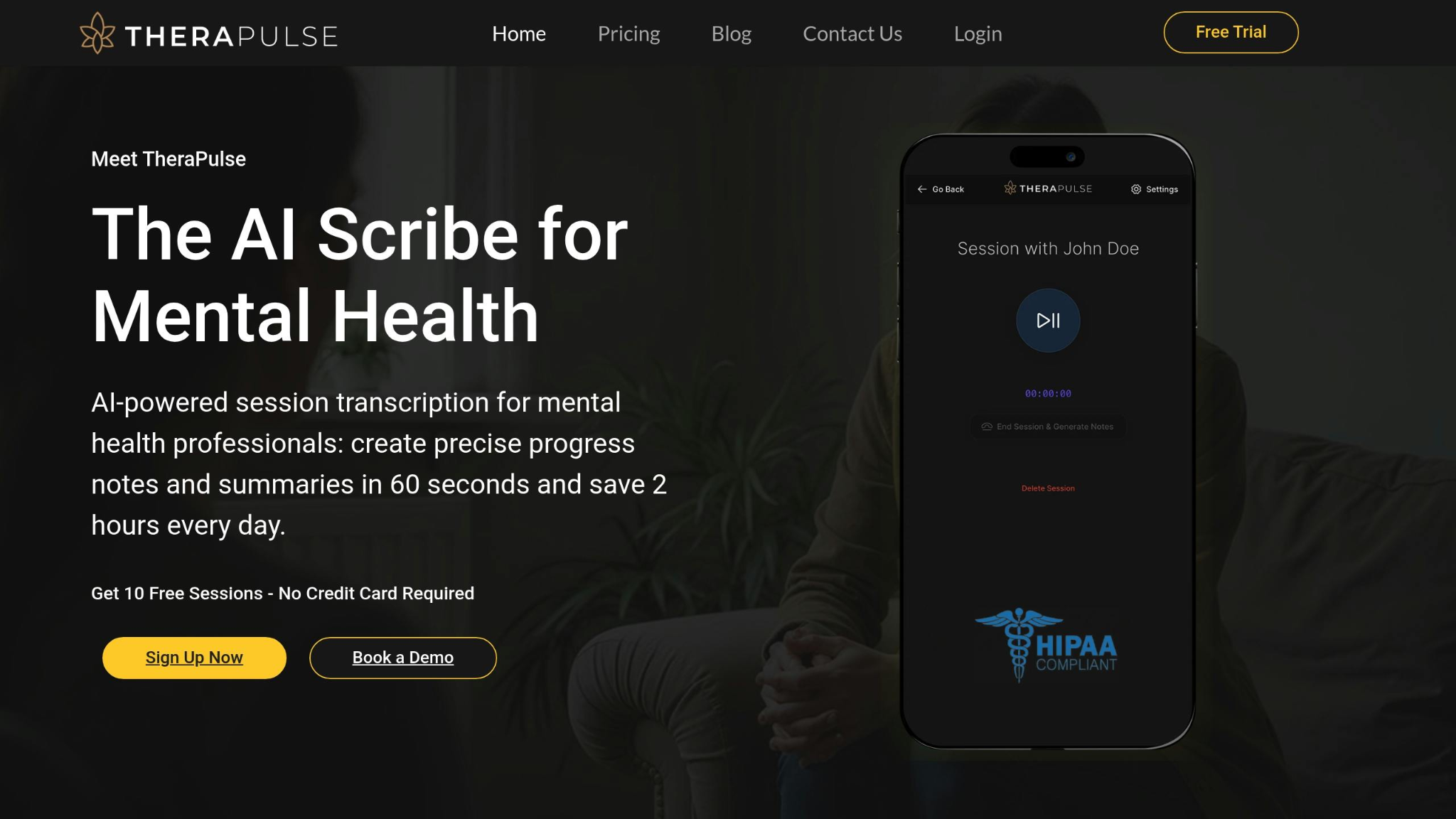 TheraPulse is designed specifically for mental health professionals, focusing on therapy-related needs that broader behavioral health tools often overlook. One standout feature is Session Scribe, which uses HIPAA-compliant speech-to-text technology to transcribe AI therapy notes in real-time. This allows therapists to stay focused on their clients, fostering stronger connections during sessions.
The platform also creates progress notes automatically, tailored to therapists’ preferred formats and supporting various therapeutic approaches. This feature significantly cuts down on administrative tasks. Unlike Bells AI, which caters to multiple settings, TheraPulse includes specialized voice detection for different therapy environments:
| Setting | Capability |
| Individual | Real-time transcription |
| Group/Couples | Speaker differentiation |
Fully HIPAA-compliant, TheraPulse integrates seamlessly with major EHR systems. For added flexibility, its Post-Session Dictation feature converts verbal summaries into structured notes using AI, complementing Bells AI’s ambient listening approach.
TheraPulse also comes with built-in analytics that highlight treatment trends and generate progress summaries. These tools help therapists monitor client progress and refine treatment plans as needed. To ensure a smooth experience, the platform offers guided onboarding with live support.
3. Freed AI
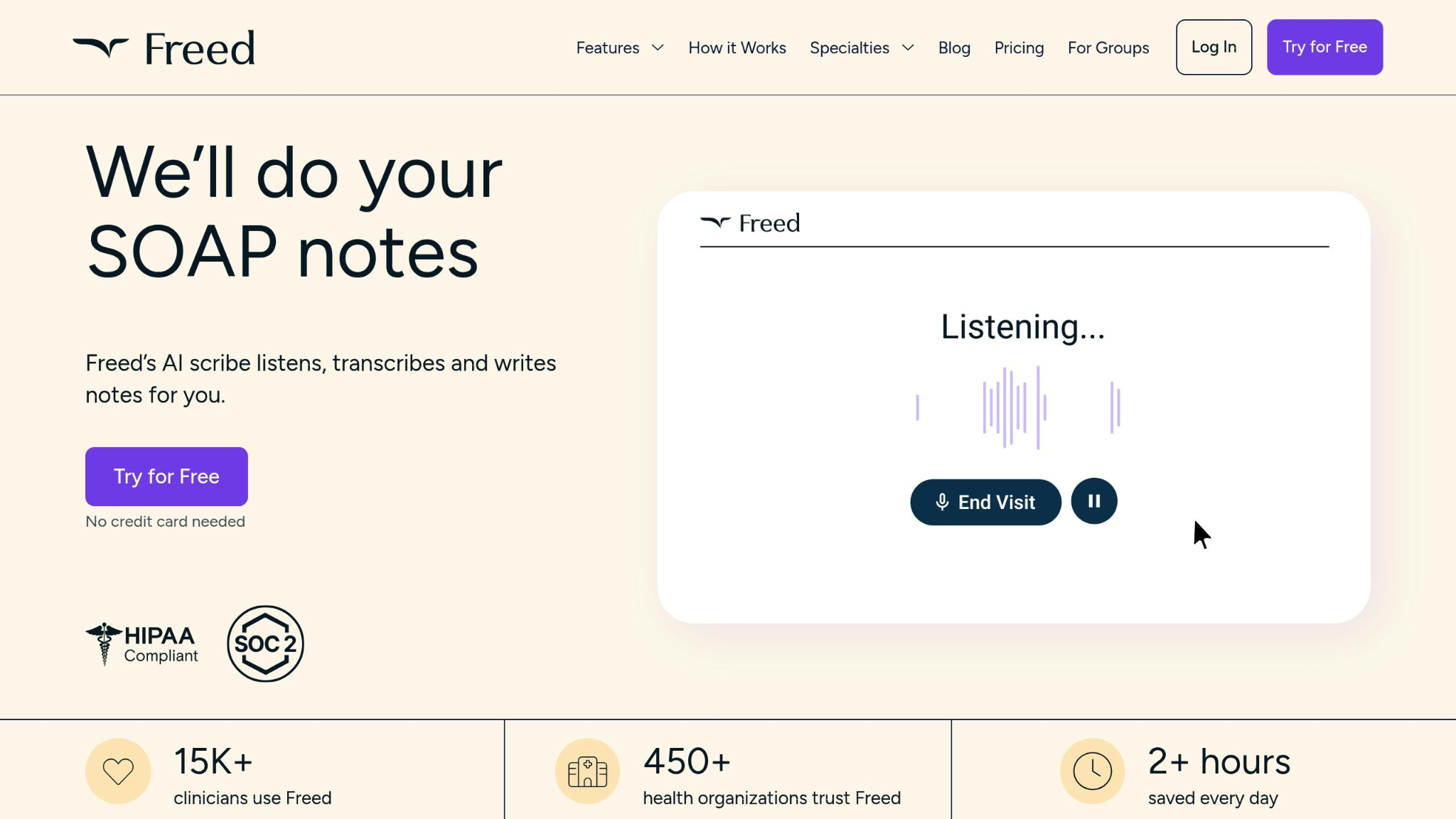
Freed AI offers a real-time documentation tool designed for clinicians who need specialty-specific solutions. Using ambient AI scribing, it turns patient conversations into structured notes while learning and adjusting to each clinician’s preferences over time.
This platform cuts down documentation time by an impressive 73%, tackling the burnout issues discussed earlier. Notes are ready within a minute after a visit, enabling providers to dedicate more attention to their patients. Key features include:
- Templates tailored for specialties like pediatrics and cardiology
- Hands-free functionality with voice-activated commands
- Automatic start of documentation using the “Capture visit” feature
- Recognition of complex medical terms, including prescription names
“Best medical scribe ever. I am extremely pleased with this service with the accuracy in the notes. Save me time and enables me to focus more on the patient than typing.” – Hortense Noble, ARNP
Freed AI continually improves by learning from user edits, creating a more personalized experience. Its customized workflows ensure the accuracy required for AI-assisted documentation. This mix of speed and customization makes it a great fit for reducing paperwork in busy practices.
Tool Comparison
When comparing these AI documentation tools, a few standout features set them apart:
| Feature | Bells AI | TheraPulse | Freed AI |
| EHR Integration | Yes | Yes | Some integration options |
| HIPAA Compliance | Yes | Yes | Compliant (details unspecified) |
| Documentation Formats | Customizable templates | SOAP, DAP, BIRP formats | – |
| Mobile Functionality | Online/offline syncing | Mobile app available | – |
| Pricing (Monthly) | Enterprise pricing | Starting $29 (30 sessions) | – |
These tools stand apart in how they address specific documentation needs and their implementation approaches:
Specialized Features
Each tool offers unique functionalities tailored to distinct challenges. Bells AI focuses on auditing notes for compliance, TheraPulse supports group session tracking, and Freed AI provides templates tailored to different specialties. These features cater to various aspects of the documentation process.
Analytics and Reporting
Analytics play a role in reducing errors, which can alleviate physician burnout:
- Bells AI: Identifies compliance errors in documentation.
- TheraPulse: Tracks patient progress over time.
- Freed AI: No analytics features have been disclosed.
Implementation and Support
TheraPulse is designed with an intuitive interface to simplify onboarding and daily use.
While all tools aim to ease documentation workloads, their pricing structures differ. For example, TheraPulse offers tiered pricing starting at $29 per month for up to 30 sessions. Practices should evaluate these costs alongside the tools’ capabilities to ensure they align with their workflow.
“Best medical scribe ever. I am extremely pleased with this service with the accuracy in the notes. Save me time and enables me to focus more on the patient than typing.” – Hortense Noble, ARNP
Conclusion
AI-powered documentation tools are transforming healthcare by streamlining processes and improving the quality of care. For example, Mount Sinai Health System’s adoption of these tools across eight hospitals led to a 40% drop in after-hours charting and a 25% boost in clinical note completeness. Dr. Sarah Chen, their Chief Medical Information Officer, highlighted the impact:
“The AI tool has not only saved our clinicians valuable time but has also improved the quality of our patient records, leading to better continuity of care.”
These tools show how AI can enhance clinical documentation by improving accuracy and consistency in patient records. They also offer features tailored to the unique needs of different healthcare environments.
While implementation may require adjustments, early adopters are already seeing benefits like increased efficiency and improved patient outcomes. As these tools continue to advance, they provide stronger EHR integration and real-time insights, making them valuable for healthcare providers.
For behavioral health clinics, therapy practices, and specialty care teams aiming to refine their documentation processes while prioritizing patient care, these AI solutions are a meaningful step toward delivering better, faster care.
FAQs
What is the AI app for clinical notes?
The AI tools mentioned here – Bells AI, TheraPulse, and Freed AI – use advanced technology to simplify clinical note-taking. They achieve this by automating the documentation process, each tackling specific challenges in medical record-keeping.
How is AI used in clinical documentation?
These tools leverage ambient clinical intelligence (ACI) technology to automatically capture and process key medical details during patient-physician interactions. Using natural language processing (NLP) and AI models, they analyze conversations and generate precise clinical notes.
Key benefits of AI in clinical documentation include:
- Reducing documentation time by 30% to 73%, depending on the tool
- Improving the accuracy of medical records
- Easing administrative workloads
With tools like Bells AI, TheraPulse, or Freed AI, clinicians can spend less time on paperwork and more on patient care, all while ensuring reliable records.