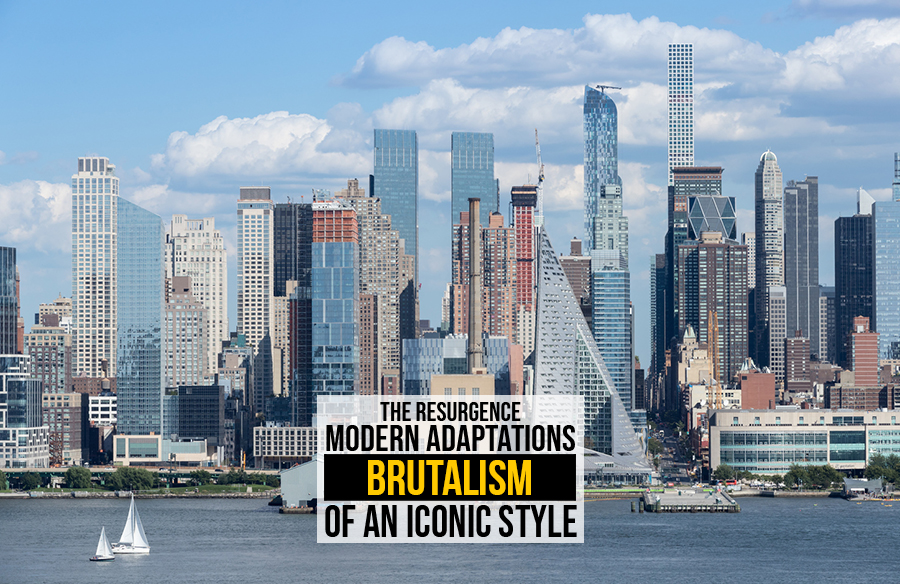
Brutalism, one of the most polarizing architectural movements of the 20th century, has made a bold comeback. Known for its stark, fortress-like structures of exposed concrete, Brutalism once dominated the post-war architectural scene before falling out of favour. Criticized as cold, oppressive, and associated with urban decay, the style all but disappeared in the late 1970s. Yet, Brutalism has found new life in contemporary architecture. Today, architects are reinterpreting its raw, sculptural qualities in innovative ways, blending its iconic aesthetic with modern materials, sustainability, and human-centered design.
So, how did this once-vilified style return to the architectural mainstream? And how are modern architects managing to refresh and humanize Brutalism without losing its uncompromising edge?

Brutalism’s Origins: A Philosophy of Rawness
Contemporary architects are revisiting Brutalism not as a mere revival but as a platform for innovation. Today’s Brutalist-inspired structures are less rigid and monolithic, offering a more sophisticated play on materiality, light, and space. Instead of the heavy, often overwhelming forms of the past, modern Brutalism feels lighter, more refined, and more integrated into the urban fabric.
Brutalist architecture originated from the French term béton brut (concrete) as a rebuilding solution post World War II crisis led primarily by architects like Le Corbusier and Peter Smithson among others who valued simplicity and functionality in design, over decorative elements to showcase the essence of a buildings structure authentically without embellishments or frills.
The design approach was quite controversial, in terms of style. It received both praise for its authenticity and strong shapes as well as criticism for its radical and unwelcoming appearance. During the 1980s era, Brutalism fell out of favour leading to the demolition or neglect of many of its structures.
Brutalism Reinvented: A New Brutality
Contemporary architects are revisiting Brutalism not as a mere revival but as a platform for innovation. In today’s buildings, there’s a shift towards fluidity and dynamism compared to the solid and imposing structures of the past. The contemporary embraces a sense of lightness and sophistication while seamlessly blending with the surrounding cityscape through the integration of materials and spatial elements.
The Return of Concrete, But Smarter
Concrete continues to be a defining material of architecture; however contemporary architects are exploring refined approaches, to its use today with polished finishes and creative blending, with other materials instead of the raw and unrefined surfaces typically associated with mid-century Brutalist structures. Innovations like ultra-high-performance concrete (UHPC) allow for thinner, more elegant structures without sacrificing strength, while offering more freedom in shaping forms.

Humanizing Brutalism: Designing for Comfort and Connectivity
Critics of Brutalism often found fault in its perceived lack of warmth and consideration for human proportions; however today architects are addressing this by integrating design approaches that prioritize human experiences and create a friendlier ambiance within Brutalist structures. They achieve this by combining the rawness of Brutalism with elements of comfort and modern conveniences to develop spaces that strike a balance between grandeur and intimacy.
BIG’s VIA 57 West: Brutalist Geometry Meets Human Comfort
The design of Bjarke Ingels Groups, VIA 57 West in New York is an example of how Brutalism can be reimagined for the urban landscape. The building’s striking geometric shape exudes a sense of boldness and artistry that pays homage to aesthetics. However, the way it embraces light and open communal spaces sets it apart from Brutalist buildings. Incorporating courtyards and terraces VIA 57 West fills its interiors with sunlight—a deliberate departure, from the typical dark and solitary ambiance associated with conventional Brutalist architecture. This is Brutalism reinvented for human comfort while still preserving its essence without compromising on livability.

Beton House: Colour Meets Concrete
In Beton House in Sheffield, they took the Brutalist foundation of the Park Hill Estate and injected new life through colour, modern materials, and communal design. The structure’s harsh concrete and strict geometry have been rejuvenated with interior hues and softer textures to create a striking juxtaposition, with the rugged exterior facade. The end outcome is a place that honours Brutalism’s essence while fostering a vibrant atmosphere, for those who call it home.

Brutalism and Sustainability: A Natural Evolution
Perhaps the most surprising aspect of Brutalism’s resurgence is its compatibility with sustainable architecture. As the environmental impact of buildings becomes a central concern, Brutalism’s focus on durability and material efficiency is increasingly relevant.
Aedas Architects’ Al Bahr Towers: Adaptive Brutalism
In Abu Dhabi, Aedas Architects’ Al Bahr Towers takes Brutalism’s concept of heavy massing and adapts it for sustainability. The towers feature an intricate facade that opens and closes depending on the sun’s intensity, controlling the building’s internal temperature and reducing energy consumption. While the towers’ underlying structure retains a Brutalist sense of mass and form, the kinetic facade offers a contemporary, responsive layer that breathes new life into the raw aesthetic.

Conclusion: Brutalism, Reimagined for a New Era
Brutalism’s revival isn’t about nostalgia—it’s about rethinking the past in light of the present. By embracing new materials, sustainable practices, and human-centered design, architects are transforming Brutalism from a relic of the post-war era into a versatile, forward-thinking style. These modern adaptations maintain Brutalism’s core philosophy of material honesty and expressive form while addressing its historical shortcomings.
In doing so, architects are ensuring that Brutalism remains not just an aesthetic choice but a relevant, dynamic force in contemporary architecture, pushing the boundaries of form, function, and material innovation.
Bibliography:
- lorddecor. Available at: https://www.lorddecor.com/blog/brutalist-house (Accessed: October 2024).
- bluentcad. Available at: https://www.bluentcad.com/blog/what-is-brutalist-architecture (Accessed: October 2024).
- archdaily. Available at: https://www.archdaily.com/798955/take-a-look-inside-via-57-west-with-photographs-by-danica-o-kus (Accessed: October 2024).
- Detail. Available at: https://www.detail.de/de_en/a-pink-shimmer-on-concrete-student-housing-in-sheffield.
- livinspaces. Available at: https://livinspaces.net/design-stories/ls-tv/discussing-the-design-an-indepth-look-at-the-design-of-the-al-bahar-towers-in-abu-dhabi-by-aedas-architects/ (Accessed: October 2024).