Speaking the courage of the great kings, queens, fortresses, temples, Baoris and the incessant tales of the intricacy of the structures and storytelling is what echoes through the alleys and history of Rajasthan. Rajasthan sustains more than traditional beliefs, values and realms through the long-established construction methodologies and passive techniques considering Rajasthan’s climatic behaviour.
Jaipur
Footprints of the lineage are held through distinct architectural styles and articulate details of the pink city. Jaipur houses structure more than their heritage values but of the community and elemental architecture. More than 15 historical structures echo along with the city’s founder home, City Palace. The City Palace was built in the 18th century by the Rajput king of Amber, Jai Singh II. Architects Sir Samuel Swinton Jacob and Vidyadar Bhattacharya infused the Palace with all the recognized and existing architectural styles of that time- Mughal, European and Rajput styles of architecture. Designed on the accordion texts of Vastu Shastra, it is the distinctive features of jalis and many architectural marvels existing within the Place premises.

Chandra Mahl houses the royal family of the city. Abiding not only the art frescoes and portraits of the rulers expressing the timeless generation that evolved and existed but also ornamented architectural features throughout the Palace such as arches and detailed minarets that follow the passage towards Jai Niwas Garden before it also opens to the outstanding fountain system of Chandra Mahal. Chandra Mahal depicts its existing lineage through the present royal family living in the southern section of Chandra Mahal which is guarded by the wrought iron gate which indeed is a medium of visuals to the royal family. The Jai Niwas Garden is an entry to the public bounded by beautiful vegetation, canals, step wells, walkways, jade green and deep red mahal.
Another epitome of architecture delving into the realms of the historic city is Hawa Mahal widely known as the “Palace of Winds”. A pseudo yet iconic 5-storied structure grandly described through 953 Jharokha, Jharokhas are the covered windows designed to allow efficient ventilation while keeping in consideration Jaipur’s climate. The design of the building is grandeur to emphasise the presence of the court harem to witness the exuberant city’s life and reside in the palace as the royal body. The majestic façade appears to be five stories originally the palace is one room deep though that does not nullify the presence of architectural characters existing in the palace, midget windows, lavish finishing of the exterior with red and pink sandstone and minimalistic yet subtle interiors of Hawa Mahal house temples in every floor.

Other than these historic structures the notable city sheathes a 137-year-old structure, an iconic architectural marvel in Indo-Saracenic architectural style through a collaborative team up by architect Sir Samuel Swinton Jacob and Mir Tujumaul Hoosein was planned and designed to embrace the visit of the Prince of Wales, Albert Edward. Distinctive structural elements used throughout the museum are chhatris, jharokhas, pinnacles, domed roofs, minarets, brackets, and plinth moulding. Divided into 16 galleries the museum encompasses collections of all the military equipment used during training and war, captivating miniature paintings, chiselled artwork, galleries dedicated to coins, furniture, woodwork, garments, musical instruments along with 2300-year-old Mummy and other miscellaneous archives.

Many other architectural marvels such as Jal Mahal, Amer Palace and Jantar Mantar derived from the diverse architectural styles again redefine the heterogeneous and extravagant pink city of Rajasthan.
Udaipur
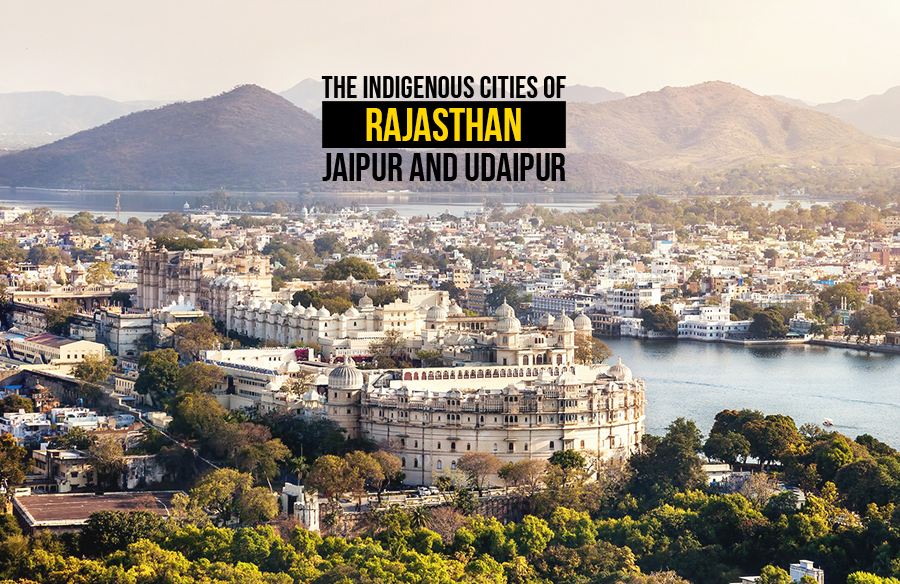
Udaipur features a similar character to that of other marvellous cities of Rajasthan, Udaipur shares another name matching its character, the City of Lakes presenting throughout the architectural characters like jharokhas, step-wells, fortresses, courtyards, gardens, jalis and use of locally available materials i.e., the adaption of vernacular architecture even in current and future structures.

Defined through the voices of guides taking to the exploration of the white city to the tourists, the Udaipur-Jewel of Mewar ruled by the long and historic Sisodiya Dynasty and the planning of Udaipur follows around Lake Pichola. Like its name, Udaipur pays homage to the major 5 lakes- Lake Pichola, Like Fateh Sagar, Lake Doodh Talai, Lake Rangsagar and Lake Swaroop Sagar. Captivating oil paintings by notable artists speak highly of the lakes surrounding the white-draped structures denoting the use of white marble throughout the structural elements of the city. The use of marble, limestone, granite, and painting along with line plaster cast glittery reflections of the lake and uproar distantly visible on looking towards the lake.
City Palace is the foci of Udaipur that lies between the junction of Lake Pichola and Lake Swaroop Singh, 30 metres tall and 240 metres wide palace commemorating multiple generations of the Mewar Dynasty. The palace glamour derives through the disco-ball room i.e., the use of tiny pieces of mirrors blending with the definition of jewels. The city palace also inculcates marble work, murals, wall paintings, inlay work and lattice work on jharokha giving an exuberant view of the city surrounded by the lake.