How does a single monument transcend time, culture, and religious boundaries, while firmly rooting itself in the political ambitions of an early Islamic empire?
- How does architecture become a statement of power and endure through centuries of conflict?
- How is a building a testament to the cultural give and take, and embraces the dialogue between civilizations?
- In Islamic architecture, built forms are often considered the threshold between heaven and earth, how does this built space achieve spirituality?
A profound philosophical shift in how the built environment could engage with the divine, the human, and the natural world marked the rise of a new political and religious order. The motivation behind Islamic architecture is deeply rooted in the idea of TAWHID, the oneness of God, and this permeated into design and spatial thinking. Architecture has been surpassed as merely a decorative or functional endeavour – it manifests spiritual and metaphysical truths, thus becoming a tangible connection.


Islamic architecture distinguishes itself by its ability to synthesise the cultural and intellectual influences of preceding civilizations: The Byzantine and Sassanian empires. A unique aesthetic comprising pure geometries, profoundly symbolic, evolved as an identity of Islamic architecture. ANICONISM: The absence of representation of figurines, idols that depict living creatures, or religious figures; particularly relevant to the Jewish, Islamic, and Byzantine artistic traditions, gained popularity. The interplay of light, space, and form was in the forefront and guided by the notion of the divine, which is omnipresent and can be embraced and invoked through patterns, symmetry, and the use of repetitive forms such as arches, domes, and courtyards.

These architectural achievements were part of a broader cultural ambition of asserting Islamic identity in the rapidly expanding world. Thus architecture became a means/ a catalyst to influence and reshape culture. From Damascus to Cordoba, Islamic architecture imprinted its intellect and artistic force onto European, North African, and Asian design traditions. The DOME OF THE ROCK, commissioned by Caliph Abd al-Malik, exemplifies this ambition – not just as a religious monument, but as an assertion of a new architectural language, reframing how specs are experienced and understood with divinity and spirituality at its core.
The Dome of the Rock – Architectural dialogue between cultures:
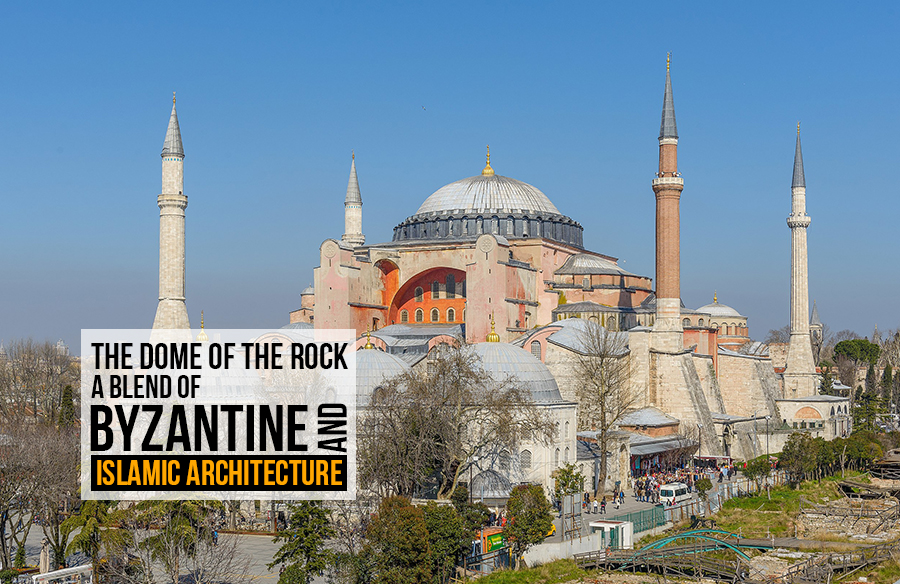
This is one of the oldest surviving Islamic monuments, the most iconic and historically significant structures, located on the Temple Mount – Haram al-Sharif) in Jerusalem. Completed in 691-692 CE it is a quintessential example of early Islamic architecture and blends theological symbolism and architectural sophistication. The design draws from various traditions, achieving a unique identity that reflects not only the Islamic empire’s cultural and religious aspirations but also the distinct synthesis of Byzantine, Sassanian, and Indigenous architectural influences.


Architecture as a Vessel – Symbolism and Identity:
The octagonal plan, crowned with a central dome made of wood and adorned by gold leaves, reflects a deliberate blend of religious symbolism and structural innovation. This 20m dia dome rises 25 m above the sacred rock and is an interpretation of the unity of heaven and earth. The Dome dominates the skyline of Jerusalem, marks the sanctity of the site, and creates a profound spatial experience.

The dome sits on a drum supported by a ring of columns and piers, featuring two concentric ambulatories creating a fluid circulation space around the central rock. The circular movement invites the visitor into this contemplative spatial experience, reinforcing the concept of divine ascension and centrality of the space. Taking inspiration from the typical Byzantine martyrium, the intricate mosaics with vegetal patterns, calligraphy, and inscriptions from the Quran, emphasise the transcendence of God and are a reflection of the Islamic focus on Aniconism. Thus, leading to the creation of contemplative, calm, and captivating ethereal environments.

The epigraphy is noteworthy, as it presents the Quranic verses as an integral part of the architecture as an embodiment of Islamic theology. A dialogue between form and meaning is formulated as a result of a combination of text and ornaments, thus the building becomes a vessel for conveying spiritual truths. The ornamentation also attempts to establish the building as a powerful statement of Islamic faith.

The ornamentation plays a pivotal role in the experience of the structure. Thus, the attention to materiality – the golden mosaics, marble, and timber – was a reflection of the Umayyad Caliphate’s ambition to affirm its wealth, power, and prosperity. The rich colours, intricate mosaics, and reflective surfaces were used to create a serene environment, symbolising divine presence.

Faith and Friction:
The Dome of the Rock marks a place for everybody because it’s the reason that prophet Muhammad ascended from heaven during his Isra and Mi’raj, or Night Journey. The design of this structure is the architectural expression of this ascent.
The building of such an enormous monument on the Temple Mount, so crucial in Jewish tradition, was a powerful political declaration. It declared that Islam was superior to the lands and religious traditions it had usurped. As the holiest place in Judaism, the location chosen for the Dome of the Rock was the pièce de résistance through which the Umayyad dynasty made its stunning declaration of Islamic supremacy-not only as faith but also as political power.
Where, in the centre of the shrine, the rock at the centre is counted to be the traditionally holy spot of the holies of both the first and the second temple of the Jewish. To most of the Jewish communities, the Dome of the Rock stood as a painful reminder of the destruction caused by the Romans over the once-standing place of the Jewish Second Temple. The loss of the Temple remains at the heart of Jewish historical trauma: this event marked not just the termination of Jewish sovereignty in ancient Judea but also the opening shot of the Diaspora. The replacement of such a sacrosanct place by a monument of another faith has only fueled religious tensions for centuries. Al-Aqsa Mosque is situated within the Haram al-Sharif (the Noble Sanctuary) which for Jews constitutes the Temple Mount as well. It surrounds and forms part of the Dome of the Rock, an extremely symbolic and sacred space in which both Israelis and Palestinians claim a deep and traditional right. This results in quite violent clashes and disputes over control and access. The monument therefore serves not only as a religious landmark but also may be the point of flash in the broader political struggle over Jerusalem. Thus, the Dome of the Rock is more a symbol of conflict than of interfaith unity.


Echoes of the Dome – The Legacy:
The Dome of the Rock must be understood in the political and cultural context. Construction, under Caliph Abd al-Malik, was as much an affirmation of Islamic religious identity as it was of Umayyad political power in a contested sacred landscape. Within that process, it borrowed from and transcended the architectural traditions of the Byzantine and Sassanian empires.
More broadly outside the immediate footprint of the building, the Dome of the Rock influenced in grander terms. Its vocabulary of formal and decorative forms inspired a succession of Islamic architecture from the Great Mosque of Damascus to the Taj Mahal in India. The symbolic use of the dome and the centralised plan became recurrent themes in the then-growing monumental architecture of Islam, reinforcing the natural role of architecture inside the celestial sphere.


Faith and Division:
This religious exclusivity can also be said to be its weakness, particularly concerning its theological inscriptions. The Dome is not a neutral monument; it communicates a particular religious message toward reinforcing the tenets of Islam. The Quranic writings inside and outside the Dome reiterate the idea of one God, believing that Muhammad is the final prophet, contradicting the foundation of Christianity about Jesus as a God in himself and therefore explicitly claiming superiority over previous traditions of monotheism.
The Arabic writings denying Jesus’s divinity would be blasphemous, from the Christian perspective, and a divine rebuke. Although those inscriptions form an integral part of the Islamic character of the building, they underline an exclusively religious character that the Dome conveys beyond its location, sacred to a variety of religious communities. At a time when in a space as heterogeneous and controversial a space as Jerusalem, this theological stance of the Dome may remind people of historical supersession on religious grounds, often a heavy marker of interfaith relations in the region.
Shared Heritage and Political Rivalry:
The Dome of the Rock is today at the heart of profound political and religious conflicts, mainly in the contemporary relations between Israelis and Palestinians. Entrance to the Dome and the wider Haram al-Sharif/Temple Mount site is strictly regulated and highly restrictive to non-Muslim visitors. The restrictions on the site that hold great cultural importance for the Jews, Muslims, and Christians have brought mutual religious group tensions.
A second layer of complication to the status of the Dome has been added by the Israeli-Palestinian conflict. Now that both Israel and Palestine have declared Jerusalem to be the capital of each, control over the Temple Mount is a burning point of contention. Violent confrontations between Israeli security forces and Palestinian worshipers often break out in and around the compound, making the site a sensitive flashpoint for broader regional tensions.
For some people, this restricted access will be a concern because it does not allow them to enjoy the Dome of the Rock as a shared, vital part of cultural and religious heritage.
Shared yet Contested –
Built on solid ground, the Dome of the Rock is an extraordinary architectural and spiritual masterpiece, representing the nascent brilliance of Islamic architecture at the same time as it symbolises religious and political power. Its remarkable form, rooted in Byzantine and Sassanian influences, captures the moment when Islam was defining its aesthetic language. Yet, by situating this edifice within the highly contested Temple Mount, it imbues it with profound layers of religious and cultural tensions, in other words, often conceived of as an appropriation of sacred Jewish space. Quranic inscriptions assert theologically paramount domination, contributing to centuries of conflict between Judaism, Christianity, and Islam. Instead of being a symbol of unity or coexistence among the Abrahamic faiths, it usually prolongs disunity and emphasises complications in navigating these sacred shared spaces in one of the world’s most brutal conflict zones. Current-day political struggles over Jerusalem add to its complicated legacy, turning the Dome into a symbol of religious majesty and a flashpoint in this ongoing dispute. Its beauty and significance cannot be detached from the historical, political, and spiritual complexities that continue to surround it.
Are the religious and political connotations of the Dome of the Rock separable from its architectural value, or are they indissoluble?
Citations:
- (PDF) The Dome of the Rock: Origin of its octagonal plan. (n.d.-a). https://www.researchgate.net/publication/233604991_The_Dome_of_the_Rock_Origin_of_its_Octagonal_Plan
- Encyclopædia Britannica, inc. (n.d.). Dome of the Rock. Encyclopædia Britannica. https://www.britannica.com/topic/Dome-of-the-Rock
- Dome of the Rock | definition, architecture & history – video. (n.d.-a). https://study.com/academy/lesson/video/dome-of-the-rock-definition-history-architecture-facts.html
- Lawler, A., & Gafić, Z. (2023, August 15). An unprecedented look inside the dome of the rock. Premium. https://www.nationalgeographic.com/premium/article/revealing-jerusalem-landmark-dome-of-the-rock
- Byzantine domical churches are the source for all Islamic domed architecture down to the present day. snowwhitedesign.wordpress.com. (2013, March 11). https://snowwhitedesign.wordpress.com/writings/year-1/byzantine-domical-churches-are-the-source-for-all-islamic-domed-architecture-down-to-present-day/