

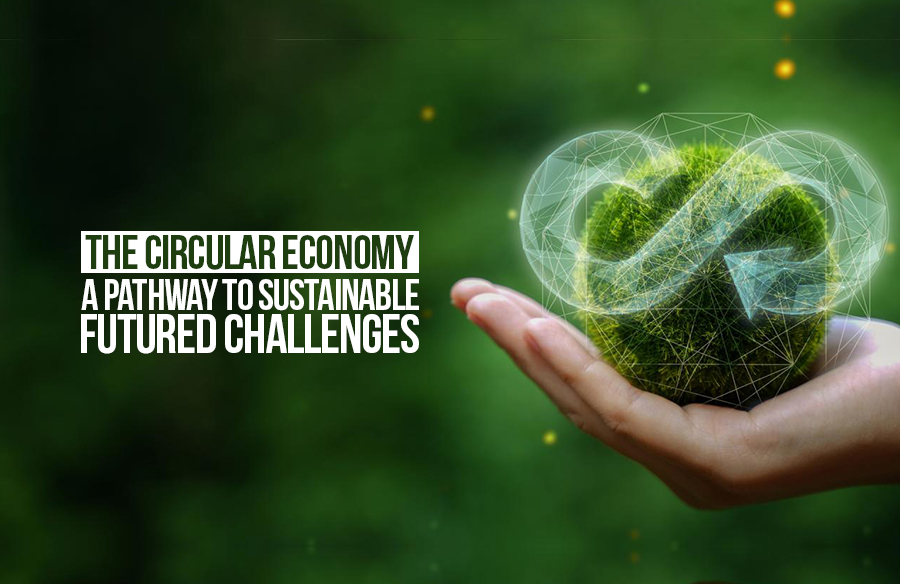
Any economic model that emphasises sharing, leasing, reusing, repairing, refurbishing, and recycling current materials and products for as long as feasible is known as a circular economy. In order to address global issues including pollution, waste, biodiversity loss, and climate change, the concept emphasises the shift towards a circular economy, for which three key concepts need to be followed: minimising waste and pollution, extending the life of products and resources, and restoring natural systems. The traditional linear economy is characterised in contrast to the circular economy.

The circular economy is becoming popular as it can lower the over-consumption of raw materials, reduce carbon emissions, open up new markets, and encourage consumer sustainability. In addition to fostering long-term growth, the circular economy can reduce global warming.
Implementation, Challenges and Opportunities

There is no denying that implementing an engineering circular lifecycle strategy presents a significant number of difficulties. When switching to renewable energy sources, complex engineering systems—particularly those with long lifecycles and complex safety and certification governance frameworks—may face challenges. Nonetheless, the circular lifespan idea may be applied to a wide variety of engineering and produced goods, demonstrating its universal application.
The establishment of these novel approaches and a mentality shift within businesses will be the main challenges. The application of this engineering lifecycle strategy has great promise for organisations and consumers alike, notwithstanding these obstacles. This is particularly evident when a cooperative, through-life service strategy is used, underscoring the enormous financial gains that may result from incorporating circularity into engineering lifecycles.
Adaptations and Applications in Industries

Industries can transition to a circular economy, but this will need significant adjustments to their business structures. The circular business models are the result of a major redesign of product concepts, service offerings, and channels toward long-term solutions, as well as new visions and strategies, all of which are required to implement the circular economy principles.
A circular economy can be implemented globally to cut emissions worldwide. Cement, aluminium, steel, plastics, and food are the five industries where circular economy solutions can be implemented to cut 9.3 billion metric tons of CO2 equivalent—all of the transportation sector’s present emissions.
Construction Industry:
The building industry is a significant contributor to global trash production. The circular economy appears to be an effective strategy to reduce the industry’s negative environmental impact. As they produce hazardous residuals and consume more nonrenewable resources, buildings have a substantial influence on the environment. The cement sector is responsible for 2.4% of the CO2 emissions worldwide from all energy and industrial sources. The circular economy can be approached in three different ways: tactically, strategically and operationally. It has the potential to impact both building projects and construction businesses. Buildings that have outlived their usefulness can be demolished to make way for new construction elements and development.
Textile Industry:
The technique of consistently recycling garments and fibres so they can be reused rather than going to waste is known as the circular economy in the textile industry.
The fashion industry’s present linear paradigm, which entails obtaining raw materials, turning them into finished garments, buying, wearing, and eventually discarding them, is being challenged by a circular textile economy. Fast fashion retailers have compounded the issues inherent with a linear system by promoting excessive consumption. This strategy has multiple adverse effects on society and the environment and costs more than $500 billion a year. A prime illustration of these negative effects on the environment is the enormous quantity of clothes that ends up in incinerators and landfills.
Furniture Industry:
Considering most furniture sector items are passive durables, implementing business strategies and procedures that extend product lifetimes—such as repairing and remanufacturing—would often result in lower costs and environmental impacts. Companies that refurbish and reupholster furniture for reuse promote a cyclical approach to furniture.
As per a study on the Danish furniture industry, in efforts to adopt a circular economy, 44% of the companies had maintenance built into their business plans, 22% had take-back programs, and 56% created furniture that could be recycled. Reuse and recycling in the furniture industry have enormous potential, according to another UK survey. Research found that 42% of the bulk waste dumped in landfills each year is made up of furniture. Additionally, it has been noted that about 80% of the raw resources are wasted throughout the manufacturing process.
Critique of the Circular Economy Model:
Energy and resources are needed for the recovery and recycling of materials that have been dispersed due to pollution, trash, and the disposal of end-of-life products. These requirements increase nonlinearly as the percentage of recycled material increases.
Furthermore, the circular economy has come under critique for not having a significant social justice component. Regarding how circular economy technology and solutions will be regulated and how their costs and benefits will be allocated, the majority of circular economy visions, programs, and laws fail to address important societal issues.
Reference list:
https://web.archive.org/web/20190731195422/https://www.ellenmacarthurfoundation.org/resources/apply/circularity-indicators
https://www.ellenmacarthurfoundation.org/topics/circular-economy-introduction/overview
https://www.sciencedirect.com/science/article/pii/S0921344920302354?via%3Dihub
https://link.springer.com/article/10.1007/s43615-023-00272-3
https://www.mdpi.com/2071-1050/11/18/4819
https://www.katche.eu/circular-economy-danish-furniture-sector/
https://www.businessoffashion.com/articles/workplace-talent/dame-ellen-macarthur-on-building-momentum-for-sustainability-in-fashion/
https://ibimapublishing.com/articles/JEURB/2018/909360/
https://www.nawic.london/events/event/circular-economy-101-part-of-nawic-ldnse-conference-2020/
https://www.bigrentz.com/blog/construction-waste-statistics?srsltid=AfmBOoqQSbWZft7XsDBuuYzadjRQNIU-ZfoFXp2LiK9VcRQhByFrxWV6
https://quizlet.com/504126839/ch-12-lean-supply-chains-flash-cards/







