On the United Nations Educational, Scientific and Cultural Organization (UNESCO) list of world heritage sites, the Group of Monuments in Mahabalipuram holds an important place as an example of classic Indian architecture. Mahabalipuram or Mamallapuram was a renowned port city of the Pallavas, along the southeastern coast of India. Pallava kings built the historic Group of Monuments in Mahabalipuram in the 6th to 8th centuries. The monuments, famous for their rock-cut architecture, embody a blend of Hindu religious pantheon, culture, and legends. They are natural expressions sculpted into rocks or boulders, on a large scale, blending nature with art. The monuments exemplify the craftsmanship of Pallavas. There are around forty monuments which are divided into five groups namely, Rathas, Mandapas, Rock reliefs, Structural temples and Excavations.

Outstanding Universal Value (OUV) of the Group of Monuments in Mahabalipuram
To be classified as a UNESCO World Heritage site, the site must demonstrate Exceptional Universal Value (OUV). The collection of monuments in Mahabalipuram includes all the necessary elements to demonstrate the extraordinary worldwide importance of the site, such as pavilions, chariots, stone carvings, temples, and archaeological remains from the Pallava dynasty.

The monolithic temples, known as rathas, are referred to as chariots because they resemble the processional chariots of a temple in the local area. Each of the five monolithic temples is carved from a massive rock. They showcase the complete design and characteristics of modern temple structures, demonstrating differences in both layout and height. They are intricately carved with artistic designs and wall panels displaying numerous Hindu gods and goddesses, as well as images of royalty.
The rock-cut caves, known as mandapas, saw new developments in the form of cave temples during the reign of Narasimhavarman-I Mamalla. Konerimandapa, Mahishmardhini Cave, and Varahamandapa are some noteworthy cave temples. These caves carved out of rock are adorned with intricate sculptures admired for their elegance and flexibility. Some of the most notable ones include Mahishamardhini, Bhuvaraha, Gajalakshmi, Tirivikrama, and Durga.
Sculptural bas reliefs are another crucial type of expertly made works produced in Mamalla’s reign. Mamallapuram has four reliefs, with the most remarkable ones being Arjuna’s Penance and Govardhanadhari.
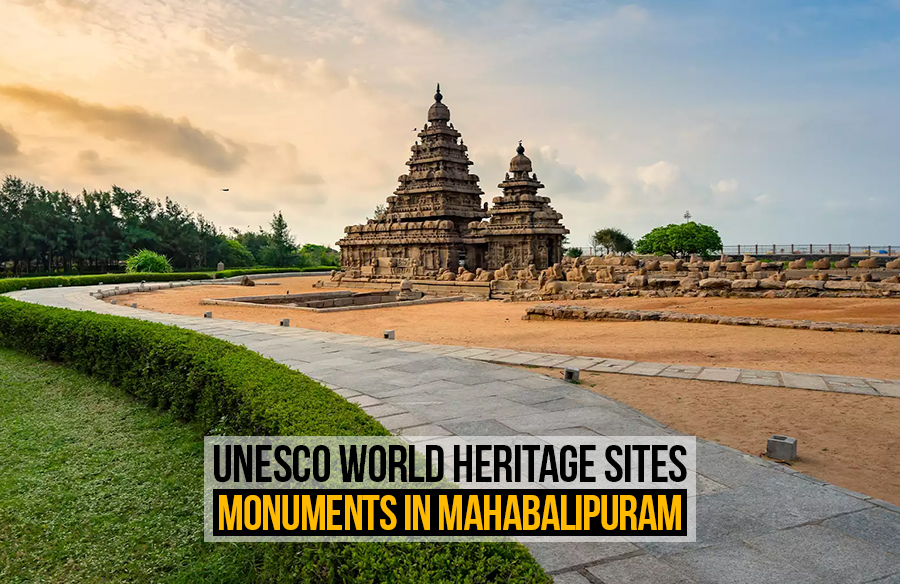
King Rajasimha implemented large-scale structural architecture in the temples. The first and simplest temple is the Mukundanayananar temple, with the Olakkanesvara temple coming next, located on a rock close to the lighthouse. The speed at which architectural structures were built reached its peak with the construction of the well-known Shore temple, which boasts the most intricate design of a Dravida vimana, elegantly sitting on the edge of the sea.
Continuous excavation for an extended period has revealed numerous buried buildings near the Shore temple. Distinguishing itself from the others is a stepped design, a small shrine, a Bhuvaraha statue, a reclining Vishnu statue, and a well from the rule of Pallava King Narasimhavarman Rajasimha (638-660 CE), all carved into the natural rock. Additional temples’ remains have been unearthed recently, with one located south of the Shore temple.

Selection Criteria of the Group of Monuments in Mahabalipuram
Out of the 10 cultural and natural criteria to be classified as a UNESCO World Heritage site, the Group of Monuments fulfil 4 criteria.
Criterion (i) seeks to illustrate the highest point of human intelligence and innovation. The bas-relief depicting the “Descent of the Ganges” is a unique artistic achievement, much like the one located on Elephanta Island.
Criterion (ii) emphasises the importance of showcasing a significant exchange of human values, whether it be over some time or within a specific cultural area, especially in the domains of architecture, technology, monumental arts, urban planning, or landscape architecture. The Mahabalipuram sculptures, known for their smooth and flexible design, greatly impacted regions like Cambodia, Annam, and Java.
Criterion (iii) involves showcasing a specific cultural heritage or civilization that is either current or extinct, with a unique or important testimonial component. Mahabalipuram is essentially a portrayal of the Pallavas culture in the southern region of India.
Criterion (vi) should have a distinct correlation with significant global events or living traditions, concepts, beliefs, and artistic and literary creations of exceptional importance. The sanctuary plays a crucial role as a centre of worship for Shiva.

The Group of Monuments in Mahabalipuram, situated close to the sea, benefits from its aura and charm, creating a stunning setting for both worshippers and tourists. The peaceful atmosphere for worshippers is enriched by the calming effect of the waves rhythmically hitting the shore. The Archaeological Survey of India is closely monitoring and maintaining the Group of Monuments in Mahabalipuram, with no major threats reported at the moment. The group of monuments retains its original state in terms of locations, forms, materials, and designs. The genuineness of the monuments centres on the innovation and testing in rock-cut architecture, leading to the development of elaborate temples.

Overall, the Group of Monuments in Mahabalipuram honours the cultural legacy and architectural skill of the Pallava dynasty. It showcases the architectural and artistic achievements of ancient India with its rock-cut temples, cave shrines, and sculptural reliefs. Designated as a World Heritage Site by UNESCO, it continues to inspire awe and reverence from visitors and scholars alike, preserving the Pallava civilization’s legacy for future generations to appreciate.