In its simplest form, a fire station is little more than a residence with an oversized garage. At its most complex, it embodies community values and serves as a highly technical emergency response facility.
Project Name: Fire Station 76
Studio Name: Hennebery Eddy Architects
Design team:
Michelle Vo, Principal-in-Charge
Camilla Cok, Project Architect
Ian Gelbrich, Project Manager
Contractor: Bremik Construction, Inc.
Civil Engineer: KPFF Consulting Engineers, Inc
Structural Engineer: IMEG Corporation
Mechanical Engineer: Interface Engineering, Inc.
Electrical Engineer: Interface Engineering, Inc.
Landscape: Otten Landscape Architects
Wood Charring: Barnwood Naturals
Cost Consultant: ACC Cost Consultants, LLC
Client: Gresham Fire & Emergency Services, Multnomah Rural Fire Protection District 10
Photography: Josh Partee

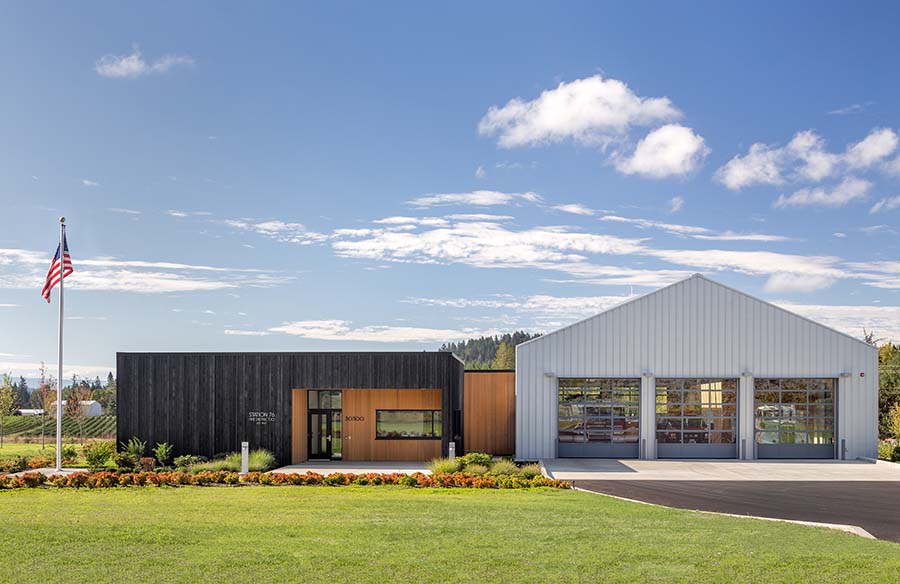
This dual understanding, interwoven with storytelling and context, guided the design for Fire Station 76. The station embraces fire as a symbol of protection and beauty while reflecting its rural context through both massing and simple materials. Drawing inspiration from local agricultural buildings, the design subtly integrates the area’s rural character with distinct living and working functions.

The 10,120-square-foot structure comprises two primary volumes: a vaulted apparatus bay clad in metal, and office and living quarters wrapped in charred wood. The apparatus bay houses emergency response vehicles and includes essential working spaces such as a shop, bunker gear washer, storage, and an EMS room. The attached living quarters accommodate the crew with a day room, kitchen, fitness room, showers, lockers, and bunk rooms. A public reception area, including the station office, conference room, and District administrative office, is located at the front entry of the living quarters.

Shou Sugi Ban, a traditional Japanese technique, was used for portions of the exterior to provide protection from rot, decay, and insects. Warm-hued western red cedar-clad porches are integrated into the living quarters, creating a rich contrast with the adjacent charred wood. This cedar continues into the day-lit interior, blending the inside with the outside. The apparatus bay exterior is wrapped in light metal, while glulam Tudor arches, spanned by tongue-and-groove cedar decking, vault over the engines within.

The station features numerous sustainable design strategies, including daylight harvesting, passive solar heating, a high-performance building envelope, an efficient mechanical system, LED lighting, and low-flow plumbing fixtures. A rooftop solar panel array and a backup generator further enhance the building’s resilience.

The orientation of the building is strategic: the east porch and day room, where crews spend most of their time, are angled to capture views of the Cascade mountain range, while the metal-clad apparatus bay faces the road, showcasing the engines—the most recognizable feature of a fire station—to the public. Natural, non-toxic materials throughout the station provide healthy, restorative spaces for the crew to recharge from active duty.