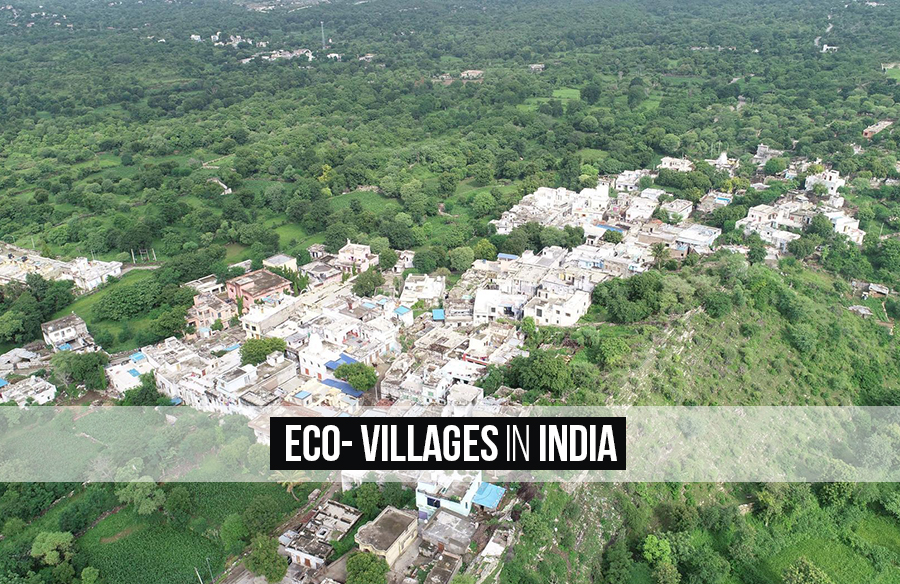
In the past decade, rapid urbanisation has threatened to deplete the world of its natural resources. Resources like food and water are becoming scarce while forests are cut to increase land availability. As most resources are concentrated in metropolitan cities, remote villages face extreme conditions. Across the globe, ecovillages are being set up to practise sustainable living. An ecovillage is an intentional community initiated for social, cultural, economic or ecological sustainability. Villages like Mawlynnong (Meghalaya), Piplantri (Rajasthan) and Hiware Baazar (Maharashtra) are ecovillages that prioritise ecological sustainability.

Mawlynnong
Known as “God’s Own Garden”, Mawlynnong is a tribal village tucked away in Meghalaya. Located at a distance of 90 km from Shillong, it is home to the Khasi, a tribe known for their matrilinear ways. The small village, known for its cleanliness, has banned plastic and instead uses bamboo dustbins to collect garbage. The collected waste is then directed to a pit and used as manure. This ecovillage rose into recognition after being named the cleanest village in Asia in 2003. Since then it has experienced an increase in tourism and income of the residents. Despite this, residents are determined to keep their homes clean.
Hiware Bazaar
Hiware Bazaar lies across 10 sq. km at the foothills of the Sahyadris. The ecovillage lies in the drought-prone district of Ahmednagar and receives only 200-300 mm of rainfall annually. Under the leadership of Popatrao Pawar, the villagers devised a five-pronged plan. They prioritised safe drinking water, irrigation, employment, education and health. The watershed development initiative began in 1992 with the reforestation of the steep slopes of the Sahyadri. They used contour trenches to replenish groundwater, reviving farming as the primary occupation. Shallow dams were constructed using stone or cement along natural drain lines to catch rainwater. The replenished water tables changed the cropping patterns drastically. Farmers could now cultivate cash crops like potatoes, onions and tomatoes along with previously grown crops. Hiware Bazaar has now become a green model village with 294 water wells. The village has become an inspiration and its initiatives can be adapted across the country as a module of water sustainability. These initiatives were accompanied by a campaign for social change which included a ban on liquor, family planning and shramdaan (voluntary labour for the village).

Piplantri
Rajasthan is home to Piplantri, an ecovillage whose residents take pride in the extensive plantations done since 2006. Shyam Paliwal, a former village sarpanch, started this initiative after his daughter passed away due to dehydration. Since then, 111 trees have been planted for every girl born. Approximately 300 million trees, including Mango, Amla, Neem, and Sheesham, were planted. The villagers planted 2.5 billion Aloe Vera plants as a natural termiticide. The villagers soon realised the health benefits of the succulent and began exporting Aloe Vera products, improving their economy. Not only does Pipplantri support ecological sustainability but also prevents female foeticide. The village introduced an eco-feminist model for sustainable living.
Lana Bhalta
Lana Bhalta is a remote village in the Sirmaur district of Himachal Pradesh. It is located 50 km from the state capital, Shimla. Known for its sanitation initiatives, it is leading in zero waste generation policies. All 333 households are equipped with toilets and a localised system to sift the waste from water flowing out of kitchens. Each household is given a sanitation kit which includes a toilet brush, a jute bag for collecting garbage, a dustpan, a dust bin and a nail cutter. Measures are taken to ensure each school in the panchayat is equipped with toilets. Almost all items from the garbage are recycled. Raddi (wasted paper) is recycled into paper and stale, oily food into manure. Oil-free waste like raw vegetables and left-over food find their way into the vermicompost pit. Nothing is left unused. A lorry goes around the gram panchayat each day collecting garbage left by the villagers in jute bags. Workers with masks and gloves sift through the items for sale or recycling. Construction waste like stone, brick and rubble is reused, while glass, tin, shoes, clothes and toys are sold to trash buyers.
Mawlynnong, Piplantri, Lana Bhalta and Hiware Bazaar are testaments to the power of community-driven initiatives. Mawlynnong prioritised cleanliness, Pipplantri honoured the girl child through plantations, Lana Bhalta worked towards hygiene and sanitation, while Hiware Bazaar prevented a crisis through their initiatives. The origins of the initiatives in the four villages were different but reaped substantial benefits. All three villages saw an improvement in the standard of living, employment and literacy rate and a boost in the economy. These villages have successfully implemented innovative strategies to combat environmental, social and economic challenges. By prioritising socio-ecological sustainability, they improved their surroundings. Collectively they offer valuable lessons and inspiration for other communities around the world.
References:
- (No date) Eco villages in India to visit for a tryst with nature. Available at: https://www.lifestyleasia.com/ind/travel/eco-village-trips-you-can-take-in-india/ (Accessed: 19 May 2024).
- Balaji, Narayan and Arunkumar (2024) Eco village is talking about it now at the end of 2022, Top Real Estate Agent In Bangalore. Available at: https://cbvalueaddrealty.in/what-is-an-eco-village/ (Accessed: 20 May 2024).
- Barua, A. (2022) 20 inspiring villages giving life to India’s vision for a self-reliant future, The Better India. Available at: https://www.thebetterindia.com/274165/top-inspiring-indian-villages-sustainable-development/ (Accessed: 20 May 2024).
- Changoiwala, P. (2023) The rebirth of Hiware Bazar, Grist. Available at: https://grist.org/drought/hiware-bazar-drought-rural-india-irrigation-farmer-community/ (Accessed: 20 May 2024).
- Choudhury, S. (2018) A trip to Asia’s ‘Cleanest Village’: Meghalaya’s mawlynnong, mint. Available at: https://www.livemint.com/Politics/Cj9BZ34PK7wiItnqzaAEUL/A-trip-to-Asias-cleanest-village-Meghalayas-Mawlynnong.html (Accessed: 20 May 2024).
- Fezehai, M. (2018) A village in India where clean living became a tourist attraction, The New York Times. Available at: https://www.nytimes.com/2018/08/08/travel/a-village-in-india-where-clean-living-became-a-tourist-attraction.html (Accessed: 20 May 2024).
- The Hindu features Lana Bhalta, #BaruSahib for being the leading exemplary in Sanitation & Waste Management! – international non-profit organization: Charitable NGO for Education (2022) Kalgidhar Society – Baru Sahib. Available at: https://barusahib.org/story/the-hindu-features-lana-bhalta-barusahib-for-being-the-leading-exemplary-in-sanitation-waste-management/ (Accessed: 20 May 2024).
- Hiware Bazar (2024) Wikipedia. Available at: https://en.wikipedia.org/wiki/Hiware_Bazar (Accessed: 20 May 2024).
- Pal, S. (2017) 15 progressive Indian villages that will make you want to ditch your city life right away!, The Better India. Available at: https://www.thebetterindia.com/85354/inspiring-indian-villages-sustainable-development/#google_vignette (Accessed: 20 May 2024).
- Person (2016a) Hiware Bazar: A water-led transformation of a village, India Water Portal. Available at: https://hindi.indiawaterportal.org/articles/hiware-bazar-water-led-transformation-village (Accessed: 20 May 2024).
- Person (2016b) Hiware Bazar: A water-led transformation of a village, India Water Portal. Available at: https://hindi.indiawaterportal.org/articles/hiware-bazar-water-led-transformation-village (Accessed: 20 May 2024).
- Piplantri (2024) Wikipedia. Available at: https://en.wikipedia.org/wiki/Piplantri (Accessed: 20 May 2024).