Architecture design studios act as the first chapter of a story to rewrite the past and envision a new future. This is because architecture school has the opportunity to foster a culture of worldbuilding. Allowing each student to question their surroundings—both in their opportunities and shortcomings—where each building has the potential to reflect a future and its stories which have yet to be supported, constructed, or imagined by the existing built world. This is architecture’s power, but it demands the support of educators to teach the necessary tools for their students and graduates to convey their use in society—both as it stands and for coming futures.
Nobody Tells You Architecture is Worldbuilding
Worldbuilding is often associated with fantasy and science fiction writing, but it equally applies to architecture. Many believe that the pedagogy of architecture schools and drafting classes are synonymous, but rarely do the technical applications of building codes, structures, and graphical standards come into play daily for architecture students.

Instead, a young architecture student is often tasked with de-constructing every given they have presumed over their two decades of living in the present built world: Why must a window sill be 36 inches off the ground? Why can’t a wall be a roof? What does it mean if a building doesn’t distinguish between inside and outside?
Although specific, these questions must be wrestled with and reflect a need to understand history, geography, ecology, and society—key tenants in the act of any process of worldbuilding.
Students become tasked with reinventing and reconceiving every given that our built world has instilled in them. Architecture students must realize that the built world as it is known, tells a single story. As designers, theorizers, and artists, students must consider what alternatives to that world may look like. This is the act that building architecture engages with—it is an art of worldbuilding.
Development of the Story
Through research and analysis, students are taught to seek out the underlying plot points to construct their future world. What are the needs of the community? How do people use space? What does their current built environment fail to do? These questions drive alternative realities and must be answered to convince critics and clients that the futures students are envisioning are plausible and needed.
The research and analysis are then backed up by the mediums that often convey architecture: drawings, visualizations, videos, and models. It isn’t the job of architecture schools to just develop these hard skills but to instill in their students the necessary soft skills of how to cut, frame, problem-solve, and speak to how the work produces this vision of their future worlds.
Critiques and Pin-ups as a Mode of Storytelling
This leads to the final and most crucial component of worldbuilding within architecture schools: the critique. The critique conveys that the world is needed, and should work to bring the critics, clients, and society into this future world. This demands each student to have a strong grasp of storytelling. Every piece of information shared at a review moves the story forward.
This is a hard-fought lesson that demands time—often more than the four or five years of schooling offers—to fully grasp. A student may have a beautiful plan they have drawn and dedicated hours of their life to, but if it doesn’t convey the underlying message of their world it will most likely confuse or distract the intended audience. This being said, it underscores the importance and consideration that students must invest in developing their story which accompanies the world they envision, and why as a tool of architecture schools, informal critiques offer such an insightful and invaluable opportunity for educators to hone concepts, critique worlds, and propose methods of improving storytelling through the produced image which the students are developing.
Just as it is helpful, if an educator isn’t invested in realizing the world or fine-tuning the story and instead too fixated on achieving technical excellence it can burden students and blind them to architecture and architecture school’s underlining goal: to support students in the development of their storytelling and worldbuilding abilities.
Which Stories is the Profession Telling?
While architecture school acts as a crucial place to foster this sense of storytelling and worldbuilding within architecture, it then becomes the job of architects to remain critical of opportunities and create the worlds that reflect the needs of communities, cultures, and ecologies both regarding where they are and what their futures may hold. Architecture holds this power to ideate and work through these scenarios before the plans get set in motion. This is what is powerful, but should be critiqued in regards to storytelling. Storys are not neutral, they contain power and opportunity and impact individuals, communities, and ecologies. As such, worldbuilding and the stories told by architects in building the world have impacts.
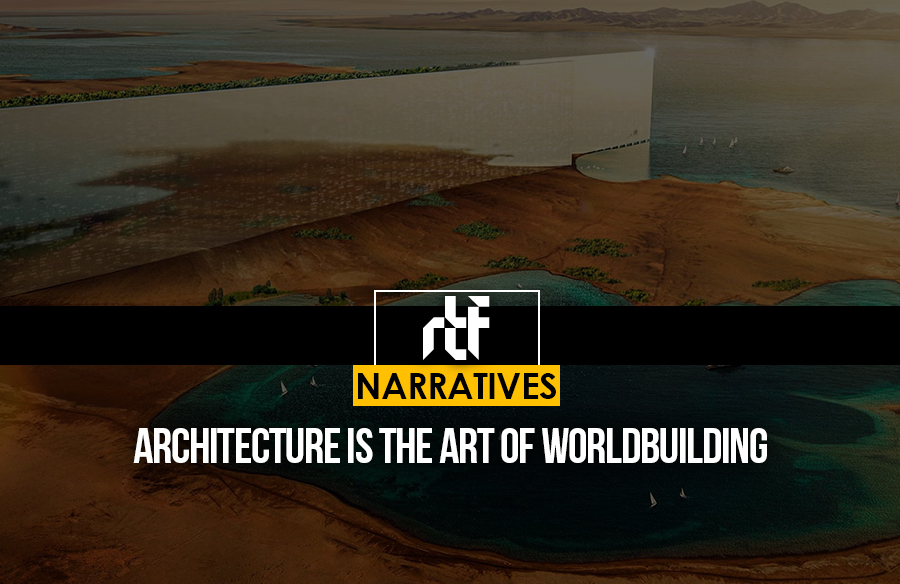
The Line in NEOM, Saudi Arabia is one such example. A linear city of 170 kilometers which will have a height of 500 meters and just 200 meters wide is envisioned as a single building stretching from the Red Sea to Tabuk, Saudi Arabia. While we may consider deserts to be just that—deserted—they are biomes for creatures and the land on which The Line is being constructed came at the cost of evicting and forcibly moving thousands of people from their homes(Lazos, 2022)—realities hidden from the images that are presented by The Line’s designers.

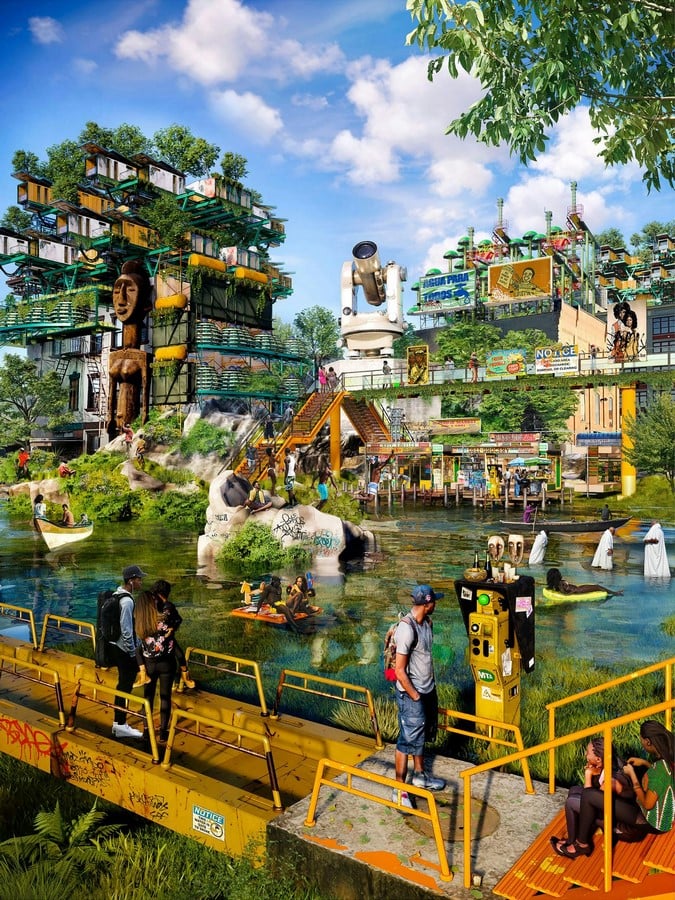
Alternatively, There is the world that Olalekan Jeyifous imagines in his “[TFN] The Frozen Neighborhoods” project which analyzes and reimagines Brooklyn, New York following the government’s institution of “mobility credits” to reduce greenhouse gas emissions. Under capitalism, these credits become corrupted and Jeyifous imagines how the world looks regarding this shift which still reflects the underlying issues of inequality along racial and ethnic lines which is pervasive in the United States.


Push for Worldbuilding and a Pluriverse of Storys
If architecture school is the act of worldbuilding, and architects are trained to tell stories, then we must ask, how many stories, and therefore alternative ways of life, do we wish to envision for our built future? This is the envisioned reality of pluralism, where “people of different social classes, religions, races, etc, are together in a society but continue to have their different traditions and interests” which demand alternative built worlds (www.britannica.com, n.d.).
The problem we face is that our built world today favors a single story: globalized development under modernity, capitalism, state domination, and masculinist values. This is visualized in our built world through glass-shrouded skyscrapers, domed-capital buildings, and nondescript industrial factories. Instead, we must ask, and allow architects—just as students in architecture schools are—to envision new futures of worldbuilding. This pluriverse, constructed of many worlds and the stories that tell them, will then reflect the reality that underpins architecture schools’ pedagogies: to support and help ideate worlds that the young hope to inhabit in the future.
References
Bassler, B. and Hedges, K.E. (2017). Architectural Graphic Standards. Somerset: John Wiley & Sons, Incorporated.
Jeyifous, O. (2021a). Grand and Flushing: Farm + Freshwater Corridor. Available at: https://jeyifo.us/MOMA.
Jeyifous, O. (2021b). Plant Seeds, Grow Blessings: BLKYN Interfaith Seed Vault. Available at: https://jeyifo.us/MOMA.
Jeyifous, O. (2021c). The CrownPro Wetland Intersection. Available at: https://jeyifo.us/MOMA.
Lazos, N. (2022). Analyzing the Environmental and Social Factors of the Saudi Arabian Project ‘The Line’. opentext.ku.edu. [online] Available at: https://opentext.ku.edu/environmentalgeopolitics/chapter/analyzing-the-environmental-and-social-factors-of-the-saudi-arabian-project-the-line/#:~:text=Thousands%20of%20people%20were%20evicted.
NEOM (2022). THE LINE. [online] www.neom.com. Available at: https://www.neom.com/en-us/regions/theline.
www.britannica.com. (n.d.). Pluralism Definition & Meaning | Britannica Dictionary. [online] Available at: https://www.britannica.com/dictionary/pluralism#:~:text=%3A%20a%20situation%20in%20which%20people.