

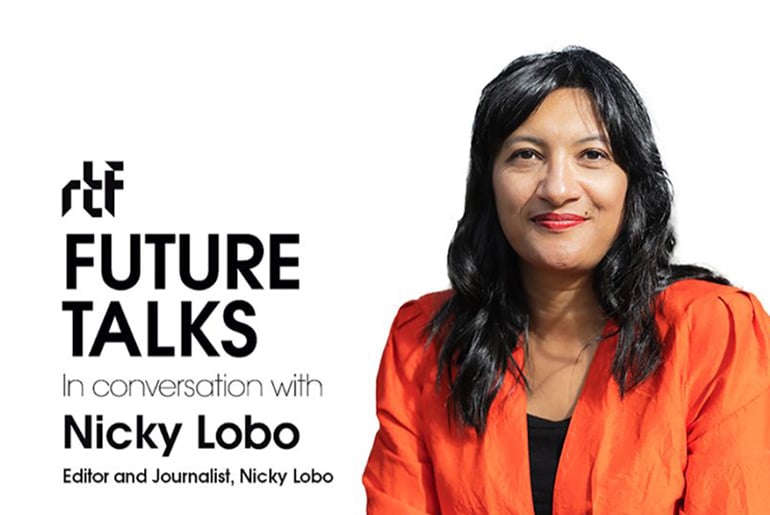
Ladies and gentlemen, envision a journey through the captivating world of design, where innovation meets creativity, and where the stories behind the most exceptional brands come to life. It is our pleasure to introduce you to Future Talks by RTF, a platform where pioneers of the design industry share their experiences and insights, shedding light on the evolution and soul of design.
Today, we have an opportunity to bring industry insights from none other than Nicky Lobo, a luminary in her own right. With over 15 years of experience as a writer, editor, and brand strategist, Nicky’s journey has taken her through the realms of publishing, freelance work, and agency collaborations. Her expertise lies in weaving words that breathe life into brands, and she has an uncanny ability to connect deeply with audiences, fostering a profound relationship between businesses and their patrons.
Nicky’s passion lies in unraveling the essence of design, not merely through words, but by delving into the very heart of creative enterprises across architecture, design, property, and travel industries. Her mission is clear: to employ the power of language as a catalyst for growth and evolution in the world of business. Whether it’s crafting compelling brand strategies, writing captivating copy, or orchestrating special content projects, Nicky is the driving force behind the stories that shape the future.
Join us on this remarkable journey, as we explore the design universe through the eyes of those who have breathed life into it. “Future Talks” by RTF promises to be a portal where design enthusiasts, entrepreneurs, and visionaries converge to celebrate the past, present, and, most excitingly, the future of design.
RTF: Hi Nicky, We are glad to have you as a guest on Future Talks by RTF. Thanks for joining us. Congratulations on your new website. What is your vision of it and what were the challenges involved in coming up with it?
Nicky: Thank you for inviting me here, and for the congratulations. The vision was to put my services out into the world in an authentic and strategic way, in order to attract the right kind of clients and work. The previous website was quite general as I put it up when I first started freelancing, so the approach was very much ‘I’ll do anything for anyone’. After 7 years of business, I had the experience and motivation to look at what I had been doing, think about what I enjoy, what I do best, and how I can best serve people.
As anyone who’s put a website up knows, there are many challenges along the way. As a brand strategist and copywriter, I have an advantage when it comes to the words (though I still went through 7 versions of the copy!). However there are many parts to a website that I’m not skilled in, such as branding, website design and development. Of course, anyone can do anything DIY these days, and there are amazing resources for those who want to go down this route. For me, it was important to collaborate with skilled professionals – not just for a better result, but also to cultivate the momentum and spirit of being in a team. As a remote, freelance business, these opportunities for creative collaboration are greatly welcomed. The biggest challenges for me are generally around decision-making, so having the right people around me—contractors as well as friends, mentors and colleagues—was critical.
RTF: What was your idea behind recently pursuing a master’s in peace and conflict studies when you professionally look well settled?
Nicky: This study was definitely a wild card decision! I was on a kind of work hiatus at the time, on an 18-month adventure in Florence, Italy, living with an amazing 90-year-old woman named Claudia, as her companion. In the relative peace and quiet of a Florentine village, without the ‘noise’ of ongoing projects, I realised that I wanted to study again. I considered a few different courses, but once I came across this masters, I knew it was ‘the one’. Although I’d never studied anything like it before, the description really pulled me, and I remember thinking it would be really important for me to learn, however challenging, about these ever-present topics.
So whilst it wasn’t strategic in the sense of knowing what I wanted to get out of it, it has greatly impacted my life, the way I look at things, and how I approach living in the world. I ended up writing a dissertation inspired by my stay with Claudia, looking at ageism as a generational conflict and exploring how multigenerational living might address some of the problems. I hope to further research, write, and ultimately collaborate and consult with organisations working in aged care and senior living design, and who are envisioning more integrated communities.
RTF: You’ve worked as an Editor at Habitus. How has ‘redefining’ come into play for magazines when it comes to ideas and approaches, looking at a constant shift in the media landscape and people’s perception towards it?
Nicky: I finished up with Habitus in 2016, so it’s been quite a while since I sat in an Editor’s chair. However, I would say that ‘Redefining’ is a constant in media, publishing and content in general. On a micro level, stories about people will always reflect their time and place so themes and angles are always being reshaped; and on a macro level, technologies, markets and audiences are shifting rapidly, impacting the way stories are told. Thousand-line epics recited by memory over several nights around the village campfire could now be a 280-character tweet, a 2-minute video, an animation… who knows where it will go in the future.
But a good story or message will always connect with people, regardless of the format.
RTF: How did you look at the interests of advertisers in publishing? What was the ‘acceptable’ amount of influence that you let in?
Nicky: As in any profession, writing and editing is part of an ecosystem, of which advertisers are a core and critical component. Without one or the other, the industry doesn’t survive and audiences don’t get what they need and want. So it’s important to find ways to work together in order to meet the objectives of multiple stakeholders – and these negotiations are actually fertile areas for creative collaboration. We were lucky to have close relationships with our sales team, and so by communicating regularly and openly about different perspectives—with the audience’s expectations and experience as a shared guiding principle—we were usually able to find solutions for promotion that felt balanced, intuitive and beneficial to all parties.
RTF: How did you look at the content that comes your way and decide on working towards that? What was the process like? From selection to the importance of pitch?
Nicky: Managing editorial content is both a science and an art. There are strict parameters to work within—budgets, timelines etc.—as well as huge creative freedom in theming and execution, so the process is equal parts organised and intuitive. When deciding on pitches, there are several initial considerations including available space, project quality, publishing exclusivity and budget. After these foundational criteria, decision making can become more subtle, depending on the approach of the title. With Habitus, we would consider the issue theme, the balance of projects geographically, typologically, project size, new build vs. alteration/addition, and aim for a cross-section of established and emerging practices, and increasingly, representation of women- and Indigenous-led projects. So it’s quite a balancing act, added to the fact that editors are as a rule quite busy – which means that the way that practices pitch can have a big impact on the editorial decision.
RTF: What would you suggest to aspiring designers and creatives who wish to get their feature published in the top publications? What are some challenges in doing so?
Nicky: To create a good pitch, you need to show the editor (through words and images) why the project is a good fit for the publication.
We all know that good photography is critical. First of all in terms of quality – most print publications will be looking for 300dpi minimum, whilst online only needs to be 72dpi; and all shots should be sharp and clear. You also need to think about a range of horizontal and vertical shots; and a variety of scale, from contextual down to detail. If you have a particular publication that you want to be featured in, get familiar with the style of photography they like. You could even consider commissioning a photographer whose work they’ve already published.
With the words – it’s helpful to have a press release or at least a short project description so the editor can get a feel for the story behind the images. What is really great though, is if you can also communicate why the project is a good fit (beyond it’s a ‘good’ project) for that particular magazine or website. Do they have a particular editorial focus or approach that your project or practice is aligned with? Is there a feature or section eg. coastal projects, small projects, renovations etc. where your project could work well? The more you know the publication and can think like an editor as to how your project would add value to their content, and be a drawcard for their audience, the more chance you’ll have of identifying aligned opportunities.
RTF: How impactful is a comprehensive media kit according to you? How can it be made better?
Nicky: A media kit doesn’t have to be lengthy or huge – it just needs to be smart. In fact, sometimes having too much information can be overwhelming.
My recommendation is to keep press releases or project texts to a single page if you can. Be succinct and write in a way that helps the editor understand the project beyond what they see in the photography. I see a lot of architects and designers simply describing the elements in an image, and whilst some key features are good to include, what’s often more useful is to share the brief, the design response, key challenges and how they were overcome. Use paragraphs and even bullet points to create pause and hierarchy, and including quotes – from the project lead or a client representative – can be a powerful way to ‘show, don’t tell’.
Be succinct also with photography. You don’t need to include every version and every angle of a space; instead put in the effort to edit your selection before you share with an editor. Choose a few hero shots and perhaps 1–2 shots of each space or zone, with a couple of details to reveal your aesthetic. I’d say 10–15 shots should be enough to make a decision, and you can always let them know that there is more photography available.
Of course, many magazines and online journals will have specific submission criteria, which you should adhere to as closely as possible. So in general – do a bit of homework before you pitch.
RTF: What were some challenges you faced while working as an editor for Habitus magazine? What would be your tips for young professionals wishing to enter the fray of editing and publishing?
Nicky: As with many careers, time management was a huge challenge and learning curve as my responsibilities grew and became more complex. I ended up doing a 3-day time management course, which exposed me to some excellent strategies and models for prioritising, setting boundaries and organisation that I still use today.
The other big challenge was staying playful and creative amidst the deadlines and pressure of print and online publishing. As an editor, it was important to carve out time for visiting new places, meeting people and having the kinds of conversations that could spark the theme for an issue, or plant a seed for a story idea.
To anyone wishing to get into architecture and design writing – start writing! The more practise you have not just describing projects, but also telling the story behind a space, the better. You could do a writing course to keep you motivated and accountable, or even ask to contribute or intern at a publishing house you admire. That’s how I got my foot in the door!
RTF: What are your plans for the future and what are some off-the-table habits that keep you motivated?
Nicky: My plans are to continue helping businesses to grow and transform through the power of words. I’m looking forward to some professional collaborations on the horizon, and hopefully doing some more speaking and sharing in verbal formats. I feel this expansion of my professional relationship with Voice, from written to vocal, will be the next challenge and opportunity for me.
Outside of work, I have a couple of things that keep me motivated. Yoga is a big one, which I started doing as an antidote to work stress; and which ended up becoming a passion, a career as I studied and then taught for a while, and a real anchor in my life.
The other thing that I do without fail is read. After absorbing so many dense, and often heavy academic journal articles during my 3 years of recent study, returning to fiction feels like such a treat. I typically have 1 or 2 fiction books on the go (I have to have 1 ‘boring’ one to read before bed so that I don’t stay up all night), and usually 1 non-fiction as well, to feed my inner student. Yoga and reading definitely keep me supple, humble and hungry for more – there’s always so much more to learn!


