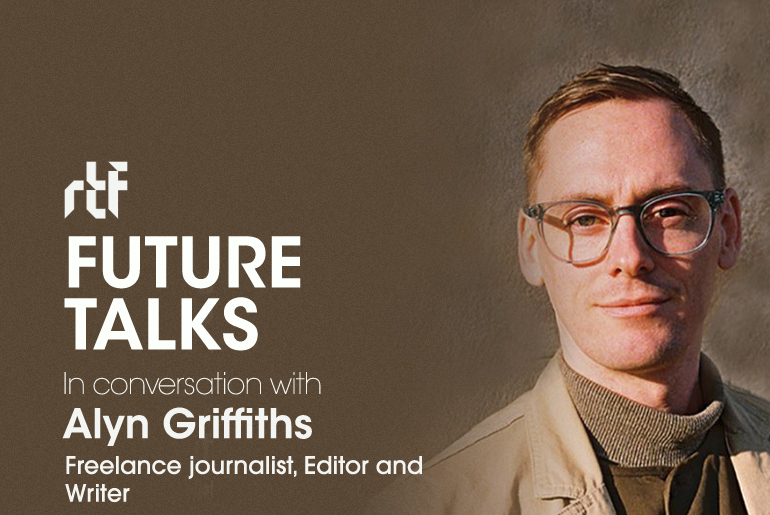
Welcome to “Future Talks” by RTF, a captivating series of conversations with the visionaries who breathe life into design narratives. In this enlightening series, we delve deep into the world of contemporary culture and creativity through the eyes of Alyn, a seasoned journalist, editor, and copywriter with over 12 years of experience in storytelling.
Alyn’s journey began when he obtained his Master of European Design from the prestigious Glasgow School of Art, setting the stage for a remarkable career. His early days in London saw him taking a bold step by launching his own blog, marking the inception of his exploration into the realm of design, culture, and creativity.
Alyn has written for leading publications including Wallpaper*, CNN Style, Dezeen, FT Property and Interior Design magazine. He was the Design Editor at Port magazine and has authored three books; 21st Century Lighting Design (Bloomsbury, 2014), The Future City (Lannoo, 2021) and Hidden Architecture (Lannoo, 2022).
Alongside editorial content, Alyn works with brands to create engaging copy for websites, e-commerce platforms and printed publications. He has also helped to produce short films, podcasts and experiences that bring a brand’s values to life.
Join us on this captivating journey as we engage in enlightening conversations with Alyn and the pioneering minds who bring design stories to life. “Future Talks” by RTF promises to be an inspiring exploration of the creativity that shapes our world.
RTF: Hi Alyn, We are glad to have you as a guest on Future Talks by RTF. Thanks for joining us. Congratulations on your latest book ’The Future City’, which is an insightful read. What was your motivation behind coming up with the book?
Alyn: I think to some extent we’re all fascinated by the future and the idea of what it might look like. What will our future homes be like? How will we design and build cities that help us to confront issues around climate change? Will we all be travelling in flying cars in 20 or 50 years’ time? Architects have an important role to play in determining the answers to these questions and I thought it would be interesting to compile a selection of projects that help to illustrate different visions of the future city.
One reason for producing this book now is that the standard of computer-generated imagery has improved immeasurably in recent years, so these speculative projects can be made to look very real. Almost all of the case studies featured in the book are illustrated using renderings rather than photography, which is unusual for this type of publication. I thought it was a great opportunity to share ideas about how architecture can address the problems of today by making cities cleaner, greener and smarter, as well as presenting more speculative concepts such as floating cities that could combat rising sea levels or cities built on the moon. The Future City aims to be both informative and provocative, prompting readers to consider what sort of urban future they wish to experience.
RTF: You have worked with numerous prominent architecture and design websites, what propelled you to take this realm of writing?
Alyn: I began my writing career in 2011 when I started my own blog covering art, design and culture in London. It was a fun way to share the experiences I was having at the time visiting exhibitions and attending events. I never paid much attention to how many people were reading it and it’s one of my biggest regrets that I didn’t keep it going once I started to receive commissions from various architecture and design magazines and websites.
I was lucky to have the opportunity in the early days of my career to work for a diverse range of publications, both in print and online. Sadly, many of the printed magazines no longer exist or have gone online only. However, I did take a role as Design Editor at Port magazine in 2014 and loved working with the team there to produce a really beautiful publication. The rise of online publishing allows us to reach a much wider audience which can be rewarding and exciting. Websites like Dezeen do a great job of presenting new and interesting projects to an audience of millions, which can really make a difference to the career of an architect or designer.
RTF: What is the striking factor in the chunk of content that comes your way, how do you look at the content and decide on working towards that? What is the process like?
Alyn: I typically receive a couple of dozen press releases every day and the first thing my eye is usually drawn to is the imagery. Design and architecture are such visual disciplines I think it’s natural to engage first and foremost with how something looks. Of course, there also needs to be substance and quality to the actual design – a flashy image isn’t a good enough reason to publish a project. An intriguing headline can also grab my attention and it’s still exciting when something lands in my inbox that could be truly groundbreaking or make for a really interesting story.
RTF: How have you seen the architectural and design landscape change since you began working? Are the changes ‘positive’ and ‘encouraging’?
Alyn: I think the biggest change in architecture and design in the past decade or so has been the increased focus on sustainability, and this can only be a good thing. I started my career at a time when this topic was not discussed nearly as much and terms like ‘upcycling’ and ‘adaptive reuse’ were just beginning to enter the lexicon. Now, almost every press release I receive outlines the sustainable credentials of a product or architecture project, demonstrating that brands are increasingly engaging with design to help them implement their ecological agenda in a creative way.
RTF: What are some challenges that the interviews and general exchanges with architects and designers present?
Alyn: For me, the key to interviewing someone is always to try to ask the questions you think your readers would ask if they had the opportunity. This means identifying why a product or project is particularly unique, innovative or exciting, and trying to understand how it came to exist. What was the creator’s motivation and mindset when developing it? What was the main thing they set out to achieve and what was the process that brought them to this particular outcome? Then I focus on the details that are important to making a project successful.
I think that my background as a graduate of a Product Design programme helps me when I interview architects and designers as I have an appreciation of how difficult it is to bring something new into the world. This process of problem solving that starts with a blank piece of paper and can end up as anything from a skyscraper to a gadget or an improved service is endlessly fascinating to me and I enjoy talking about it with some of the world’s greatest innovators.
RTF: What is your idea of a perfect media kit? What should it consist of?
Alyn: This is something I feel is very important and should be taught more to students during their education. I have presented a short course on preparing press releases at a couple of universities in the UK to help students understand the best way to communicate their ideas. The first thing to understand is that the quality of the imagery is key: a good idea can easily be ignored if it’s not supported by professional quality photographs or graphics. Then, it’s really about showcasing the core point of difference that makes a project unique or innovative. This needs to be clearly communicated through a strong headline and reinforced through an explanatory text that outlines the main innovation. The rest of the text should tell a story about the problem the project or product solves, what brief the designer was given or gave themselves, how they solved the problem, and then provide any interesting details that are relevant to the readership, perhaps about innovative uses of materials, manufacturing or construction processes etc.
RTF: From Tadao Ando to Richard Sapper, you have interviewed generational architects and designers. How inspiring and fulfilling have these experiences been?
Alyn: In any industry, the star names are the ones people look to for their insight and opinions. It can be very difficult to get any time with these people so when you have a chance it’s important to try to ask questions that relate to wider societal issues alongside allowing them to talk about their recent work, which is usually what they want to do! So, for example, Tadao Ando told me about how he uses natural elements to give his buildings their “emotional power” and Thomas Heatherwick explained to me how he aims to engage with the human experience when designing both products and buildings. These are the sorts of insights I feel will interest and inspire readers who perhaps want to follow in the footsteps of these revered creative figures.
RTF: What fuels your creativity? And what are the things you resort to when not working?
Alyn: I’m fortunate to have a job that I enjoy and that brings me into contact with inspiring and creative people on a regular basis. The design industry is at the cutting edge of the changes that will define our future society so I try to work on projects that allow me to engage with the people at the forefront of this ongoing process. I also enjoy diversifying into other industries, though, which are related to my own lifestyle and personal interests. I’ve done some work writing about whisky and working with drinks brands which is fun because I’m based in Scotland and love whisky! I also write about travel and accommodation as this gives me opportunities to visit and stay in amazing places. A lot of the time, there is a crossover with these projects and design because the best brands, whether in hospitality, beverages or any other industry, understand the power of good design to add value to their offering.
RTF: How would you advise aspiring writers and editors who are eager to break into the field and advance their careers?
Alyn: A typical way to get started in any industry is to work with an established company but journalism is different today to when I started out because there are fewer print publications still operating. I worked in house for the publisher of Blueprint magazine and IDFX magazine as well as spending time in the offices of Dezeen and trend forecasting agency WGSN. These experiences helped me learn how to write for different audiences and how to work as part of a team to produce relevant and engaging editorial content. I also had my blog, which became an important portfolio for my writing and for showcasing my interests. There are so many platforms today that people can use to self-publish their own content so I would recommend building a unique and interesting online presence while trying to gain some appropriate industry experience. Most importantly, always focus on quality in everything you do as this will lead to success in the long run.