Fjord City Background | Mixed-Use Development
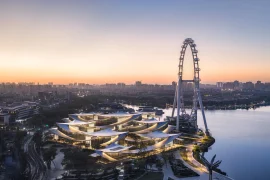
Fjord City or Fjordbyen is a large-scale waterfront urban renewal mixed-use development project in the city of Oslo (the capital city of Norway). This project has had a large impact on tourists and Oslo residents (Fjord City: A waterfront urban renewal project, 2018). The initial development of Fjord city began in the 1980s with Aker Brygge. It is a well-known area for cafes, bars, and restaurants at the center of the Oslo Waterfront. Responding to the success of this area, the Oslo City Council, in 2000, decided to invest in securing recreational areas and increasing accessibility to the Fjord City and further develop it.

Work on Fjord City began in 2008, with the area scope ranging from Frognerkilen to Sydhavna. Sydhavna was established as Oslo’s permanent harbor. The former harbor areas released for urban development purposes were Tjuvholmen, Bjorbvike-Bispevika, Filipstad, and Sorenga-Loenga. All of these areas, except Bispevika, have been developed in the last few years. The area now has flourishing public recreational spaces like boardwalks, swimming spots, fishing areas, residential areas, and offices compared to the industrial quarter it was before this development. The entire area has an excellent architecture that pushes the boundaries of what high-rise architecture, among other typologies, should be in the contemporary architecture scene.

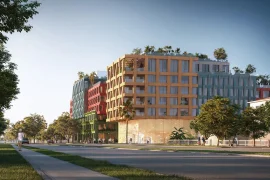
Bispevika is the last remaining part of Fjord city to be developed. Norwegian architecture offices A-Lab and LPO have recently revealed the plans to develop the last remaining plot in Bispevika (Florian, M. C., 2023). The new intervention strengthens the connection between the historic medieval city of Oslo to the new Fjord City while also introducing cultural, creative, and commercial activities to the area.
Context
Bispevika is the last part of Fjord city that hasn’t been developed yet. It is on a plot called C6. While most of Fjord city is designed with modern architecture, Bispevika is the part of the precinct that is adjoining the historic, medieval city of Oslo. Thus, for the architecture of Bispevik, the development of this plot needed to reflect the character of the old and the new, acting as a mediator of sorts between them both.
The Barcode | Mixed-Use Development

The Barcode is an important part of Fjord City. it is a master planning project consisting of two rows of high-rise buildings that compromise the majority of Oslo’s skyline. Each building is the creation of celebrated architecture firms across Europe. The Barcode represents modern architecture and is synonymous with contemporary architectural exploration pushing boundaries and exploring the possibilities of what the high-rise building typology could be. The area is called the Barcode since the buildings form an enticing composition with the gaps between them creating the impression of a barcode (Abourezk, A., 2018).
The buildings in the Barcode are examples of very creative conceptualized ideas turned into reality. Architecture firms like Dark Arkitekter, A-lab, MVRDV, and Snohetta are among the many that designed buildings for the Barcode. There are highrise buildings that form giant staircases, resemble Etris, or use the facade cladding pattern on a planar surface to create visual attractions.

Oslo’s Old Town
On the other side of plot C6 are the remains of medieval Oslo found in Gamlebyen (the Old Town), in the form of ruins, building parts, and cultural layers. The Aker estate and Old Aker Church (Gamle Aker Kirke) in this area used to be a religious center. Though it falls right in the center of the city today, in the Middle Ages this area was outside the town.
Project | Mixed-Use Development

The development plan for Bispevika, as proposed by A-lab and LPO, comprises 5 buildings that come together to form a quarter. A-Lab has been involved in the development of Fjord city since they won the competition for the masterplan of Barcode in 2003, alongside MRDV and Dark. The proposed massing, height, and scale f the buildings are designed sensitively to the context as the height is reduced towards the historical area such as the baroque residence “Ladegarden’ with its baroque garden. The project s developed by the same authority that developed the Barcode in collaboration with landscape architect SLA.

Through the positioning of the buildings in the plan, the proposal creates five plaza-like public spaces at the ground level, open to all. These are vehicle-free, pedestrian-friendly urban spaces whose activity levels are further enhanced due to the functioning on the ground levels of the adjoining buildings, which include public-friendly functions such as meeting areas, cultural activities, restaurants, a cinema, retail spaces, and areas dedicated to children and young people. The purpose behind the functional mix is to establish several low-threshold offerings that differ from the more commercial areas nearby and help create a local identity (Florian, M. C.,2023).
The development encompasses 3,300 square meters of public spaces. The architects’ design intention included creating public space to draw the public from the Barcode and towards the historic city of Oslo by creating urban spaces well connected to the street network. The aim has been to create an area that becomes a merging point for the residents and adds a connection from Fjord city to the rest of the city.

Bibliography
Fjord City: A waterfront urban renewal project (2018) Nordregio. Available at: https://nordregio.org/sustainable_cities/fjordbyen/ (Accessed: 21 January 2023).
Florian, M. C. (2023) A-lab and LPO Unveil Design for a Mixed-Use Development as Part of Fjord City Oslo, a Large-Scale Urban Renewal Project | ArchDaily, Archdaily. Available at: https://www.archdaily.com/994647/a-lab-and-lpo-unveil-design-for-a-mixed-use-development-as-part-of-fjord-city-oslo-a-large-scale-urban-renewal-project (Accessed: 17 January 2023).
Abourezk, A. (2018) Oslo’s Barcode Project Showcased in Stunning Photo Series by Rainer Taepper | ArchDaily, ArchDaily. Available at: https://www.archdaily.com/886296/oslos-barcode-project-showcased-in-stunning-photo-series-by-rainer-taepper (Accessed: 17 January 2023).