The dream of a bridge connecting Sicily to mainland Italy stretches back 2000 years to Roman times, when Consul Metellus strung together barrels and wood to create a floating bridge to move 100 elephants from Carthage to Rome, according to writing by Pliny the Elder.
Project Name: Strait of Sicily – Archipelago Floating Bridge
Studio Name: Renna Studio
Design team: Angelo Renna , Kittan Kodijat
Photographer: Angelo renna

Since then, various plans have been proposed, including tunnels crossing underground and the most recent plan for a single-span suspension bridge, which, if built, would be the longest suspension bridge in the world. This solution, evaluated alongside different possibilities by the Italian government, is considered the most suitable. However, it does not take into account the environmental impact and the fragile ecosystem in which it will be constructed.
In fact, the Strait of Messina lies in a highly seismic zone characterized by significant tectonic movements and turbulent waters. Additionally, this area is crucial for migratory birds, serving as a key passage in their migratory routes. The region is also among the most precious habitats in the Mediterranean, hosting diverse ecosystems and numerous species that depend on its unique environmental conditions. Also, the bottom of sea host numerous special plants like Posidonia and aquatic forest of a Laminaria ochroleuca.

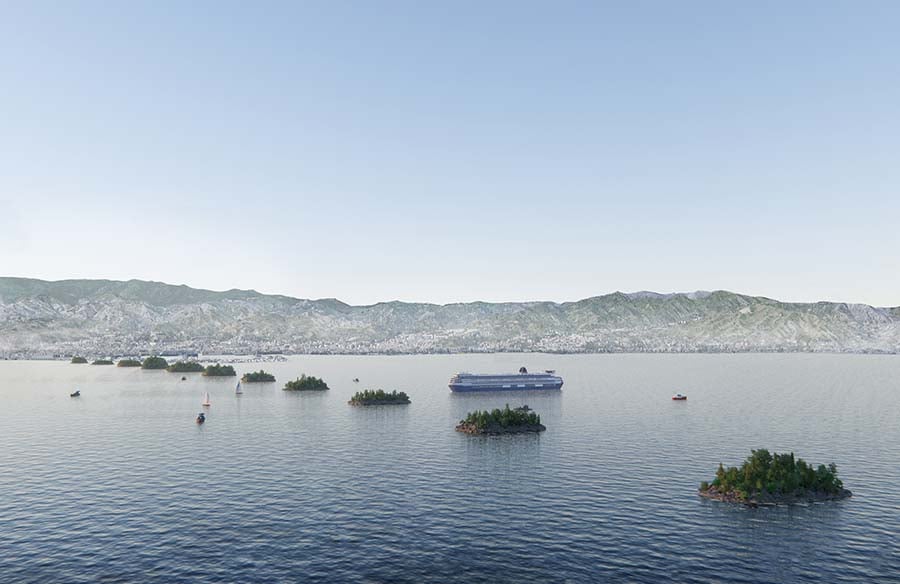
To create a bridge that supports rather than destroys the ecosystem, we propose a submerged floating bridge, also known as a submerged floating tube bridge or Archimedes bridge. This design consists of a tunnel that floats in water, supported by its buoyancy according to Archimedes’ principle. The tube is placed 50 meters underwater, deep enough to avoid interfering with water traffic such as cruises and boats of any size. The bridge is organized to allow cars and trucks on the sides and high-speed trains in the middle, spanning a length of 6.0 km. The underwater bridge will directly connect the Calabrian coast at the Campo Calabro highway interchange of the E45 with Messina Central Station, primarily utilizing abandoned public domain areas.
Additionally, the lower part of the bridge accommodates a bike lane. Terrariums inside the tunnel integrate plants and trees, enhancing the quality of the crossing. Metallic frames anchor the tunnel to pontoons on the water’s surface, preventing it from floating up or submerging. Each pontoon (500 meters apart) is envisioned as an artificial island, covered with soil and plants to create habitats for birds and microorganisms. Underwater, the structure features a topography with geometric variations, forming upside-down hills with peaks and valleys. These areas serve as habitats for various invertebrates, mosses, and plants, promoting ecological diversity in the underwater landscape.

A submerged floating tunnel has never been built, but several proposals have been made by different entities, starting in 1886, when the naval architect Sir Edward James Reed developed the first concept of this type of bridge. Recently, the Norwegian government has been planning to build one in the Fjord to connect different areas of the region. This bridge typology has significantly less environmental impact because it does not require any anchors at the sea floor and the entire structure can be removed at the end of its life. Additionally, all elements are prefabricated, which reduces construction activities in the water and minimizes harmful effects on aquatic life.

Recent studies indicate that submerged floating bridges are particularly suitable for high seismicity zones. Their large transversal flexibility and the additional damping and inertia from water-structure interaction reduce the amount of earthquake energy transferred to the tunnel, provided the connections with the shores are equipped with seismic joints. Research has also explored the potential impact of a submarine collision on the tunnel, assessing the potential damage to both the structure and the submarine. The results showed that the bridge is suitable for handling large deformation problems. However, research on human safety in tunnels after a collision remains limited.