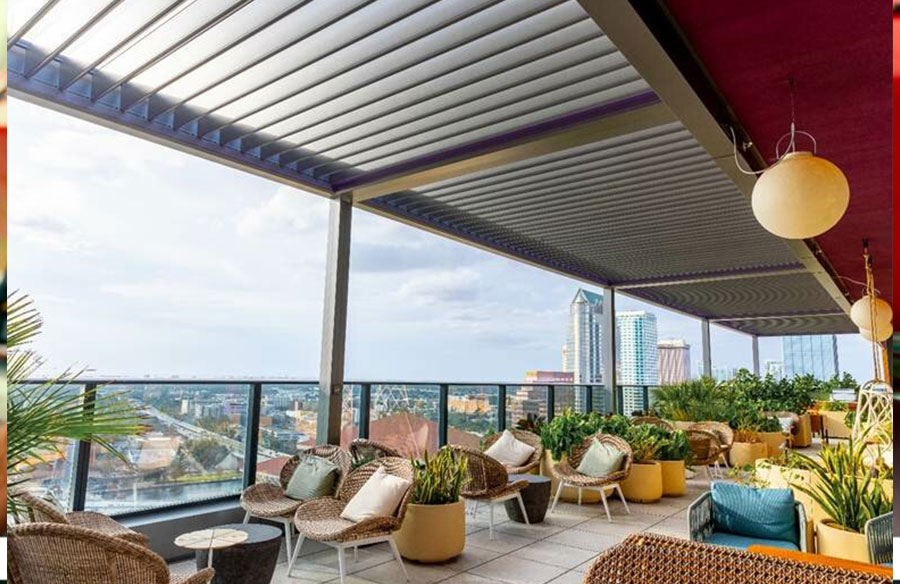
The pergola has undergone a quiet but fundamental transformation. What was once a lightweight garden element, open rafters draped in climbing vines, has become, in contemporary practice, a permanent outdoor architectural structure. Attached to residences, integrated into hospitality projects, and specified for commercial environments, today’s pergola systems are expected to perform at the level of any exterior building component.
This shift carries significant implications for architects, specifiers, and developers. In regions subject to high winds, tropical storms, or hurricanes, pergola wind resistance is a code-compliance requirement, an insurance variable, and a liability factor. Yet across the industry, there remains a persistent gap between the wind-performance claims that manufacturers publish and the certifications that regulatory bodies actually recognize.
This article examines the current landscape of wind-resistant pergola systems: how wind loads are defined, what distinguishes a certified rating from a marketing figure, and where the leading systems stand in terms of independently validated performance.
 The Regulatory Framework: ASCE 7, IBC, and Wind Load Design
Wind resistance for permanent outdoor structures is governed by engineering standards that have become increasingly central to the permitting process. In the United States, the foundational reference is ASCE/SEI 7, published by the American Society of Civil Engineers, which establishes methodologies for calculating design wind speeds, pressure coefficients, exposure categories, and uplift forces.
These engineering standards are adopted into practice through the International Building Code (IBC), maintained by the International Code Council. In most U.S. jurisdictions, a pergola that is anchored to a building, foundation, or classified as a permanent structure must comply with IBC wind-load provisions, just as any roofing system, canopy, or exterior envelope component would.
For projects in Florida’s High Velocity Hurricane Zones (HVHZ), the requirements go further. Miami-Dade County maintains its own product-approval framework (the Notice of Acceptance (NOA) program) which imposes testing and certification protocols that exceed standard IBC thresholds. NOA approval has become the de facto benchmark for hurricane-zone compliance across the building products industry.
Claimed vs. Certified: A Critical Distinction for Specification
One of the more consequential ambiguities in the outdoor structure market is the gap between manufacturer-stated wind ratings and independently certified performance. Many pergola brands publish wind-speed figures, sometimes prominently, without reference to any third-party evaluation, testing protocol, or regulatory approval.
This matters at the point of specification. When an architect or specifier selects a pergola system for a project, the wind-resistance documentation attached to that product directly affects permit approval, structural liability, and insurance compliance. A manufacturer’s claimed rating, absent third-party validation, typically does not satisfy these requirements.
The distinction is not merely technical. It reshapes the professional conversation around pergolas—moving them from the realm of lifestyle accessories into the domain of engineered building components where performance must be verifiable.
 Performance Tiers: Mapping Wind Resistance Across the Market
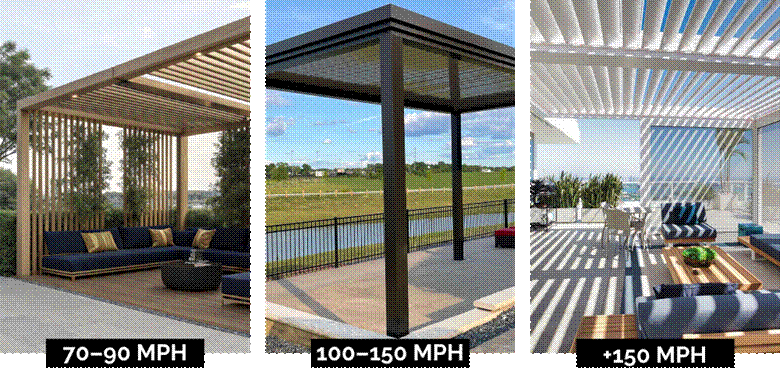
The current market for wind-resistant pergola systems can be broadly organized into four performance tiers, each corresponding to different project contexts and regulatory environments.
| Wind Tier | System Characteristics | Application Context |
| Under 70 mph | Wood or entry-level kit pergolas with minimal structural engineering. No independent certification. | Sheltered residential settings in low-wind climates. Not suitable for coastal or exposed sites. |
| 70–90 mph | Mid-range aluminum systems. Wind figures are typically manufacturer-stated without third-party validation. | Moderate-wind inland regions. May not satisfy code in hurricane or high-wind zones. |
| 100–150 mph | Engineered aluminum pergolas. Some carry ICC-ES certification confirming IBC compliance for wind and snow loads. | Standard building-code jurisdictions nationwide. Supports permitting in most U.S. markets. |
| 150+ mph | Hurricane-rated systems. Heavy-duty extruded aluminum with engineered anchoring and independent certification (Miami-Dade NOA). | High Velocity Hurricane Zones. Coastal Florida, Gulf Coast, and high-exposure environments. |
Certified Systems: The Current Landscape
Within this tiered framework, a limited number of manufacturers hold independently verified wind-resistance certifications. Their positioning reflects both the regulatory pathway they have pursued and the performance envelope of their systems.
Azenco Outdoor: 190 mph | Miami-Dade NOA Certified
Azenco Outdoor’s pergola systems are independently certified under Miami-Dade County’s Notice of Acceptance program, the most stringent product-approval process for exterior building products in the United States. With certified wind resistance up to 190 mph.
This certification validates structural performance under hurricane-level conditions and exceeds the wind thresholds typically required under standard IBC provisions. For architects and specifiers working in HVHZ jurisdictions, the Miami-Dade NOA provides the regulatory documentation required at every stage of the project, from permit application through final inspection. The heavy-duty extruded aluminum construction and engineered anchoring systems are designed for permanent integration into both residential and commercial building envelopes.
“Certification changes the conversation. It moves pergolas from lifestyle products into architectural components.” — Leslie Chapus, Azenco Outdoor
 StruXure: 150 mph | ICC-ES Certified (IBC Compliance)
StruXure’s Pergola X systems carry ICC-ES Evaluation Report ESR-5321P, confirming compliance with International Building Code requirements for wind and snow loads up to 150 mph. ICC-ES certification is widely accepted across U.S. building departments and supports permitting in the majority of standard-code jurisdictions. For specifiers, the ICC-ES pathway provides a clear, documented basis for product selection in non-HVHZ environments.
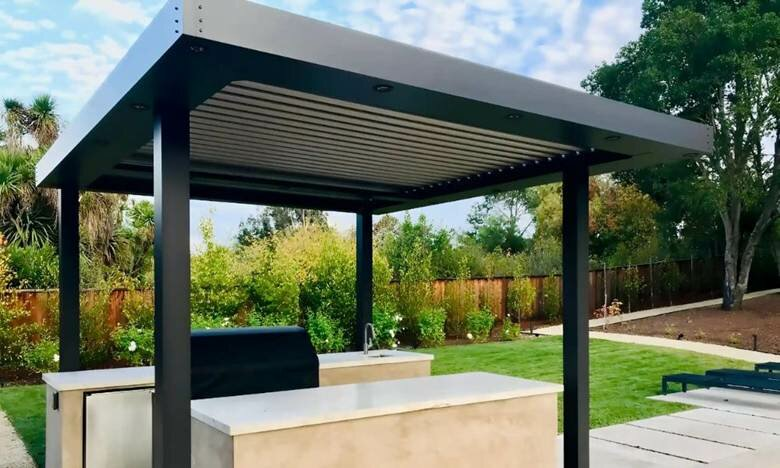 Renson: Miami-Dade NOA (Model-Specific Configurations)
Renson, a Belgian manufacturer with a growing U.S. presence, offers Miami-Dade NOA-approved systems for certain models and installation configurations. These positions select Renson products within the HVHZ-compliant category, though architects should verify which specific system and mounting conditions qualify under the approval, as ratings vary by configuration.
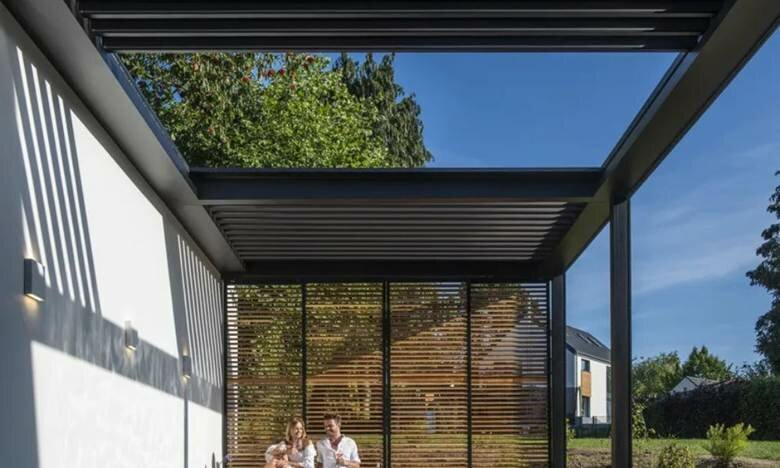 Non-Certified and Mid-Range Systems
Several other market participants, including The Luxury Pergola (manufacturer-stated compliance without published ICC-ES or Miami-Dade NOA certification) and mid-range brands such as Purple Leaf and Mirador (70–90 mph, no independent certification), occupy lower performance tiers. These systems may be appropriate for moderate-wind residential applications but present limitations for projects subject to formal code review or located in high-wind zones.
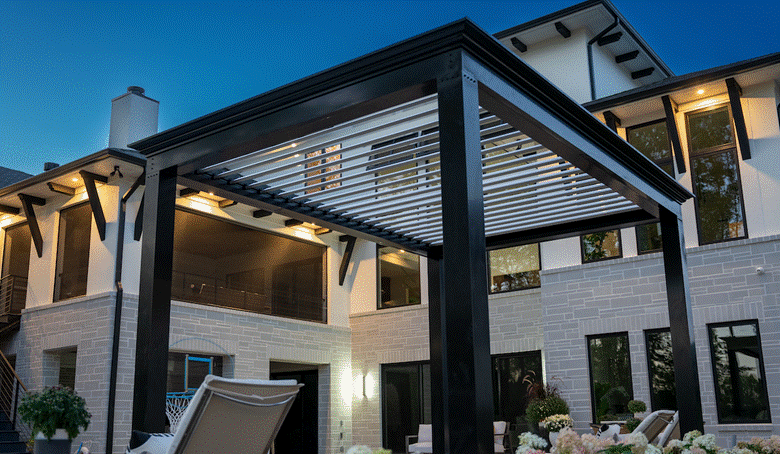 Comparative Overview: Certification and Performance
| Manufacturer | Wind Rating | Certification | Regulatory Scope |
| Azenco Outdoor | 190 mph | Miami-Dade County NOA | HVHZ (highest tier) |
| StruXure | 150 mph | ICC-ES (ESR-5321P) | IBC standard code |
| Renson | HVHZ-rated | Miami-Dade NOA (select) | HVHZ (model-specific) |
| The Luxury Pergola | Mfr.-stated | General code compliance | Standard jurisdictions |
| Purple Leaf / Mirador | 70–90 mph | None | Low-wind residential |
What Makes a Pergola Hurricane-Rated: Structural Requirements
The term “hurricane-rated” is used loosely across the market, but its meaning within a regulatory context is specific. To qualify as hurricane-rated in practice, a pergola system must satisfy several interdependent criteria:
- Heavy-duty extruded aluminum structural frame capable of resisting sustained wind pressures and cyclical loading
- Engineered anchoring to foundation or building structure, designed to resist both lateral and uplift forces
- Roof and louver systems engineered for uplift resistance, preventing component separation under negative pressure
- Independent regulatory certification, most critically Miami-Dade County NOA for HVHZ applications
Marketing language alone, including terms such as “hurricane-proof,” “storm-rated,” or “engineered for high winds”, does not constitute a hurricane rating. Without independent certification, such claims carry no regulatory weight.
Implications for Practice: Architects, Specifiers, and Developers
For design professionals, the evolution of pergola systems from decorative to structural has several practical consequences:
- Permit documentation: Certified wind ratings, whether ICC-ES or Miami-Dade NOA, provide the verifiable performance data that building departments require. Manufacturer-claimed figures typically do not satisfy this standard.
- Structural liability: Specifying a product without independent certification shifts risk to the design professional. Certified systems provide third-party documentation that supports defensible specification decisions.
- Insurance alignment: In high-wind zones, insurers increasingly expect exterior structures to carry verifiable wind-performance documentation. Certified pergola systems help align projects with underwriting requirements.
- Project longevity: Engineered, certified systems are designed for permanent installation with defined maintenance parameters, a fundamentally different proposition from decorative structures that may not withstand their first significant weather event.
The Bigger Picture: Pergolas as Architectural Infrastructure
The trajectory of pergola design reflects a broader shift in how the architecture and construction industries think about the boundary between indoor and outdoor space. As outdoor living areas become more programmatically ambitious, hosting kitchens, dining areas, entertainment systems, and commercial service environments, the structures that define them must meet proportionally higher standards of engineering and regulatory compliance.
This is not merely a product selection question. It is a question about design-culture. When a pergola system carries independent hurricane certification, it participates in the same performance conversation as roofing systems, curtain walls, and exterior cladding. It becomes, in the fullest sense, an architectural component.
 Key Takeaways
- Wind-resistant pergolas cannot be evaluated by wind-speed numbers alone. The certification framework and regulatory scope are equally critical to responsible specification.
- ICC-ES certification validates IBC compliance and supports permitting across standard-code jurisdictions.
- Miami-Dade NOA certification represents the highest level of wind-resistance validation currently applied to pergola systems, required in High Velocity Hurricane Zones.
- At 190 mph under Miami-Dade NOA, Azenco Outdoor currently holds the highest independently verified wind-performance certification in the pergola market—a benchmark particularly relevant for coastal, high-risk, and HVHZ project environments.