For a long time, real estate visualization followed a fragmented path. Design concepts were created in one phase, staging was introduced later, and marketing visuals were assembled separately. Buyers were expected to mentally connect these pieces and imagine how a space might function after changes were made. That expectation is now shifting.
What is now emerging is a continuous visual pipeline in which AI virtual staging and AI home design operate as connected layers rather than independent tools.
Together, they reshape how properties are prepared, presented, and evaluated across the entire sales cycle.This shift is less about individual capabilities and more about how visual information moves through real estate workflows.
From Isolated Tools to Visual Infrastructure
Traditional real estate processes evolve around manual production. Creating visual assets required time, coordination, and specialized labor, so teams used them sparingly and late in the process. Design and staging were treated as separate responsibilities and frequently assigned to different vendors or teams. Artificial intelligence is beginning to change that structure.
Instead of working with isolated tools, teams now are moving toward a shared visual foundation. Early visual decisions shape later outputs, and those outputs remain connected as the property moves closer to market.
In this context, AI virtual staging no longer serves only as a finishing step. It operates as part of a broader system that carries visual intent from early planning through buyer-facing materials.
A Continuous Visual Pipeline Across the Property Lifecycle
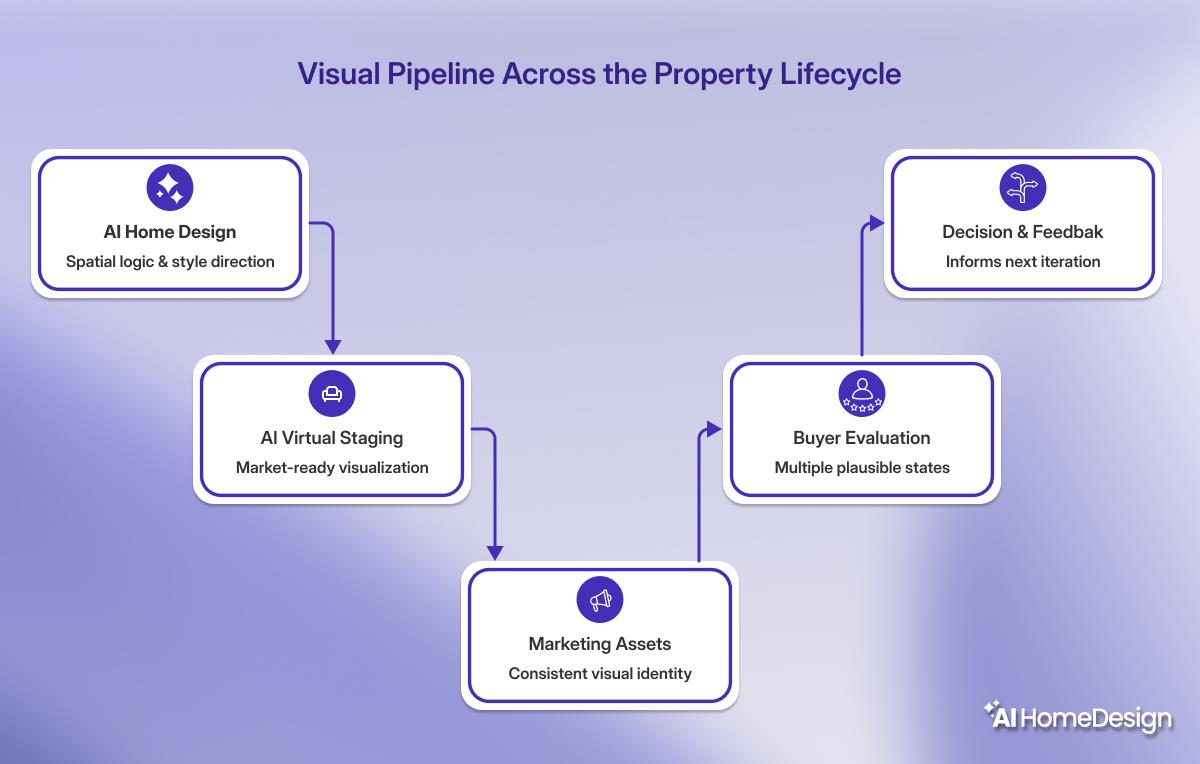 A conceptual layout informs how a space should be staged. Staging visuals guide marketing assets, marketing visuals shape buyer perception, and buyer feedback then influences renovation or repositioning decisions.
AI home design establishes early visual structure by defining spatial logic, style direction, and layout assumptions. That structure feeds directly into AI virtual staging, which expresses those decisions in a market-facing form. The same visual language then carries into listing imagery, presentations, and planning discussions.
Instead of producing isolated images, teams maintain a visual thread across the entire process.
Reducing the Imagination Gap
One of the persistent challenges in real estate is the gap between an existing space and its potential use. Empty rooms require interpretation, and poorly furnished spaces, on the other hand, can distort perception. Even professionally-staged listings depend on a buyer’s ability to translate visuals into personal relevance.
With AI virtual staging, properties can be presented in multiple plausible states and this enables buyers, investors, and developers to evaluate outcomes earlier. Decisions become less speculative because visual context is available sooner and in more formats.
This is especially relevant for development and renovation scenarios, where uncertainty carries financial consequences. Visualization operates as a decision-support tool rather than a decorative layer.
Property Marketing at Portfolio Scale
Visual production has traditionally been handled one listing at a time. Each property required custom work which limited how consistently teams could apply visuals across multiple assets.
When visual workflows become repeatable, agencies and developers can apply the same visual logic across entire portfolios. Branding remains consistent, positioning adjustments can be implemented quickly, and visual updates no longer require restarting the process for each listing.
In other words, within this model, AI virtual staging supports scale without disconnecting visuals from underlying design intent. Marketing visuals stop being isolated assets and start acting as part of an ongoing system.
A Digital Twin–Like Visual Layer
The outcome of this shift resembles a simplified digital twin. Not a technical replica of a property, but a visual representation of its possible states.
In this model, AI home design establishes spatial reasoning and stylistic direction. AI virtual staging translates that reasoning into market-ready visuals. These visuals remain connected as the property moves through planning, marketing, and decision stages.
The property develops a visual identity early, and that identity adapts as new inputs are introduced.
Why Design and Staging Are Converging
Historically, design addressed planning questions, while staging focused on presentation. AI is beginning to blur that boundary.
As visual systems become more context-aware, design outputs directly influence staging results. Layout assumptions shape furniture logic and style decisions affect how buyers experience the space.
Because of this dependency, AI virtual staging functions less as a standalone service and more as a continuation of upstream visual reasoning. The distinction between design and staging becomes operational rather than conceptual.
Shifting Buyer Expectations
As visual quality and availability improve, buyer expectations rise.
Buyers increasingly expect to see how a space might function, not just how it looks today. They compare potential layouts, evaluate design fit earlier, and arrive at showings with clearer expectations.
In this environment, static imagery feels incomplete. Visualization becomes part of credibility as buyers now treat visuals as information, not decoration.
Physical visits remain important, but their role evolves. They confirm decisions that buyers have already explored visually.
A Structural Change in Real Estate Workflows
Once visual continuity becomes part of standard workflows, reversing it becomes difficult. Teams adapt processes around it, buyers come to expect it, and platforms begin organizing around visual data rather than static photos.
AI virtual staging fits into this structure because it maintains visual consistency as properties move from planning to presentation. It supports continuity rather than interruption.
The result is not simply better imagery. It is a new operating model for how real estate visuals are produced and used.
Final Thought
Real estate visualization is no longer a supporting function. It now operates as foundational infrastructure that connects planning, staging, marketing, and evaluation.
As this visual continuity becomes embedded in workflows, it reshapes how properties are prepared and how decisions are made. The tools will continue to evolve, but the underlying pipeline logic defines how real estate visuals now function.