
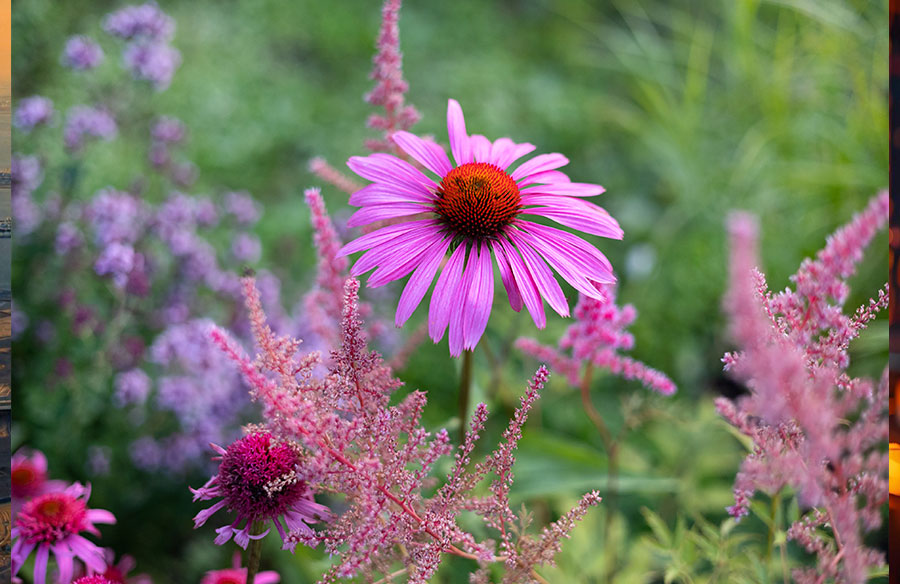
Most gardeners reach a point where they stop chasing novelty and start asking harder questions. Not “what will look good this season?” but “what will this garden look like in five years?” That shift in thinking is usually the moment native plants start making real sense, and native perennials in particular.
Native plants have an earned reputation for resilience, but the case for building a landscape around them goes deeper than drought tolerance or low maintenance. Native perennials are the structural layer of a functioning garden ecosystem. They return year after year, improve with time, support local wildlife in ways that non-native ornamentals simply don’t, and, once established, ask very little in return.
Why Perennials Outperform Annuals Over Time
Annual plants have their place. They’re useful for filling gaps, introducing quick color, and testing combinations before committing. But they come with a cost that compounds quietly: the time, money, and energy spent replanting every season adds up over years in ways that most gardeners underestimate at the start.
Perennial plants change that math. You plant them once, and if you’ve chosen the right species for your region and soil type, they continue showing up season after season. Many native perennials, once established, become genuinely self-sufficient. They spread at a reasonable pace, fill in bare patches, and grow more impressive with each passing year rather than requiring annual replacement to maintain their visual impact.
The long-term savings are real. Perennials that are well-suited to local growing conditions rarely need supplemental fertilizer, tolerate seasonal drought without crisis, and build root systems that improve soil structure over time. That’s a fundamentally different return on investment than replanting annuals every spring.
Native Perennials and the Ecosystem They Support
Beyond economics, there’s the question of what a garden actually does for its surroundings. This is where the case for native plants becomes much harder to argue against.
Native perennials have co-evolved with regional insects, birds, and soil organisms over thousands of years. The relationships that exist between a native blazing star and the specialist bees that depend on it, or between milkweed and the monarch butterfly, are not relationships that non-native ornamentals can replicate. Gardeners who prioritize Perennials that are native to their region are doing something that genuinely matters at a landscape scale, not just aesthetically, but ecologically.
The numbers behind this are difficult to ignore. According to the Xerces Society for Invertebrate Conservation, eastern monarch populations have declined by more than 80% since the 1990s, and western monarch populations by more than 95% since the 1980s. Milkweed and native nectar plants, including many native perennials, are the primary resources monarchs depend on throughout their migration. Planting them is direct, meaningful habitat restoration.
And monarch butterflies are far from the only species under pressure. A study cited by the Xerces Society in March 2025 found that total butterfly abundance across the United States declined by 22% between 2000 and 2020. That means for every five butterflies visible two decades ago, roughly four remain today. A garden built around native perennials and native plants more broadly is one of the most practical responses a gardener can make to that trend.
Choosing the Right Native Perennials for Your Garden
Not all native perennials perform the same way in every setting, and the difference between a thriving native planting and a struggling one usually comes down to plant-to-place matching. Soil type, light levels, moisture retention, and hardiness zone all factor in before a single plant goes in the ground.
That said, there are several native perennials that consistently perform well across a wide range of conditions and that experienced gardeners return to repeatedly because they deliver results year after year.
Milkweed (Asclepias spp.) is the single most important native plant you can add if monarch conservation is a priority. It’s the only host plant for monarch caterpillars, and several milkweed species thrive across a range of sun and soil conditions. Butterfly weed (Asclepias tuberosa) works particularly well in drier, sunny spots and is one of the longest-blooming native perennials available.
Blazing Star (Liatris spp.) brings vertical structure and rich purple color to mixed perennial borders. It establishes quickly, tolerates drought once rooted, and draws butterflies and native bees in large numbers. In a garden context, it pairs well with the rounder forms of coneflowers and black-eyed susans to create layered interest.
Wild Bergamot and Bee Balm (Monarda spp.) provide some of the highest pollinator value of any native perennial, attracting hummingbirds, bumble bees, and a wide range of specialist bees. They spread naturally over time and can be divided every few years to maintain vigor and share with other areas of the garden.
Goldenrod (Solidago spp.) is frequently misunderstood as a cause of hay fever (it isn’t; that’s ragweed) and underplanted as a result. It’s one of the most ecologically valuable native perennials in existence, providing late-season nectar when most other plants have finished blooming and supporting over 100 species of native bees. It deserves a place in almost every native garden.
Native Asters extend the productive season well into fall and provide critical late-season food sources for migrating monarchs and other pollinators. New England aster in particular offers both ornamental value and strong ecological function, blooming in rich purple well into October across much of the eastern United States.
Building a Planting Plan That Works
The best native perennial gardens aren’t random collections of individual plants. They’re thought through in terms of bloom sequence, plant height, ecological role, and seasonal interest. A well-designed planting should have something happening from early spring through late fall, with structure and texture remaining through winter.
Start with a framework of three to five native perennials that you know are suited to your conditions, then add species over time as you understand how the space performs. Many experienced gardeners and restoration professionals use the USDA PLANTS Database as a starting point for regional species verification before committing to a planting plan.
Spacing matters. Native perennials that spread naturally will do so, and a planting that looks sparse in year one is often exactly right by year three. Resisting the urge to fill every gap immediately is a discipline that pays off.
The result, if you get the plant selection right, is a garden that requires progressively less intervention as the years pass. That’s the honest return that native perennials offer: not dramatic instant impact, but compound improvement over time. For gardeners playing a long game, that’s the more interesting proposition.