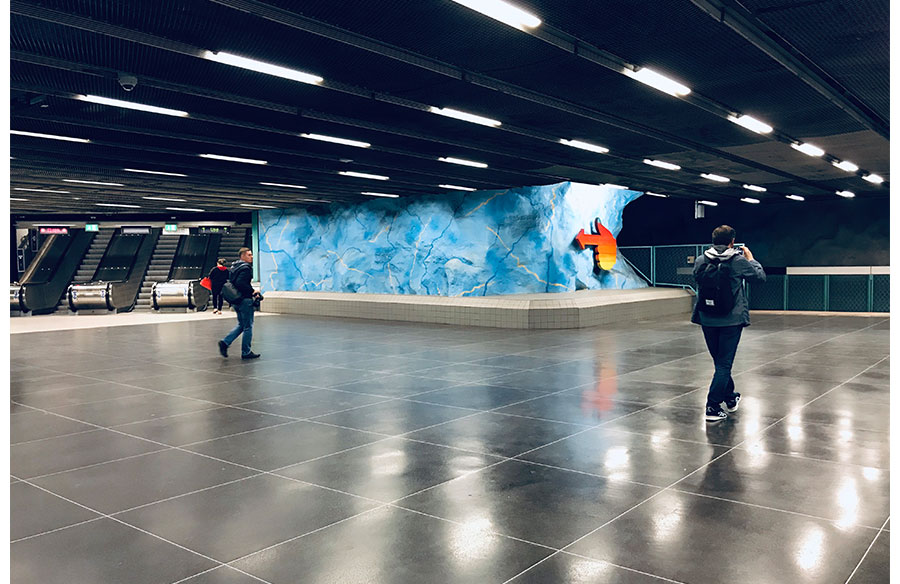
Airports today function less like transportation facilities and more like complex urban environments. Major terminals operate as miniature cities where architecture must organize vast volumes of space, guide thousands of passengers per hour and simultaneously create an environment that feels coherent rather than overwhelming. Within these immense interiors, one of the most persistent design challenges is memory: how to make a place that passengers remember even after passing through it only once.
Large-scale kinetic installations integrated into architectural surfaces — often referred to as kinetic wall — have begun to address this challenge in increasingly sophisticated ways. Rather than functioning as decorative additions, these dynamic surfaces can structure spatial perception, create visual landmarks and transform otherwise anonymous corridors into memorable spatial experiences.
For architects, airport planners and developers, kinetic walls represent a powerful intersection of art, architecture and engineering. Studios working in this field, approach these installations as architectural elements embedded directly within terminal environments rather than standalone sculptures placed inside them.
Airports as Complex Spatial Systems
Modern airport terminals are among the largest interior architectural environments in contemporary cities. International terminals often extend across hundreds of meters, combining check-in halls, retail boulevards, security zones and gate concourses within continuous spatial sequences.
The architectural challenge is not only to move passengers efficiently but also to prevent these environments from feeling monotonous. Long corridors, repetitive structural grids and extensive glazing can create visually uniform spaces where orientation becomes difficult.
This is where large kinetic surfaces integrated into terminal walls begin to play a spatial role. Instead of functioning purely as partitions or façade treatments, these walls introduce visual rhythm and movement into the architectural envelope.
A notable example can be found at Singapore Changi Airport, where the famous Kinetic Rain installation — although suspended rather than wall-mounted — demonstrates how movement can transform a terminal interior into a memorable spatial landmark. The installation consists of over 1,200 aluminum droplets moving in choreographed patterns above the terminal hall. Beyond its artistic impact, it has become one of the most recognizable spatial elements of the airport.
Kinetic walls apply similar principles to vertical surfaces, turning entire architectural planes into dynamic spatial experiences.
Movement as an Orientation Tool
Passenger orientation in airports relies heavily on visual cues. While signage systems remain essential, people instinctively navigate large environments through memorable spatial markers.
Kinetic walls can function as these markers. When integrated along major circulation corridors, they introduce a dynamic element that naturally draws the eye and helps passengers build mental maps of the space.
Consider a terminal concourse connecting security checkpoints to departure gates. Without distinctive elements, such corridors can feel interchangeable. A large kinetic wall integrated into the architectural surface immediately creates a spatial reference point within the journey.
As passengers move along the corridor, the installation shifts in response to airflow, light or programmed mechanical motion. The result is a constantly evolving visual experience that subtly guides movement through the terminal.
This approach transforms passive architectural surfaces into active orientation devices. Instead of relying solely on signage, passengers remember spatial landmarks: the moving wall near security, the dynamic façade before the gates, the installation visible from the escalators.
Transforming Transitional Spaces
Many of the spaces passengers spend the most time in are transitional areas — security queues, immigration corridors and waiting zones. These spaces are rarely designed as architectural highlights, yet they play a significant role in shaping the overall passenger experience.
Kinetic walls offer an opportunity to transform these otherwise neutral environments into engaging spatial sequences.
In several international airports, designers have begun experimenting with responsive architectural surfaces that react to environmental forces such as airflow or changing light conditions. The work of kinetic artist Ned Kahn, for example, demonstrates how architectural facades composed of thousands of small moving elements can transform large surfaces into fluid kinetic landscapes.
One example is Kahn’s Wind Arbor installation at Charlotte Douglas International Airport. Although located outside the terminal, the project illustrates how movement across a large surface can respond to wind patterns, producing constantly shifting visual textures that make the environment feel alive.
Applying similar principles within terminal interiors allows designers to introduce motion into spaces that would otherwise remain static. A kinetic wall in a waiting lounge or boarding corridor subtly animates the environment, reducing the psychological fatigue often associated with long airport journeys.
Architecture, Technology and Passenger Experience
The integration of kinetic walls into airport terminals is made possible by advances in digital fabrication, responsive systems and engineering design. Modern installations often combine mechanical components, lightweight materials and programmable control systems that allow movement to be carefully choreographed.
From an architectural perspective, this creates an opportunity to align spatial experience with environmental conditions. A kinetic wall may respond to air currents generated by HVAC systems, to the movement of passengers nearby or to programmed sequences that change throughout the day.
In this sense, the wall becomes part of the building’s atmospheric system rather than an applied decoration.
A comparable approach can be seen in large media and kinetic facades integrated into contemporary architecture. At Incheon International Airport in South Korea, digital installations and large-scale moving surfaces contribute to the terminal’s identity as a technologically advanced environment.
Studios specializing in kinetic installations — combine artistic vision with engineering and digital technologies to design these responsive surfaces. Their work demonstrates how dynamic installations can become structural components within the spatial composition of large public interiors.
Creating Identity for Global Gateways
Airports serve as gateways to cities and countries. For many visitors, the terminal interior forms their first physical impression of a destination. As a result, airport authorities increasingly seek architectural features that communicate identity and create memorable experiences.
Kinetic installations integrated into terminal architecture can contribute significantly to this goal. Unlike static artworks, moving installations capture attention immediately and remain memorable long after the journey ends.
The Kinetic Rain installation in Singapore again provides a compelling example. Although located within a commercial area of the terminal, it has become one of the most photographed elements of the airport. Passengers often pause to watch its slow transformation from abstract shapes into recognizable objects such as airplanes or waves.
This type of installation transforms an airport from a purely functional infrastructure into a spatial experience that passengers associate with the city itself.
Similarly, kinetic walls integrated into terminal interiors can function as architectural signatures — elements that distinguish one airport from another in a world where many terminals share similar spatial layouts.
Integrating Kinetic Surfaces into Terminal Architecture
The most successful kinetic installations in airports are those that are integrated into the architectural design from the earliest stages of the project. When considered during the masterplanning and interior design phases, kinetic walls can align with structural grids, circulation routes and sightlines.
Positioning becomes critical. Installations located at spatial intersections — such as the transition between security and retail zones or the entrance to gate concourses — naturally attract attention and reinforce the spatial hierarchy of the terminal.
Scale is equally important. In large terminals with ceilings exceeding twenty meters in height, small artworks can easily disappear within the architectural volume. Kinetic walls allow designers to work at an architectural scale, covering entire surfaces that interact directly with the surrounding space.
By treating these installations as architectural components rather than decorative objects, architects and developers create environments where art, structure and movement operate as a unified spatial system.
As airports continue to expand and evolve into complex public environments, the need for memorable and navigable spaces becomes increasingly important. Architecture establishes the framework of these environments, but additional elements are often required to animate them and provide clear spatial identity.