The path to graphic design often winds through art schools and digital academies. Yet, for Brooklyn-based designer Ingrid Schmaedecke, her profound understanding of space, materiality, and systems was forged in the rigorous five-year architecture program at Brazil’s Universidade Federal do Paraná. Schmaedecke isn’t just a graphic designer; she’s an architect who designs, translating the foundational principles of building into compelling brand identities, immersive environmental graphics, and impactful exhibition experiences. Her journey exemplifies a powerful cross-disciplinary approach that redefines the scope and impact of modern design.
Schmaedecke’s architectural education in Brazil, particularly at UFPR within the Centro Politécnico, was anything but conventional for someone destined for graphic design. Surrounded by engineering, science, and technology departments, the architecture and urban planning program, while the most humanities-oriented, maintained a heavily technical curriculum. “Architecture in Brazil is a five-year, full-time program,” Schmaedecke explains. “The training was still heavily technical, including geometry, perspective, physics, structural systems.” This demanding environment, coupled with an exchange at The Royal Academy of Art (KABK) in The Hague and extensive internships, taught her the mechanics of design from the ground up.
However, it was a specific class—Methodology—that truly ignited her intellectual curiosity. “I was less interested in making buildings than in the way architecture frames how you think about space, systems, and meaning,” she recalls. This distinction became the bedrock of her future career, demonstrating that the value of architectural training extends far beyond physical structures themselves.
Schmaedecke’s philosophy is deeply influenced by a pantheon of architectural masters who, like her, saw design as a holistic enterprise. Foremost among them is Lina Bo Bardi, the Italian-Brazilian modernist whose work Schmaedecke explored intimately during a two-week, 5,000-kilometer field course across Brazil. That trip, she says, “was existential and rewired how I think about architecture: cross-disciplinary, anti-formalist, rooted in vernacular culture rather than imported theory.” Bo Bardi’s embrace of Brazilian identity and her integrated approach to design across disciplines resonated with her.
She also draws inspiration from Aldo van Eyck, whose 700 playgrounds in Amsterdam championed the idea that “space should invite behavior, not determine it”—a principle that finds echoes in environmental graphic design and wayfinding. Carlo Scarpa’s meticulous obsession with detail underscores Schmaedecke’s own precision, while Cedric Price’s provocative assertion that architecture “must actually create new appetites, new hungers—not solve problems; architecture is too slow to solve problems” speaks to her desire for design that innovates rather than just rectifies. These influences combine to form a design sensibility that is both deeply theoretical and intensely practical.
The architectural lens, Schmaedecke argues, fundamentally alters her approach to graphic design projects, manifesting particularly in her consideration of materiality and constraints.
“I’m interested in how things meet,” she explains. “Not materials in isolation but the negotiation between them: where steel touches glass, where type sits on a perforated metal panel, how light hits, paints mixing.”
This acute awareness of junctions, interactions, and transitions—each an articulation of hierarchy, tension, and flow—is a direct transfer from her architectural training into the seemingly two-dimensional world of graphic design.
An architect’s world is inherently one of constraints: budgets, sites, regulations. Schmaedecke embraces this, applying it creatively to graphic work. “Good architecture and good graphic design share the same condition: you rarely have enough [constraints] to make a design unquestionably unique and full of character,” she notes.
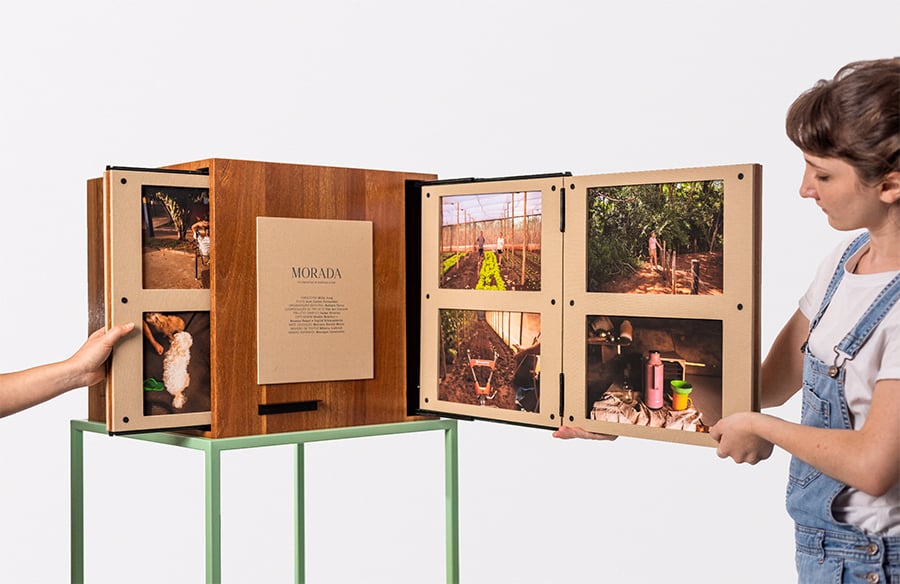
The solution? “Part of the work is constructing your own constraints, your own stories and myths to follow. You define the rules that will generate the project.” She cites her work on “Pradasphere II,” where the rule was “signage behaves like warehouse infrastructure.” This single, self-imposed constraint produced the entire signage language, demonstrating the generative power of a well-defined framework. A similar logic drove “Caixa Morada,” a traveling documentary photography exhibition she designed as a portable wooden crate system that folds into its own shipping container and unfolds into the full display. “The constraint was physical: everything had to be self-contained and transportable. The design couldn’t be separated from the object,” she explains. Two very different projects, but the method is the same — define the rule, and the project generates itself.
The understanding of spatial depth also fundamentally reshapes her graphic design practice. Schmaedecke is quick to point out the historical precedent of architects delving into graphic design—El Lissitzky, Herbert Bayer, the Eames, Lina Bo Bardi herself, and Massimo Vignelli all moved seamlessly between architectural and graphic mediums.
“When architecture and graphic design meet, it usually comes from a place where the person is less attached to the medium and more interested in form as expression, regardless of format,” she observes. For her, the “thinking is transferable,” whether it’s a building, a sign system, a book, or an identity. What spatial training uniquely offers is an “instinct for sequence and scale.” The technical challenges of “typography at 300 millimeters and typography at 3 meters are entirely different design problems,” she explains, yet “the medium changes, the eye doesn’t.”
So, why the shift from architecture to graphic design? For Schmaedecke, it boils down to impact and pace. “I design how people encounter things; a building, a sign system, a brand: different objects, same question. How does someone approach this, what do they meet first, and where do they go from there? The object changes, the question doesn’t.” This core curiosity about human interaction with designed environments is constant. However, the architectural process, as Vignelli also noted, is notoriously slow. “Graphic design lets you think, test, produce, and put something into the world in weeks, not years,” she says.
Graphic design, she found, offered a more direct path to exploring these systemic questions and engaging audiences. In her current practice, Ingrid Schmaedecke excels in branding and environmental design systems, building on over eight years of experience in visual identity, strategy, editorial design, wayfinding, activation, and exhibition projects. Based in Brooklyn, NY, her work combines a sharp aesthetic with profound functionality. Her academic journey, culminating in a Master of Fine Arts in Graphic Design from the Rhode Island School of Design (RISD) in 2023, further solidified her interdisciplinary expertise.
Her leadership roles include coordinating the Graphic Design Department at Museu Paranaense in Brazil, where she spearheaded institutional redesigns and exhibition graphics, managing complex budgets and timelines while collaborating across departments. As co-founder of Studio Bombus, she led creative direction for furniture, interior, and spatial design, alongside book design and research. At ATO1Lab, she designed scenographic, graphic, and interior projects for cultural spaces like the Oscar Niemeyer Museum, enhancing visitor experiences through thoughtful environmental graphics and spatial layouts. Each role has allowed her to apply her unique architectural perspective to diverse design challenges, continually pushing boundaries.
Perhaps one of the most common misconceptions she encounters in graphic design ties back to her architectural roots: the power of composition and, specifically, negative space. “This is really basic, but I’ve seen some people get uncomfortable with certain amounts of negative space. Clients see it as wasted real estate, instead of structure,” she recounts. Her response is simple: “In architecture, you don’t look at a hallway and say it’s wasted square footage. It’s how you get from one room to the next. It’s not empty, I say, it’s organizational.”
By Margaret Wright
Published March 1, 2026