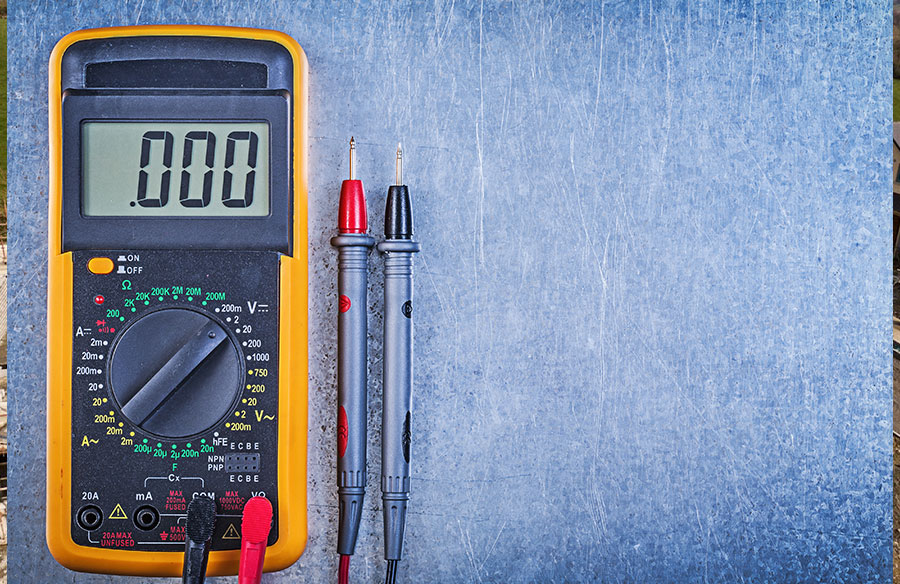
The handheld diagnostic tool known as a digital multimeter – or “DMM” – is one of the most useful instruments for anyone working with electricity in the home, garage, or workshop.
When it comes to such tasks as checking a car battery, testing appliance faults, troubleshooting household wiring, or working on electronics projects, a digital multimeter can be hugely useful.
However, it hopefully goes without saying that knowing how to use this tool safely and accurately is essential. After all, any mistakes with live circuits can lead to serious injury or death.
This guide to digital multimeters is written with UK audiences predominantly in mind, although its advice on generally safe practices is – of course – applicable more broadly, too.
1. Understanding A Digital Multimeter and Its Safety Rating
The principle of what a digital multimeter does may seem simple enough to understand: this tool is used to measure various electrical parameters, displaying the results on a digital screen. It combines the functions of a voltmeter, ammeter, and ohmmeter.
But of course, there’s a lot more that any responsible user needs to know about this tool. Most modern digital multimeters measure voltage (AC and DC), current (AC and DC), resistance (Ω), continuity (often with a buzzer), and additional functions like capacitance, frequency, or temperature.
It is also important, though, to be familiar with CAT ratings (Categories), which are critical for safety. These ratings indicate a multimeter’s ability to withstand voltage spikes (transients) without failing dangerously.
Common CAT ratings that are relevant in the UK include:
- CAT II, which is suitable for household appliances and sockets
- CAT III, which is recommended for distribution boards, fixed wiring, and most home electrical work
- CAT IV, for utility supplies and outdoor overhead lines.
2. Adhering To General Safety Rules
A few of these rules may seem a little “obvious” to some readers. Nonetheless, they are critically important principles for anyone working with multimeters to follow:
- Someone inexperienced should never work alone on live mains circuits; they should ensure there is always someone nearby.
- Before wires are touched, efforts should always be made whenever possible to turn off power at the consumer unit (fuse box) and verify it’s dead.
- Current should never be measured directly across a mains socket or live supply, given that this creates a short circuit and can blow the meter’s fuse.
- Safety glasses and insulated gloves should always be worn for work near live parts.
- It is crucial to only hold probes by the insulated grips, with fingers kept behind the finger guards.
3. Setting Up the Multimeter
Correct port selection is vital for digital multimeter users to ensure accuracy and prevent blowing internal fuses.
The black lead should always be plugged into the COM (common) port.
With regard to the red lead, for voltage, resistance, or continuity, the port often labelled VΩmA should be used. For current, the user will need to move the red lead to the 10A or mA port, depending on the anticipated load.
4. Taking Accurate Measurements
Users of manual-ranging digital multimeters should always follow the “start high” rule. By this, we mean that if the meter isn’t auto-ranging, the user should set the dial to the highest range for that setting first, before working down to get a more precise reading.
Let’s assume that the user wishes to measure voltage. In that case:
- For AC voltage (V~), which is used for UK mains (standard 230V), they will need to set the dial to V~ and place probes in parallel across the circuit.
- For DC voltage (V=), which is used for batteries and electronics, they will need to set the dial to V= and connect the red probe to the positive terminal and black to the negative.
As for if the multimeter user is seeking to measure resistance and continuity, they should first power off the circuit completely and discharge any capacitors. They can then set the dial to Ω (ohms) for resistance, or the continuity symbol (often a diode or sound wave icon), before touching probes to the two points.
- From here, determining resistance will be as straightforward as reading the value (for example, a 10kΩ resistor should read close to 10,000 Ω).
- As for the continuity check, once the dial has been set to the sound wave symbol, a beep will indicate a complete path. “OL” (overload), on the other hand, normally means a broken wire or blown fuse.
Never Underestimate the Importance of Safe Multimeter Use
A digital multimeter is unquestionably a hugely useful and powerful tool when used with respect and attention. The correct use of this tool can make it an excellent solution for the safe measurement of socket voltage, continuity on isolated circuits, and component voltages.
However, it is critically important to always respect the risks of mains electricity. If you’re new to electrical work or planning anything beyond fixed wiring, we urge you to consider enrolling on a basic electricity safety course or consulting a Part P registered electrician.
Remember: electricity doesn’t give second chances, so stay safe!