For quite some time, seasonal flora have been found to shape lobby transition feels in real-time, from a neutral waiting space to a psychological threshold between noise and interior identity. Biophilic design research, including studies from Terrapin Bright Green and global hospitality reports, shows natural elements improve comfort, spatial quality, and guest retention.
Your floral strategy is spatial design, not just surface styling.
Seasonal Rotation as Spatial Storytelling in Architecture
Seasonal planting in contemporary lobbies is serving as a means to narrate stories in a rather controlled manner. When the flowers’ colors change with the seasons, the entire architectural design seems to communicate that it is alive and sensitive rather than being unchangeable.
This sensitivity simply changes how people visualize these locations and eventually leads them to connect a certain attitude of care and refinement with the environment. For instance, in highly populated cities like London, Singapore, and New York, hospitality and commercial skyscrapers can use seasonal variation to refresh the cycles of visual perception. If there is no change, even the best of interiors can lose their sensory effects due to repeated exposure.
Seasonal flowers can help to regain that perception even though the structure and materials remain unchanged, which is why it is one of the most economical means in environmental design.
Micro Seasonal Planning Aligned with Occupancy Rhythms
Some studies observed that contemporary lobby architectures are seen as social environments that are constantly changing and being shaped by the way people move and behave. Hence, seasonal floral systems can be in sync with changes in activity rather than being dependent on the calendar.
For instance, cities like New York and Dubai change the visuals of the lobby according to the ups and downs of the business cycles and different tourism seasons. You can enhance this by studying the number of visitors, their mood, and the function of each space, thereby transforming floral planning into a kind of environmental programming instead of mere decoration.
Seasonal Flora as an Extension of Spatial Identity
In contemporary interior architecture, material systems are no longer limited to stone, glass, or wood. Living systems, like flowers and plants, are increasingly treated as dynamic materials that evolve over time.
Seasonal flora becomes part of that material logic. When planned effectively, floral transitions strengthen recognition of the layout. Building guests can empathize and gradually link their moods with the different atmospheric situations in the lobby. This is not merely a form of decorative elaboration; rather, it is a conditioning of experience within the built space.
Operational Continuity Through Structured Floral Procurement
Operational inconsistency is one of the most overlooked issues in lobby design. Regardless of how well a floral concept is planned, it will fail if the sourcing changes from time to time or if the maintenance is rarely done.
In professional facility management, continuity is considered a critical factor that can influence every spatial experience. This is why subscription-based procurement models these days are being used more and more in commercial interiors. A farm-fresh bouquet subscription system, for instance, helps maintain predictable replenishment cycles along with the preservation of seasonal variations.
From a design operations point of view, this means less cognitive work for the facility teams. They no longer have to keep making procurement decisions every time an order is needed. Instead, they focus on the logic of the placement, the calibration of the scale, and the spatial harmony.
In the lobbies that get a lot of visitors, especially in the financial and hospitality centers all over the world, it is this kind of operational stability that will really support the brand consistency.
Layered Composition Strategies For Spatial Depth
Working with lobby flowers is a much more complex task than simply placing a few focal points here and there. By distributing the visual weight on different planes, the architectural composition gets enriched, and the perception of depth is created even if there’s only a small transitional space.
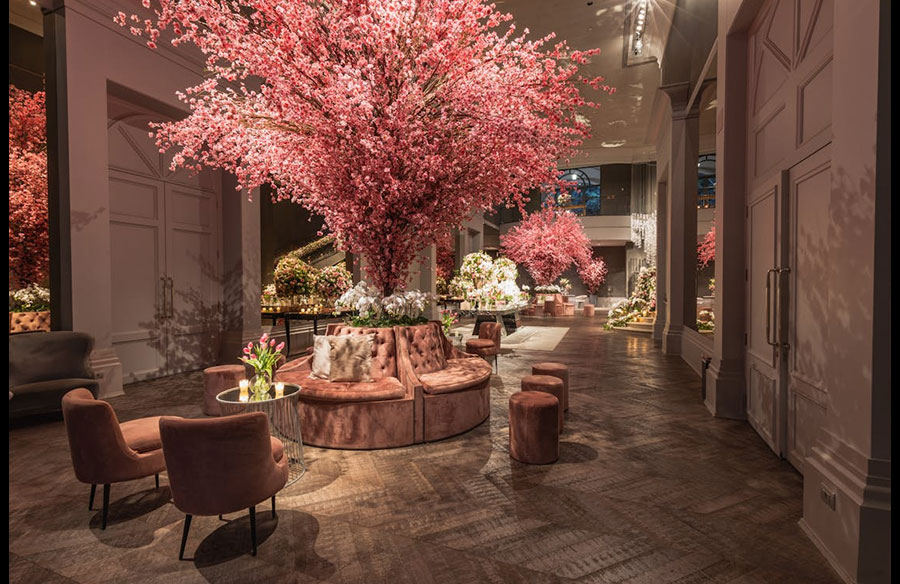
It’s usually a big floral piece that is used as a main focal point to mark the reception area. Secondary groups of flowers work together with the areas of seating or circulation. Tertiary greenery goes well with the architectural features, and at the same time, it is able to link the sightlines throughout the whole space.
This layering is also the very same method used in interior spatial zoning. Using a vertical composition to raise the perceived ceiling height is the main styling technique when it comes to small Asian city lobbies, such as in Tokyo or Hong Kong. In the Gulf regions, horizontal spread is used in hotel lobbies (which are larger) to stress the size and the feeling of openness. These flower presentations are seen as architectural proportioning tools rather than just some decorative elements.
Seasonal Flora as an Extension of Spatial Identity
In contemporary interior architecture, material systems are no longer limited to stone, glass, or wood. Living systems are increasingly treated as dynamic materials that evolve over time. Seasonal flora becomes part of that material logic.
When correctly planned, these floral transitions can help reinforce spatial memory, from crew to guests. Visitors will also begin to associate certain emotional states with specific environmental conditions inside these lobbies. It’s not an ordinary aesthetic decoration; it is experiential conditioning within built space.
A Lobby That Stays Alive Through Time
A floral system crafted right can turn a static lobby into a bright and responsive environment shaped by human rhythm and seasonal change. The aim is controlled evolution aligned with movement and architectural intent.
You can start it all off with micro seasonal mapping, stable procurement, and layered composition. Then adjust based on real visitor flow.
Your advantage is consistency, not flowers, but the experience–they quietly sustain every time.