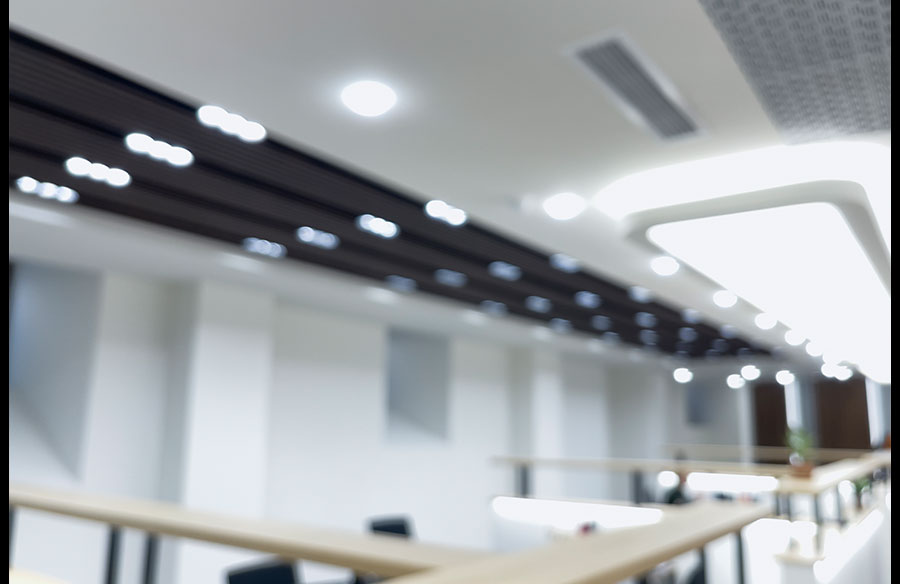
In the traditional corporate world, office lighting was often an afterthought, a sea of flickering fluorescent tubes designed for basic visibility rather than human comfort. However, as our understanding of workplace psychology and biology has evolved, so has our approach to illumination.
Today, lighting is recognized as a fundamental pillar of office design. It influences everything from employee mood and circadian rhythms to brand identity and energy efficiency. If you are looking to transform a workspace, it’s time to look up.
In this guide, we’ll explore the essential elements of modern office lighting and how the right choices can supercharge your team’s performance.
The Science of Light and Performance
Humans have an evolutionary connection to natural light. Our “circadian rhythm”, the internal clock that regulates sleep-wake cycles is governed by the quality and color temperature of the light around us.
When office lighting is too dim, it can cause eye strain and headaches. Conversely, lighting that is too harsh or “cool” (blue-toned) late in the afternoon can interfere with sleep patterns. The sweet spot lies in Human-Centric Lighting (HCL). HCL systems mimic the cycle of natural daylight, providing bright, cool light in the morning to stimulate alertness and transitioning to warmer, softer tones in the afternoon to promote well-being.
Layering Your Light: The Secret to a Balanced Space
A common mistake in office fit-outs is relying on a single light source. To create a truly functional environment, lighting designers recommend a “layered” approach:
1. Ambient Lighting
This is the base layer of light that provides general illumination for the entire room. In modern offices, this is often achieved through sleek linear LED pendants or recessed architectural lighting. The goal is a uniform spread of light that eliminates dark corners without creating glare on computer screens.
2. Task Lighting
Even the best ambient light can’t do it all. Task lighting provides focused illumination for specific activities, such as reading documents or detailed design work. Adjustable desk lamps or integrated shelf lighting allow employees to customize their immediate environment, which has been shown to increase job satisfaction.
3. Accent Lighting
Accent lighting is where brand personality shines. It’s used to highlight architectural features, artwork, or specific zones like a breakout area or a reception desk. It adds depth and visual interest, preventing the office from feeling like a sterile “box.”
Breaking the “Grid”: Lighting for Agile Workspaces
The rise of the “agile office” has changed the physical layout of our workplaces. We no longer sit at the same desk for eight hours a day. We move from quiet pods to collaborative hubs and formal boardrooms.
Your lighting must be as flexible as your floor plan.
- Breakout Zones: Use warmer, decorative pendants to create a relaxed, “hospitality” feel that encourages informal conversation.
- Meeting Rooms: These require versatile controls. You need bright light for brainstorming and dimmed options for video presentations.
- Focus Pods: Soft, localized lighting helps create a sense of privacy and concentration.
The Aesthetic Shift: Architectural and Linear Lighting
Modern office aesthetics have moved away from the “hidden” light fixture. Today, lighting is a design statement. Linear lighting has become the gold standard for contemporary offices. These long, continuous runs of light can be used to guide people through a space, emphasize the length of a room, or create geometric patterns on the ceiling.
Suspended luminaires with both upward and downward light components (direct/indirect lighting) are particularly effective. They illuminate the task area while bouncing light off the ceiling, which makes the space feel taller and more airy.
Sustainability and the Bottom Line
From an operational standpoint, switching to advanced LED office lighting is one of the fastest ways to reduce a building’s carbon footprint.
- Energy Efficiency: LEDs use significantly less power than traditional bulbs and have a much longer lifespan, reducing maintenance costs.
- Smart Controls: Integrating PIR (Passive Infrared) sensors ensures that lights are only on when a room is occupied.
- Daylight Harvesting: Smart systems can sense how much natural light is coming through the windows and dim the electric lights accordingly, maintaining a constant light level while saving energy.
Choosing the Right Partner for Your Project
Selecting the right fixtures is only half the battle; the magic happens in the layout and technical specification. When planning an office refurbishment, it is vital to work with specialists who understand the nuances of beam angles, UGR (Unified Glare Rating), and color rendering.
The team at 299 Lighting specializes in creating bespoke lighting schemes that marry technical precision with cutting-edge design. Whether you are aiming for a rugged industrial look with exposed services or a clean, minimalist corporate HQ, their range of office lighting solutions provides the tools to bring a vision to life.
Final Thoughts
Lighting is no longer just a utility; it is a strategic tool for business success. By investing in high-quality, thoughtfully designed office lighting, you aren’t just brightening a room, you are investing in your people.
A well-lit office reduces fatigue, boosts morale, and creates an environment where people actually want to work. As we redefine the future of the workplace, let’s make sure we’re seeing it in the best possible light.