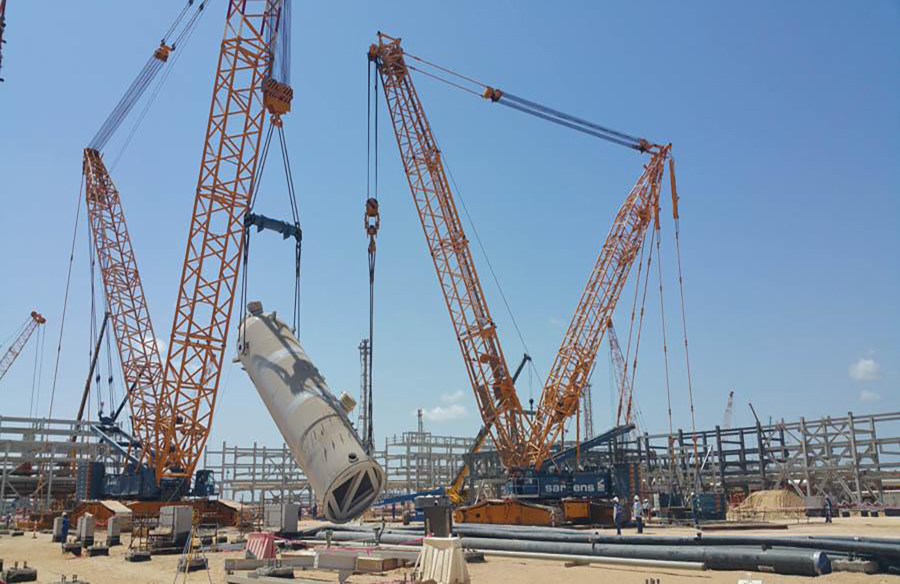
Where Complexity Becomes Physical
In most industrial projects, complexity is discussed in terms of scale, timelines, and coordination between teams. That perspective is accurate, but incomplete. The real test shows up when planning turns into execution, when massive components need to be physically moved, positioned, and installed in environments that leave little room for error.
Heavy lift projects sit at that intersection.
This is where equipment that weighs tens or hundreds of tons has to be handled with precision, often within tight schedules and even tighter spaces. It is not just about moving weight from one point to another, it is about doing it in a way that aligns with structural limitations, sequencing requirements, and safety constraints all at once.
In industrial projects, this phase tends to define whether the rest of the build moves forward cleanly or begins to absorb delays that are difficult to recover from.
An Assumption That Creates Most Delays
There is a recurring assumption that heavy lifting is simply a matter of having the right equipment. If the crane is large enough and the crew is experienced, the lift will get done.
That view misses the part that actually determines success.
Every heavy lift depends on a chain of variables that must be aligned before execution begins. Load weight and distribution need to be verified with precision. The center of gravity must be clearly understood. Crane capacity must be evaluated based on real working conditions, not theoretical limits. Ground-bearing pressures, lift radius, and environmental factors all play a role.
When even one of these elements is off, the impact tends to show up during execution, when options are limited.
This is why complex operations often rely on structured approaches like industrial project management, where lift planning is treated as part of a larger system rather than an isolated task. The focus shifts from “getting the lift done” to ensuring that the lift fits seamlessly into the entire project flow.
What Changes When Lifts Are Planned, Not Reacted To
The difference between reactive lifting and planned execution is not subtle. It affects timing, safety, and overall project performance.
In reactive scenarios, decisions are made in the field, often under pressure. Adjustments are introduced as conditions change, which increases variability and risk. In engineered approaches, those decisions are made in advance.
Planning begins with a full analysis of the site, including access routes, structural constraints, and how equipment will move through the space. From there, lift engineers define the exact sequence of operations, including crane selection, rigging configurations, and any additional systems required to complete the movement.
Heavy lift projects rarely involve a single motion. Equipment may need to be lifted, transferred, rotated, and positioned through multiple stages. Each step must be coordinated with the next, and each depends on accurate planning.
When this process is handled correctly, execution becomes controlled. Teams follow a defined sequence rather than reacting to unexpected conditions.
The Detail Most Teams Underestimate
A consistent gap in many industrial projects is the tendency to underestimate how small miscalculations can escalate.
A clearance that is tighter than expected, a load that was slightly underestimated, or a sequence that was not fully coordinated can create delays that affect multiple phases of the project. These are not always dramatic failures, but they accumulate quickly.
Another overlooked factor is the interaction between lifting operations and the broader construction schedule. Heavy lifts often require space, time, and coordination that impact other teams. When this is not planned properly, it leads to congestion, inefficiencies, and scheduling conflicts.
There is also a misconception that advanced equipment reduces risk. While modern cranes and rigging systems expand capability, they do not eliminate the need for precision. The complexity of the operation remains, regardless of the tools being used.
What Consistently Works in Heavy Lift Projects
Projects that perform well tend to approach heavy lifting as an integrated part of the overall strategy rather than a separate activity.
This means involving lift specialists early, aligning lift plans with structural and logistical decisions, and ensuring that every movement is accounted for before execution begins. It also means building schedules around critical lifts instead of forcing lifts into already constrained timelines.
Teams with established experience, such as prolift rigging, typically bring this level of coordination into projects, focusing not only on the lift itself but on how it connects to the entire construction process.
When this approach is applied, heavy lifts become predictable operations. Risks are identified early, and execution follows a plan that has already accounted for the variables that typically cause delays.
The Direction Industrial Projects Are Moving
As industrial projects continue to grow in size and complexity, the margin for error continues to shrink. Equipment is heavier, timelines are tighter, and expectations for efficiency are higher.
Under these conditions, heavy lift projects cannot rely on assumptions or last-minute adjustments. They require a level of planning that matches the scale of the operation.
The shift is already happening. More projects are moving toward engineered approaches where lifting is treated as a core component of execution, not as a supporting task.
The Difference Between Movement and Control
At a surface level, heavy lift projects are about moving large equipment. But in practice, they are about control.
Control over how each component is handled, how risks are managed, and how the project progresses without disruption. When lifting operations are planned with precision, they tend to run quietly, without drawing attention. When they are not, they become a source of delays and uncertainty.
That difference is what separates industrial projects that stay on track from those that spend time and resources trying to recover.