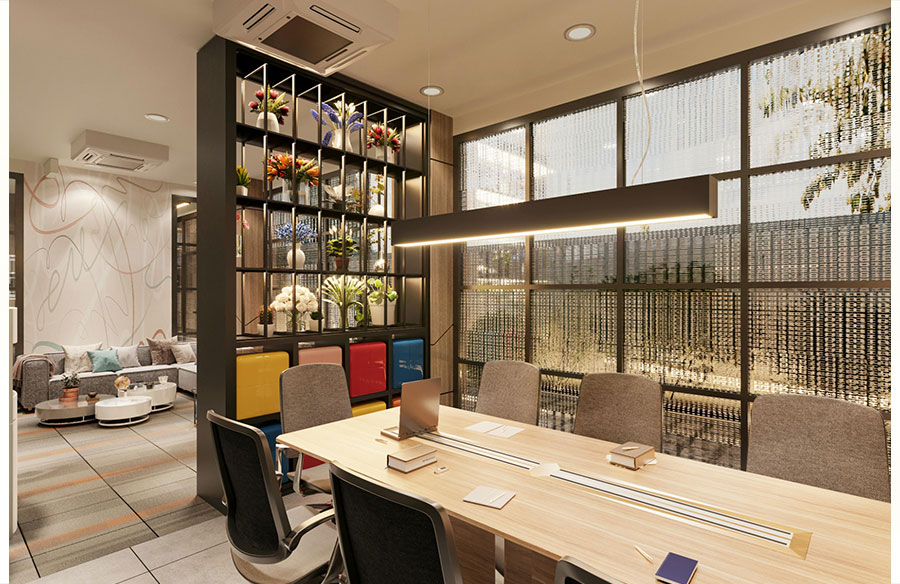
Hybrid work has shifted how offices are used — but it has not reduced their importance. In fact, research shows that the office now serves fewer daily tasks, but far more critical ones: collaboration, training, alignment, and social cohesion.
At the centre of this shift sits one often under-designed space: the boardroom.
While individual desks and hot-desking systems support day-to-day flexibility, large, well-equipped boardrooms have become the backbone of effective hybrid organisations — especially during company-wide training days, strategy sessions, and all-hands meetings where in-office teams must connect seamlessly with remote colleagues.
Choosing the right office furniture for hybrid work is no longer about density. It is about cognitive clarity, visual equity, and physiological comfort — all of which are deeply influenced by furniture, layout, and room design.
Hybrid Work Changes the Cognitive Demands of the Office
Hybrid environments place higher cognitive demands on employees than fully in-person settings.
Neuroscience research shows that:
- Video-based communication requires more mental effort than face-to-face interaction
- Delays, poor sightlines, and audio strain increase cognitive fatigue
- Poor physical environments amplify these effects [1]
This means that hybrid offices must reduce friction wherever possible — particularly in shared spaces where in-person and remote workers interact simultaneously.
Furniture is not neutral in this equation. It either supports the brain’s ability to process complex hybrid interactions, or it becomes an additional cognitive burden.
Why Boardrooms Are the Most Critical Hybrid Space
In hybrid organisations, boardrooms are no longer reserved for executive meetings. They are now used for:
- Company-wide training sessions
- Cross-team workshops
- Strategic alignment meetings
- Hybrid onboarding
- All-hands presentations
During these moments, everyone connects at once, often with:
- Large shared screens
- Multiple remote participants
- Long session durations (2–6 hours)
Scientific studies on attention and learning show that physical discomfort, poor visibility, and suboptimal seating directly impair information retention and engagement — particularly during long group sessions [2].
This makes boardroom furniture selection a learning-performance decision, not just an aesthetic one. If you’re in the market for new boardroom furniture as we speak, go to https://www.officefurniture2go.com/catalog/byType/Conference-Tables.aspx.
Seating Science: Comfort Drives Attention Span
Sustained attention is physiologically limited. Discomfort accelerates fatigue.
Medical research has demonstrated that:
- Poor seating posture increases muscular strain and sympathetic nervous system activation
- Increased muscle tension correlates with reduced attentional capacity and faster mental exhaustion [3]
In large hybrid boardrooms, seating must support:
- Neutral spinal alignment
- Pressure distribution over long durations
- Micro-movement to maintain circulation
Chairs designed for short meetings are inappropriate for hybrid training days. Ergonomically supportive seating has been shown to improve sustained attention and reduce perceived fatigue during long sessions [4].
Table Design and Visual Equity
“Visual equity” — the sense that all participants are equally visible and engaged — is critical in hybrid meetings.
Research in organisational psychology shows that perceived visibility strongly influences:
- Participation levels
- Knowledge sharing
- Psychological safety [5]
Boardroom tables must therefore:
- Avoid excessive depth that pushes participants out of camera range
- Allow clear sightlines to shared screens
- Accommodate integrated power and connectivity without clutter
Furniture that obstructs posture, forces screen craning, or blocks lines of sight increases cognitive load and disengagement — especially for in-room participants who must constantly adjust their position.
Large Screens Are Not Optional — They Are Neurological Tools
From a neuroscience perspective, screen size matters.
Visual cognition research shows that:
- Larger shared displays improve group attention synchronisation
- Reduced visual strain improves comprehension and memory encoding [6]
In hybrid training environments, a single large screen:
- Allows remote participants to appear at near life-size scale
- Reduces eye strain caused by constant refocusing
- Improves social presence, which increases engagement and trust [7]
Boardroom furniture must be selected around the screen — not the other way around. Seating angles, table height, and distance from the display all influence how effectively the brain processes shared information.
Acoustics, Furniture, and Cognitive Load
Poor audio quality is one of the strongest predictors of hybrid meeting fatigue.
Neuroscience studies show that when speech is difficult to hear:
- The brain reallocates resources from comprehension to decoding sound
- Cognitive fatigue increases rapidly
- Information retention drops significantly [8]
Boardroom furniture contributes to acoustics through:
- Upholstered seating that absorbs sound
- Table surfaces that reduce echo
- Spatial layout that prevents sound bouncing
Hard surfaces and poorly spaced furniture amplify noise and degrade speech clarity — undermining even the best video systems.
Space, Density, and Stress Physiology
Crowding is a physiological stressor.
Environmental psychology research demonstrates that:
- High-density seating increases cortisol levels
- Elevated cortisol impairs memory, decision-making, and emotional regulation [9]
Hybrid boardrooms must balance capacity with comfort. Furniture should allow:
- Adequate personal space
- Clear movement paths
- Psychological comfort during long sessions
This is especially important during training days, where learning outcomes depend on a calm, receptive nervous system.
Flexibility Without Compromise
Hybrid offices require adaptability, but flexibility should not come at the expense of ergonomics.
Modular boardroom furniture allows spaces to:
- Transition between training, workshops, and presentations
- Accommodate different group sizes
- Support evolving technology requirements
However, scientific research consistently shows that ergonomic stability is more important than novelty. Furniture should adapt around human needs — not force people to adapt to the furniture [10].
Why Boardrooms Anchor Hybrid Culture
Beyond physiology, boardrooms play a symbolic role.
Organisational behaviour studies show that shared physical experiences:
- Strengthen group identity
- Increase trust between remote and in-person teams
- Improve long-term collaboration outcomes [11]
Well-designed boardrooms signal that:
- In-office time is intentional
- Hybrid collaboration is valued
- Learning and alignment are priorities
This perception influences engagement far beyond the meeting room itself.
Evidence-Based Principles for Hybrid Furniture Selection
Science-backed hybrid boardroom design prioritises:
- Ergonomic seating for long-duration sessions
- Tables designed for visual equity and connectivity
- Furniture layouts aligned with large shared screens
- Acoustic-supportive materials
- Adequate personal space and circulation
These are not aesthetic preferences — they are performance variables.
Final Thoughts
Hybrid work has not reduced the importance of offices. It has concentrated their purpose.
Boardrooms are now the neural hubs of hybrid organisations — spaces where learning, alignment, and culture are reinforced. Choosing the right furniture for these environments is a decision grounded in neuroscience, occupational health, and performance science.
When boardrooms are designed to support human cognition and physiology, hybrid work stops feeling fragmented — and starts working as intended.
References
- Bailenson, Nonverbal Overload: A Theoretical Argument for the Causes of Zoom Fatigue, Technology, Mind, and Behavior
- Bradbury, Attention Span During Extended Learning Sessions, Educational Psychology Review
- Marras et al., Muscle Load and Cognitive Performance, Ergonomics
- Hedge, Ergonomic Seating and Sustained Attention, Human Factors
- Edmondson, Psychological Safety and Team Learning, Administrative Science Quarterly
- Raskar et al., Large Displays and Group Cognition, IEEE Computer Graphics
- Biocca et al., Social Presence in Video-Mediated Communication, Journal of Computer-Mediated Communication
- Pichora-Fuller et al., Cognitive Energy and Listening Effort, Ear and Hearing
- Evans & Wener, Crowding and Stress in the Workplace, Journal of Environmental Psychology
- Dul & Neumann, Ergonomics Contributions to Business Performance, Applied Ergonomics
- Wilson et al., Shared Physical Spaces and Organisational Cohesion, Academy of Management Journal