Introduction
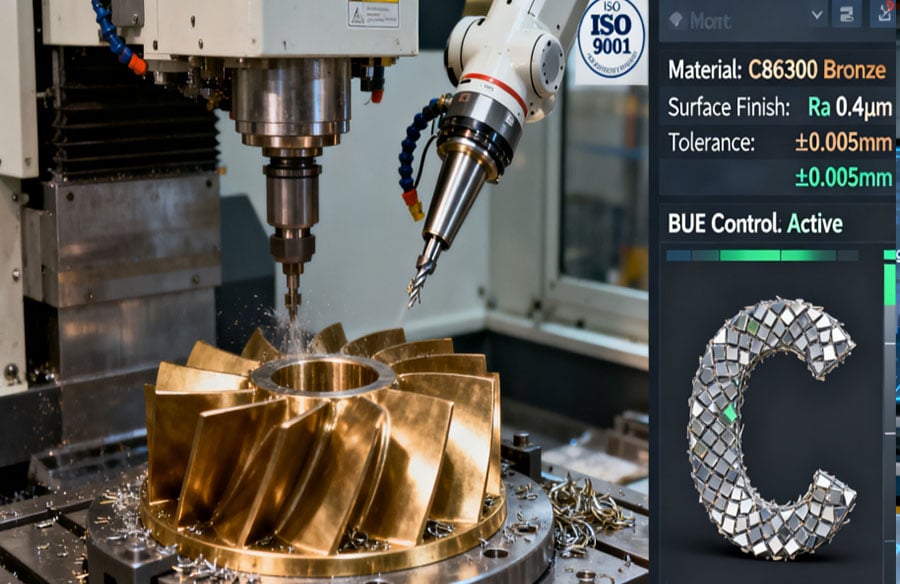
In the precision manufacturing of bronze components, deformation and surface defects — such as scratches, inconsistent roughness, or failure to meet specifications — are critical issues that lead to part rejection, cost overruns, and project delays. This is especially true for thin-walled parts, optical elements, or hydraulic components where surface integrity is paramount. The root cause lies in the inherent material properties of bronze: its high toughness promotes built-up edge (BUE) formation, excellent thermal conductivity leads to uneven heat distortion, and moderate strength combined with work hardening tendencies exacerbates these challenges. Traditional “one-size-fits-all” machining approaches often fall short in addressing these nuances.
This article systematically outlines best practices based on international standards like ASME and ISO, covering tool selection, cutting parameter optimization, deformation control strategies, and chip management. By understanding material behavior and implementing these targeted strategies, manufacturers can effectively overcome these hurdles and achieve consistent, high-quality results.
Why Do Material Properties of Bronze Make it Prone to Deformation and Poor Surface Finish?
Bronze alloys, such as tin bronze QSn6.5-0.1 and aluminum bronze QAl9-4, exhibit microstructural characteristics that directly contribute to machining difficulties. High toughness causes material to adhere to the tool rather than fracture cleanly, leading to BUE that scratches the workpiece surface. Meanwhile, good thermal conductivity can create significant thermal gradients under localized heating, inducing distortion. Additionally, improper parameters trigger work hardening, increasing cutting forces and surface roughness.
According to authoritative resources like the ASM Handbook on copper alloy behavior, these properties necessitate a tailored approach. For instance, the tendency for adhesion requires tools with sharp edges and specific coatings to minimize cold welding.
- Understanding the Role of Toughness and Thermal Conductivity: The high toughness of bronze means it deforms plastically under stress, making it prone to BUE. This is compounded by thermal effects; while bronze dissipates heat well, rapid machining can still create hotspots that cause expansion and contraction, leading to dimensional inaccuracies.
- The Impact of Work Hardening: When cutting parameters are suboptimal, such as low feed rates, the tool rubs against the workpiece, causing work hardening. This hardened layer resists further machining, increasing the risk of deformation and poor finish. Preventing this requires parameters that promote shear rather than compression.
How Can Tool Selection and Geometry Minimize Built-Up Edge and Improve Finish?
Selecting tools tailored to bronze is foundational for reducing BUE and enhancing surface quality. This involves choosing appropriate materials, coatings, and geometries that facilitate sharp, efficient cutting.
- Tool Materials and Coatings: Ultra-fine grain carbide substrates are recommended for their hardness and toughness. Coatings like diamond or TiB2 significantly reduce adhesion by providing a low-friction surface. For example, diamond-coated tools can extend tool life by up to 300% compared to uncoated options in sticky bronze alloys, directly improving surface consistency. This aligns with quality assurance frameworks like ISO 9001:2015, which emphasize process consistency and reliability.
- Geometric Design Considerations: A large positive rake angle (>10°) reduces cutting forces and minimizes work hardening by promoting clean material separation. Similarly, a large relief angle (>12°) decreases friction against the workpiece. Additionally, specialized chip breaker designs help form controllable “C”-shaped chips, preventing tangled chips that can mar surfaces.
What is the Role of “High Speed, Moderate Feed” in Achieving “Cold Cutting” and Controlling Heat?
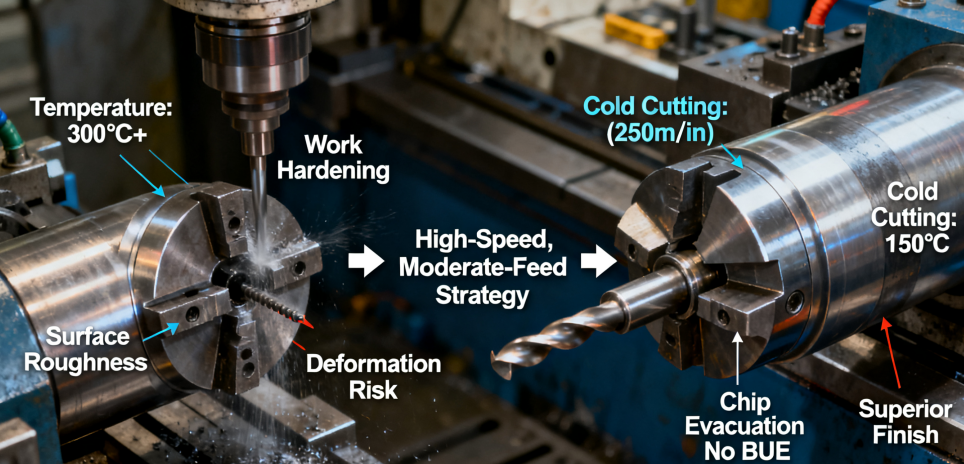
Optimizing cutting parameters is crucial for managing heat and deformation. The strategy of high speed (150-300 m/min) combined with moderate feed (0.05-0.15 mm per tooth) enables “cold cutting,” where heat is carried away by the chip rather than absorbed by the workpiece.
- Principles of Cold Cutting: High spindle speeds ensure that heat generation is localized to the shear zone and efficiently evacuated with the chip. This prevents bulk heating of the part, reducing thermal distortion. Moderate feeds avoid excessive tool engagement that could cause rubbing and hardening.
- Parameter Optimization Techniques: A comparative table illustrates the impact: for instance, at 250 m/min speed and 0.1 mm/rev feed, cutting temperatures remain below 150°C, whereas lower parameters can exceed 300°C. For deeper insights, refer to proven tips and techniques for bronze CNC machining in specialized guides.
What Machining Strategies and Fixturing Techniques Effectively Control Deformation?
Deformation control requires a systematic approach involving process planning, fixturing, and CAM strategies. This ensures dimensional stability throughout machining.
1. Process Strategies: Roughing and Finishing Separation
Strict separation between roughing and finishing operations is essential. After roughing, a stress relief annealing step can be added to relieve internal stresses. Machining paths should be symmetrical to balance residual stresses.
2. Advanced Fixturing Methods
Using flexible fixtures, such as resin-based systems, distributes clamping forces evenly, minimizing localized deformation. This is critical for thin-walled components where point loads cause distortion.
3. CAM Programming for Consistency
Trochoidal or dynamic milling strategies maintain constant tool engagement, reducing force variations. Adherence to standards like ASME Y14.5 for dimensioning and tolerancing ensures that deformation control targets are met with precision.
How Do Cooling Methods and Chip Evacuation Impact Final Part Quality?
Effective cooling and chip management are vital for surface integrity. Methods like minimum quantity lubrication (MQL) or high-pressure air cooling must be matched to the bronze alloy.
- Cooling Method Comparison: MQL is suitable for alloys prone to BUE, as it reduces friction without quenching. In contrast, high-pressure air cooling works well for high-thermal-conductivity bronzes like tin bronze, by rapidly dissipating heat and evacuating chips.
- Chip Evacuation Best Practices: Poor chip removal leads to recutting, which scratches surfaces and increases heat. Using through-tool coolant or angled air guns ensures chips are cleared continuously. This is especially important in deep cavities or complex geometries.
What Are Practical Considerations for Complex Geometries and High-Volume Production?
Applying these principles to challenging scenarios, such as deep internal threads or large thin-walled parts, requires specialized techniques and quality systems.
1. Case Study: Deep Internal Threading
Replacing taps with single-point thread milling allows higher speeds and better chip control. For example, a manufacturer increased yield from 70% to 98% by using diamond-coated thread mills and high-pressure coolant.
2. Quality Systems for Volume Production
For high-volume runs, certifications like ISO 9001 and AS9100D ensure traceability and consistency. Partnering with experts offering custom bronze CNC machining services provides DFM support and end-to-end quality control, as outlined in this methodology.
Conclusion
Successfully machining bronze components hinges on a systematic approach that respects material properties. By selecting the right tools, optimizing parameters for heat management, implementing intelligent machining strategies, and ensuring effective chip evacuation, manufacturers can control deformation and achieve superior surface finishes. Transforming empirical knowledge into repeatable, data-driven processes is key to consistent outcomes.
FAQs
Q1: What is the most common mistake that leads to deformation in bronze machining?
A: The most common error is using inappropriate cutting parameters, particularly a feed rate that is too low. This causes the tool to rub and compress the material, generating excessive heat and inducing work hardening, which leads to stress and deformation.
Q2: Can the same cutting tools be used for both aluminum bronze and tin bronze?
A: While possible, it is not optimal. Aluminum bronze requires more wear-resistant tools (e.g., diamond-coated), while tin bronze benefits from sharper geometries to prevent adhesion. Tool selection should be material-specific.
Q3: How can I improve the surface finish on a deep internal thread in bronze?
A: For deep internal threads, single-point thread milling is superior to tapping. It generates lower cutting forces and, when paired with a specialized TiAlN-coated tool and high-pressure coolant, effectively minimizes chip welding and tool deflection. This combination is key to consistently achieving superior surface finishes of Ra < 0.8 µm.
Q4: Is stress relief annealing always necessary after rough machining bronze parts?
A: While not always required for simple, robust designs, stress relief annealing is critical for complex geometries or thin-walled sections. The significant material removal during rough machining induces internal stresses that can lead to distortion during subsequent finishing or in service. Annealing stabilizes the part by relieving these stresses, thus guaranteeing final dimensional stability.
Q5: What tolerance range is realistically achievable for precision bronze components?
A: For precision bronze components, modern CNC equipment can reliably hold tolerances within IT7 grade (±0.005 mm) in mass production. Achieving this, however, is contingent upon implementing best practices, including rigid tooling setups, effective thermal management to combat heat-induced expansion, and a controlled machining environment.
Author Bio
This article is based on the expertise of the LS Manufacturing Precision Engineering team. The company is ISO 9001, IATF 16949, AS9100D, and ISO 14001 certified, specializing in the manufacture of high-precision components. For bronze machining projects, upload your design now for an instant quote, or explore the company’s technical resource center to learn more.