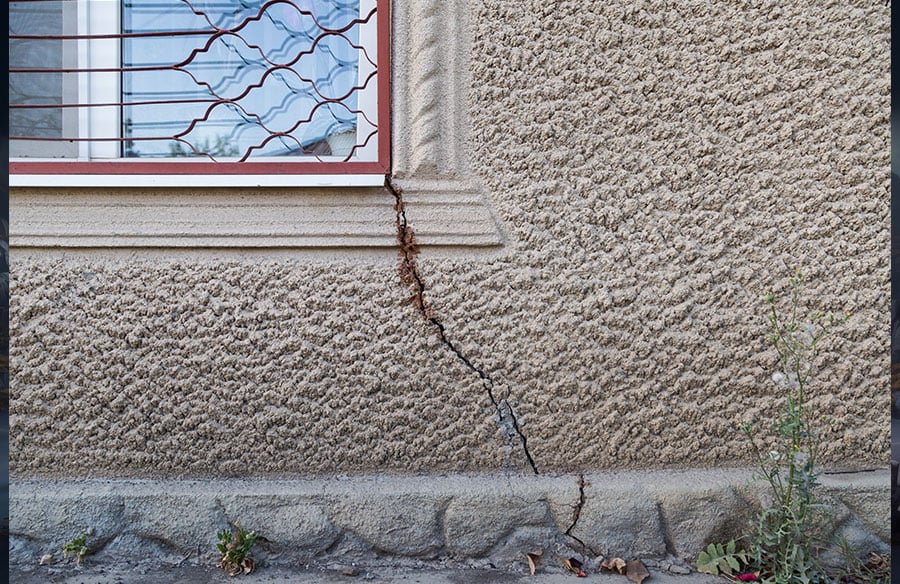
Your home may look perfectly solid from the outside, but it could be hiding a fundamental issue with the foundation. Your home’s foundation is literally what everything else sits on, and if it’s compromised, you could end up facing some serious problems. Small issues like hairline cracks, doors that stick, and floors that slope may seem like small inconveniences, but they could be signs of a major issue.
Knowing what to watch out for and how to handle it can save you a lot of trouble later on.
1. First, get an inspection
First things first. If you see any of the signs outlined in this article, get a professional inspection right away. Don’t try to diagnose the issue on your own. The minute you see even one sign of a failing foundation, an inspection is warranted.
2. Small cracks in the walls and floors
Not every crack is an alarm bell, but patterns can be red flags for foundation trouble. For example, cracks at 45-degree angles wider than 1/8” or wider at one end than the other are all signs of a foundational problem. On the other hand, hairline cracks are commonly caused by settling.
It’s tempting to fill in small cracks with epoxy or another DIY solution, but foundation issues are complex and often require addressing the soil as well as drainage. Since doing it wrong can make the situation worse, it’s not advised to fix these issues yourself. A qualified foundation expert will assess the cause at the root and propose an engineered solution rather than just a cosmetic fix.
3. Horizontal cracks or step cracks in block foundations
A horizontal crack can indicate lateral pressure from the soil or water pushing against the wall. These cracks are especially concerning because the issue often requires reinforcement like wall braces or underpinning.
If you have a block foundation with step cracks that follow mortar joints, that’s a sign of a foundation problem.
4. Doors and windows that stop functioning properly
When your doors won’t close or your windows start to stick, you might think it’s just humidity or swelling, but it’s often a sign that the foundation is shifting and distorting the frames. When these signs show up, it’s time to investigate.
Doors that suddenly stick or won’t latch properly are a sign that the doorframe is no longer squared up. You might think the door was hung wrong, but that’s not usually the case.
When your windows won’t slide or open and close like normal, that’s a big problem. Gaps are also a sign of a shifting foundation.
5. Trim, baseboards, and cabinets pulling away from the wall
When structural movement happens, cabinets and trim can start to separate from the wall or crack. These separations begin as a subtle shift but will continue to widen over time. If you see any of these issues, it’s time for a foundation inspection.
6. Cracks emanating from windows or door openings
Cracks that radiate from door and window openings are often a sign of stress happening at rigid junctures. This means the foundation has moved enough to impact the wall framing around these cut-out areas. This is a huge red flag that warrants a professional assessment.
7. Sloping floors and sagging ceilings
One of the more dramatic (and serious) signs your home’s foundation may be in trouble is sloping floors, floors that bounce or sag, and ceilings that droop. These issues point to serious load-bearing problems or foundation movement.
If your home is 100 years old, a slight slope might be normal, but if you’re constantly rolling toward the kitchen sink, that’s a problem. Floor slope is an indication that one part of the structure has settled far more than the other, which makes the load distribution uneven. This can be caused by support failure or soil subsidence and should be addressed professionally.
Sagging drywall seams are also a sign of a failing foundation. When a house shifts, the entire framing of the roof can shift and change shape, causing joists to twist. In this case, structural reinforcement is usually required.
8. A leaning chimney
If you look at your chimney and it seems to be leaning or pulling away from the house, that’s a huge indication that the foundation is shifting and calls for a professional inspection. This issue can be resolved with foundation underpinning or chimney stabilization, but it must be done by a pro.
Don’t wait to get your foundation inspected
Your home’s foundation literally carries the weight of everything above it. When it shows signs of strain in the form of cracks, gaps, slopes, and misalignment, it’s time to get a professional inspection. Catching the problem early and hiring a professional will protect your home’s value and your safety.