With its 315-mile (507 km) length, the Hudson River connects the Eastern Seaboard to the Great Lakes, making inland travel possible and economical. After centuries of use by Native Americans, Henry Hudson became the first European to explore it. Those who followed brought cultures and architectural styles.
The Hudson River Valley has also inspired many to explore the juxtaposition and integration of art, architecture, and lush, verdant landscape. From stately European architecture based on classical designs and manor houses to ultramodern buildings that explore shape, color, and texture in new ways. You’ll find it all along this path.
Little Island Park
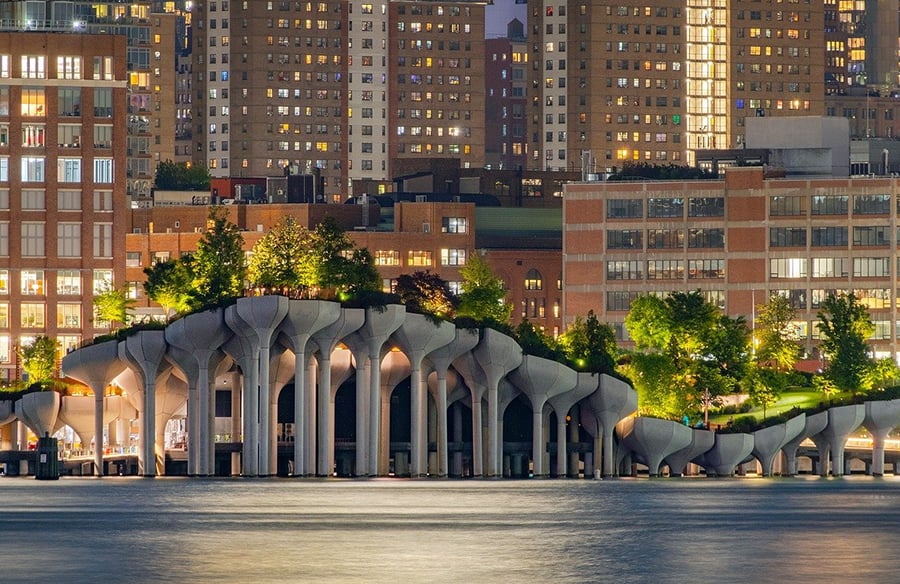
Manhattan’s Little Island Park is a bed of concrete tulips rising from the Hudson River. Tulips appear to undulate on the water’s edge because of their unique shapes and sizes.
The Hudson River Park Trust and Barry Diller wanted to rebuild Pier 54, which was damaged by Hurricane Sandy in 2013. A whimsical oasis combining architecture, arts, and green space was created to welcome everyone who visits.
One of the first things you’ll notice is the variety of plants. Over 350 species of flowers, shrubs, and trees provide an environment that varies with the seasons.
A 687-seat amphitheater offers the opportunity to see Broadway performers and the American Ballet Theatre. A smaller stage provides for a more intimate night at the theater.
According to the experts at Hudson Condos, two of the best places to live in New Jersey – Hoboken and Jersey City – are a short drive away for a quick trip to Little Island Park.
Hyde Park
Hyde Park, a palatial Beaux-Arts mansion, has been called a masterpiece of American design built specifically for the aristocratic lifestyle. The house, designed for Frederick and Louise Vanderbilt by McKim, Mead, & White, is modest compared to the homes built by other members of the Vanderbilt family.
Despite its modesty, the house interiors boast lavish, exotic wood paneling, imported marble, lush velvets, and French tapestries. As was the custom at the time the house integrates antique building components salvaged from the great houses of Europe.
Beaux-Arts mansions are grandiose, employ a symmetrical facade, and feature exterior columns, embellished wall surfaces, and a flat low-pitched roof.
Lyndhurst
Lyndhurst is one of America’s finest Gothic Revival mansions, conceived by architect Alexander Jackson Davis and its first owner William S. Paulding, Jr. Paulding called it the Knoll because of its promontory overlook of the Hudson River. Locals, however, referred to it as Pauldings Folly because of Its fanciful turrets and asymmetrical outline, which was unlike most homes constructed in the post-colonial era.
When George Merritt took over the estate he started referring to it as “Lyndenhurst” after the Linden trees he had planted on the estate. Merritt had Master Gardener, Ferdinand Mangold turn the grounds into a country estate with a European aesthetic, installing specimen trees, walkways to view the Hudson River, and a grand Moorish-style wood-framed greenhouse.
Massaro House
We’ve all heard of knock-offs, those cheap imitations of expensive designer products. Massaro House – a building reminiscent of Frank Lloyd Wright’s Fallingwater – is a knock-off on an architecturally grand scale. And its owner admits it.
In 1949, Ahmed Chahroudi purchased Petre (also known as Petra) Island and commissioned Wright to design a house for him but bailed out when he realized he couldn’t afford to build it. Years later, John Massaro bought the island – and the plans that came with it – and built the house, contracting an architect to finish the design. Because the house does not meet certain aesthetic and construction criteria as specified by the Frank Lloyd Wright Foundation, we can only describe it as inspired by the architect.
It employs Wright’s characteristic broad, horizontal planes and features geometric woodwork, built-in furniture, and careful integration with its natural site.
Armour-Stiner Octagon House
We often associate the word “marvel” with something big, flashy, and difficult to build. That’s not always the case and the Armour-Stiner House is the perfect example.
In 1872, Joseph Stiner purchased an older and simpler house and transformed it into its present lyrical structure. It is the only known fully domed octagonal house, and it replicates Donato Bramante’s 1502 Tempietto in Rome. Stiner added the dome and the verandah. He wanted to create a classical, elaborately detailed temple. The whimsical colors, designs, and decorations – designed to amuse his guests – make one wonder if he did not devote the temple to Euphrosyne, the goddess of good cheer, joy, and mirth.
Architecture, whether on a grand or a small scale, is about creating spaces that improve our lives, connect us to nature, and intelligently respond to the surrounding changes in a more sustainable, fair way.