Working at height is an inherent risk in many industries, from construction and maintenance to telecommunications and entertainment. According to the Bureau of Labor Statistics, falls, slips, and trips were the second leading cause of workplace fatalities in 2022, accounting for 865 deaths. A significant portion of these incidents involves falls from height. To combat this persistent danger, comprehensive fall protection systems are not just recommended—they are a regulatory necessity. Among the most effective solutions for ensuring worker mobility and safety are horizontal lifelines. A properly engineered and installed horizontal lifeline system provides continuous, reliable fall arrest capabilities, allowing workers to traverse large areas without needing to disconnect and re-anchor.
The effectiveness of these systems hinges entirely on their design, installation, and maintenance. A poorly planned or executed installation can create a false sense of security, potentially leading to catastrophic failure when the system is needed most. Therefore, a deep dive into the principles of correct installation is crucial for any organization responsible for the safety of personnel working at height. This involves a multi-faceted approach, encompassing site assessment, engineering calculations, material selection, and adherence to strict regulatory standards like those set by the Occupational Safety and Health Administration (OSHA) and the American National Standards Institute (ANSI).
The Core Principles of Lifeline System Design
Before a single anchor is installed, a thorough engineering and design phase must be completed by a qualified person. This is not a task for amateurs; it requires a professional engineer with specific expertise in fall protection. The design process begins with a detailed site assessment to identify all potential fall hazards and determine the specific needs of the workers who will use the system. This includes evaluating the structure to which the system will be attached, whether it’s a steel I-beam, a concrete deck, or a standing seam metal roof. The substrate’s integrity is paramount, as it must be capable of withstanding the immense forces generated during a fall event.
A key engineering consideration is calculating the maximum arrest force (MAF). ANSI Z359 standards dictate that a fall arrest system must limit the forces on a worker’s body to 1,800 pounds or less. The lifeline system itself—including anchors, cable, and energy absorbers—is designed to manage these forces. Engineers must account for the number of users who will be tied off to the system simultaneously, the total length of the lifeline, and the potential sag of the cable under load. Cable sag, or deflection, directly impacts the fall clearance distance required. A longer span or a less tensioned cable will sag more, increasing the distance a worker will fall before the system fully arrests their descent. This calculation is critical to prevent a worker from striking a lower level or an obstruction, even when the lifeline functions perfectly.
Key Components and Their Role in Safety
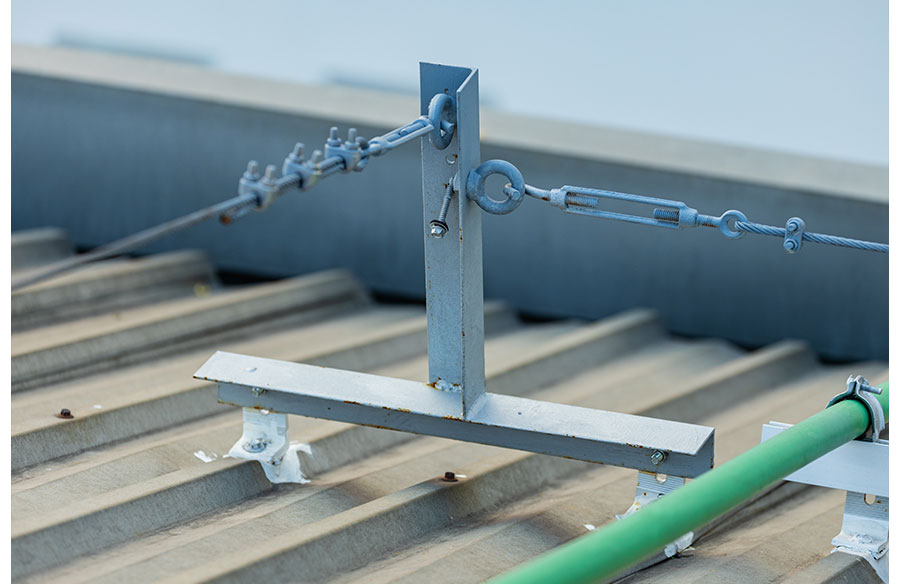
A horizontal lifeline is more than just a steel cable. It is an engineered system of interconnected components, each playing a vital role in its overall performance. A failure in any single component can compromise the entire system.
- Anchor Points: These are the foundation of the system. End and intermediate anchors must be securely fastened to the building’s structure. The type of anchor used depends on the substrate. For example, concrete requires different anchoring hardware than a steel beam. Every anchor must be rated to handle the loads specified by the engineering plan.
- Lifeline Cable: Typically made from galvanized or stainless steel for corrosion resistance and strength, the cable’s diameter and construction are chosen based on the system’s length, load requirements, and environmental conditions.
- Tensioners and Energy Absorbers: In-line tensioners ensure the cable is set to the precise tension specified in the engineering documents. Critically, many modern systems incorporate in-line energy absorbers. These devices are designed to deform or deploy during a fall, absorbing a significant portion of the shock load and reducing the forces transferred to both the worker and the anchor points.
- Connectors and Harnesses: Workers connect to the lifeline using a full-body harness, a lanyard, and a mobile anchor point or shuttle that glides along the cable. This hardware must be compatible and rated for the forces involved.
Choosing the right materials and components is a critical step. A system installed in a coastal, high-saline environment will require a higher grade of stainless steel to prevent corrosion than one installed in a dry, inland warehouse. This foresight is a hallmark of a professionally designed system. Professional companies that specialize in this field, such as Title 8 Builders horizontal lifelines, understand that regional environmental factors play a major role in a system’s long-term safety and compliance.
Installation and Verification Best Practices
The installation process must be executed with precision, strictly following the engineer’s certified plans. Installers must be trained and experienced, as improper installation can nullify even the most robust engineering design. For instance, incorrect torque on anchor bolts, improper swaging of cable terminations, or setting the incorrect cable tension can all lead to system failure. This is why organizations often rely on turnkey providers who manage the process from design through final certification.
Once the system is installed, it is not yet ready for use. A qualified person must perform a thorough inspection and verification. This involves checking that every component is installed according to the drawings, all fasteners are torqued to specification, and the lifeline cable is tensioned correctly. The system is then certified, and documentation is provided to the building owner. This documentation is essential for regulatory compliance and includes the engineering plans, component specifications, and a log for future inspections. When working with an experienced firm on a project, such as the installation of Title 8 Builders horizontal lifelines, this documentation is a standard part of the final handover.
Furthermore, a permanent horizontal lifeline system must be re-certified annually, or more frequently depending on usage and environmental factors, by a qualified person. This re-certification process involves a detailed inspection to check for any signs of wear, corrosion, or damage. Any component showing signs of degradation must be replaced immediately. This ongoing maintenance ensures the system remains compliant and ready to perform as designed.
Custom Solutions for Varied Applications
Horizontal lifelines are not a one-size-fits-all product. Different work environments demand different solutions. For example, a system for a standing seam metal roof must be designed with non-penetrating clamps to preserve the roof’s warranty and watertight integrity. In contrast, an overhead system in a bus maintenance depot or an aircraft hangar will be designed to provide fall protection over a large, open area, often attached to the building’s ceiling structure.
In architectural applications, aesthetics may also be a concern. Low-profile posts and sleek stainless-steel components can be used to minimize the visual impact on a building’s design. In industrial settings, durability and resilience to harsh chemicals or extreme temperatures might be the primary drivers of component selection. The ability to customize a system is a key advantage. Leading providers of fall protection solutions, including those who install Title 8 Builders horizontal lifelines, excel at creating bespoke systems tailored to the unique challenges of each site. This ensures that safety is never compromised for convenience or due to site limitations. The versatility of Title 8 Builders horizontal lifelines allows for integration into diverse structures, from complex industrial facilities to expansive commercial rooftops.
Final Analysis
Installing a horizontal lifeline is a complex, high-stakes process where there is no room for error. It is a life-safety system that demands a rigorous approach rooted in expert engineering, quality components, and precise installation. From the initial site assessment and load calculations to the final certification and ongoing maintenance, every step is critical to ensuring the system will perform flawlessly when a fall occurs. The ultimate goal is to provide workers with the ability to perform their duties efficiently and confidently, knowing a reliable fall protection system is in place. By adhering to the standards set by OSHA and ANSI and entrusting the work to qualified professionals, building owners and facility managers can meet their legal and ethical obligations to protect their personnel, mitigating risk and, most importantly, saving lives.