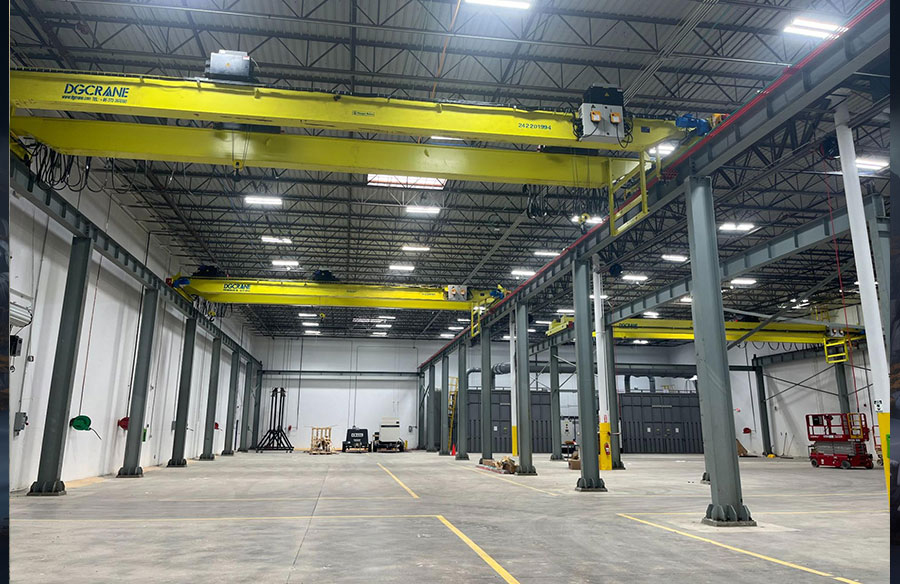
The global overhead crane market is experiencing strong upward momentum. By 2031, the market size is expected to reach 9.162 billion USD, compared to 5.024 billion USD in 2023. This growth is mainly driven by the rising automation in manufacturing and warehousing logistics, along with the increasing demand for workplace safety and production efficiency.
Market Analysis
The key stakeholders in the overhead crane market include component suppliers, crane manufacturers, and end users. A wide range of component suppliers, including trolley frames, wire ropes, bridge wheels, hoists, and rails, help crane manufacturers meet customer demand. Component suppliers are also expanding production capacity to meet the growing needs of manufacturers.
Manufacturers maintain close collaboration with both component suppliers and end users, which enables them to better understand end user requirements and develop advanced components. Many manufacturers also have distribution partners in different countries and regions to provide service support. Some of the prominent players in the market include Konecranes, Sumitomo Heavy Industries, Kalmar, Liebherr, and Weihua Crane.
End users include manufacturing facilities, warehouses, shipyards, and steel and metal production units, making them the ultimate stakeholders in the overhead crane market.
Market Overview
Overhead cranes are used in industrial manufacturing and maintenance applications for material handling. They are designed to lift and move heavy and bulky goods precisely from one location to another. Their functions include loading and unloading, controlling the movement of objects on assembly lines, and handling containers. They also support assembly, transportation, preparation, storage, and warehousing tasks.
By reducing downtime and improving safety, overhead cranes increase overall efficiency and maximize productivity. Different types of cranes include bridge cranes, jib cranes, monorail cranes, gantry cranes, underhung overhead cranes, and free standing workstation cranes. These cranes can be operated using pendant controls, remote controls, or operator cabins attached to the crane, and they are typically powered by electricity.
Market Drivers and Opportunities
Increased Manufacturing Investment
With the rise of Industry 4.0, automation, large-scale customization, and process-driven manufacturing are increasingly adopted. Growing investment in the manufacturing sector contributes to economic growth and job creation, offering a competitive advantage in the global market.
For example, under the US CHIPS and Science Act, Micron announced a 15 billion USD investment in a new memory manufacturing facility in Boise, Idaho. First Solar announced a 1.2 billion USD investment in expanding solar industry production capacity. These large-scale manufacturing expansions require overhead cranes during both construction and operation, driving demand for the equipment. As a result, rising investment in manufacturing is a significant driver of the overhead crane market.
Growth in Warehousing and Distribution Centers
Overhead cranes are widely used in warehouses and distribution centers for material handling. They reduce manual labor, improve efficiency, minimize downtime, and support automation.
According to Entrepreneur Media, Inc., India’s warehousing industry is shifting from simple storage to advanced logistics systems. The rise of e-commerce has fueled a growing need for larger inventory storage, accelerating demand for warehousing and distribution space. According to Russell and Dawson, the North American warehousing and distribution industry is benefiting from the expansion of e-commerce and the growing interest in outsourced warehousing. This trend has led to increased production and utilization of overhead cranes, creating strong opportunities for the market.
Market Segmentation
- By type: gantry cranes, bridge cranes, jib cranes, and monorail cranes. Gantry cranes held the largest market share in 2023.
- By installation: mobile cranes and fixed cranes. Fixed cranes accounted for the largest share in 2023.
- By operation: electric, hydraulic, and hybrid. Electric cranes held the largest share in 2023.
- By industry: logistics, automotive, shipbuilding, utilities, and others. Logistics represented the largest demand in 2023.
Regional Insights
North America remains one of the most industrially developed regions, with the automotive, shipbuilding, and utility sectors driving growth. In the automotive industry, overhead cranes are widely used for assembly, repair, and supply chain operations, ensuring safe handling of components and improving production line efficiency. With Toyota, Honda, Ford, General Motors, and Panasonic investing heavily in electric vehicle manufacturing, regional demand continues to rise. The presence of overhead crane manufacturers in the USA further supports the growing industrial requirements in this region.
Asia Pacific is emerging as a growth engine, led by China, India, and Southeast Asia. China, with its strong manufacturing base and government-backed infrastructure projects, continues to show robust demand for overhead cranes. Local overhead crane manufacturers in China play a key role in serving both domestic and international markets.
Conclusion
The overhead crane market is set for rapid growth in the coming years, driven by industrial automation, increased manufacturing investment, and the expansion of e-commerce logistics. By 2031, the market will provide vast opportunities for manufacturers, suppliers, and end users. Overhead cranes will continue to serve as essential equipment for safe, efficient, and heavy-duty material handling, supporting the development of global manufacturing and logistics.